On a clear night, when we look up at the stars, it is easy to imagine that each bright point of light exists alone in the darkness of space. Our own Sun appears solitary, shining as the central anchor of the Solar System. For centuries, many people naturally assumed that most stars throughout the universe lived similar lives, isolated and independent.
Modern astronomy has revealed a very different reality.
Many stars are not alone at all. In fact, a large percentage of the stars visible in the night sky belong to systems containing two or more stars. Among these, the most common arrangement is the binary star system—a pair of stars bound together by gravity, endlessly orbiting a shared center of mass.
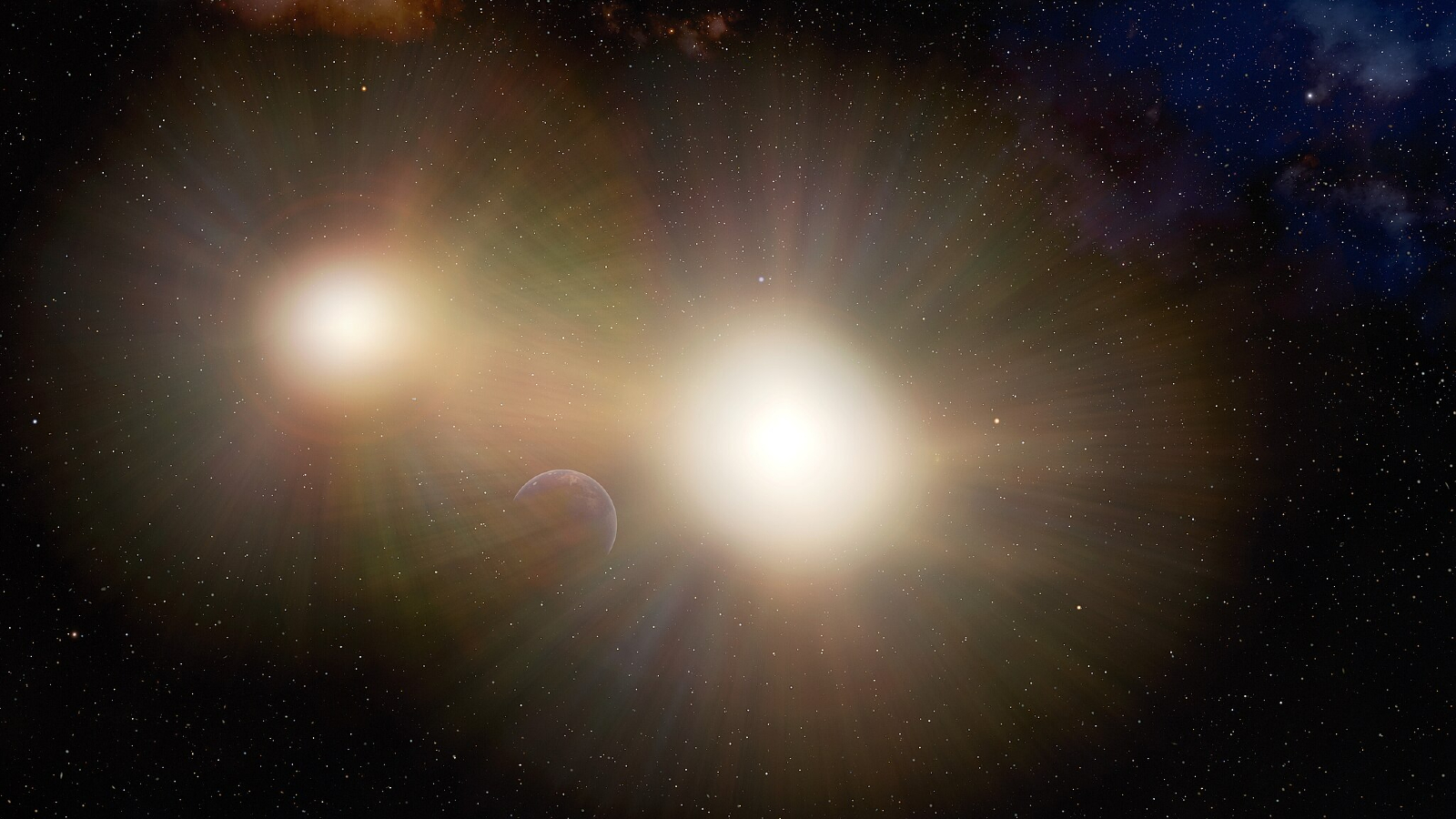
Imagine standing on a planet where two suns rise and set in the sky. Picture watching one sun glow bright white while another shines with a reddish hue. Envision two colossal stars locked in a cosmic dance that has continued for millions or even billions of years.
This is not science fiction. Binary star systems are real, and they are among the most fascinating structures in the universe.
These systems have helped astronomers measure stellar masses, understand how stars evolve, discover exotic cosmic phenomena, and even search for potentially habitable worlds. They reveal that the universe is far more dynamic, complex, and beautiful than our everyday experience suggests.
The story of binary stars is ultimately a story about relationships. Instead of living alone, these stars influence one another in profound ways. Their mutual gravity shapes their destinies, alters their evolution, and sometimes leads to some of the most dramatic events in the cosmos.
Understanding What a Binary Star System Is
A binary star system consists of two stars that are gravitationally bound to each other.
Rather than drifting independently through space, the stars orbit around a common point called the center of mass, or barycenter. This point represents the balance between their gravitational forces.
Many people imagine one star circling another, but the reality is slightly more complicated. Both stars are moving. Each follows its own orbital path around the shared center of mass.
If the two stars have identical masses, the barycenter lies exactly halfway between them. If one star is much heavier, the barycenter shifts closer to the larger star.
The same principle operates within our Solar System. Earth and the Moon orbit a shared center of mass. Even the Sun and Jupiter technically orbit a common barycenter, though the Sun’s enormous mass dominates the system.
In binary star systems, this gravitational partnership becomes much more dramatic because both objects are stars.
Their dance can continue for millions, billions, or even trillions of years depending on the characteristics of the system.
Why Binary Stars Matter
At first glance, binary stars may seem like a curious astronomical detail.
In reality, they are among the most important objects in astronomy.
One reason is that binary systems allow scientists to directly measure stellar masses. Mass is one of the most fundamental properties of a star. It influences temperature, brightness, lifespan, and ultimate fate.
Yet measuring the mass of a distant star is extremely difficult.
Binary stars provide a solution.
By observing how two stars orbit each other, astronomers can calculate their masses using the laws of gravity.
Much of what scientists know about stars comes from studying binary systems.
Without them, our understanding of stellar evolution would be far less complete.
Binary stars also serve as laboratories where extreme physical processes can be observed. Some systems transfer matter between stars. Others generate powerful X-rays. Some eventually explode as supernovae.
In many cases, the most spectacular phenomena in the universe arise because two stars are interacting.
The Discovery of Binary Stars
The existence of binary stars was not always known.
For much of history, astronomers could only see stars as points of light.
When telescopes improved during the seventeenth and eighteenth centuries, observers began noticing that some stars appeared unusually close together.
Initially, many scientists assumed these were simply chance alignments.
Two unrelated stars might appear near each other from Earth’s perspective even though they were separated by vast distances.
Over time, careful observations revealed something remarkable.
Certain pairs moved together across the sky.
Their positions changed in predictable ways.
These stars were clearly connected.
One of the earliest astronomers to recognize this phenomenon was William Herschel, who conducted extensive studies of double stars during the late eighteenth century.
Herschel eventually concluded that many stellar pairs were genuinely bound by gravity.
This discovery provided the first direct evidence that Newton’s law of gravity operated beyond the Solar System.
The universe suddenly appeared more interconnected than ever before.
Double Stars Versus Binary Stars
The terms “double star” and “binary star” are sometimes confused.
Although related, they are not exactly the same.
A double star is simply any pair of stars that appear close together in the sky.
Some double stars are genuine binary systems.
Others are merely optical doubles.
An optical double occurs when two unrelated stars happen to lie along nearly the same line of sight as viewed from Earth.
They may appear adjacent in the sky while actually being separated by enormous distances.
Binary stars, in contrast, are physically connected through gravity.
Their motions reveal a true partnership.
This distinction may seem subtle, but it is important for understanding how astronomers classify stellar systems.
How Two Stars Orbit Each Other
The motion of binary stars follows the same physical laws that govern planets.
Gravity pulls the stars toward one another.
At the same time, their motion carries them forward through space.
The combination creates stable orbits.
Some binary stars follow nearly circular paths.
Others travel along highly elongated elliptical orbits.
The distance between the stars can vary dramatically.
In some systems, the stars are separated by hundreds or even thousands of astronomical units.
In others, they orbit so closely that their outer layers nearly touch.
Orbital periods also vary enormously.
Some binary pairs complete an orbit in a matter of hours.
Others require thousands of years.
Every system tells its own unique story.
Different Types of Binary Star Systems
Astronomers classify binary stars according to how they are detected.
Visual binaries are systems in which both stars can be directly observed through telescopes. These systems often provide spectacular views.
Spectroscopic binaries are too close together to be visually separated. Instead, astronomers detect them by analyzing the light they emit.
As the stars move toward and away from Earth, their light shifts slightly due to the Doppler effect. These changes reveal the presence of two orbiting stars.
Eclipsing binaries offer another fascinating case.
In these systems, one star periodically passes in front of the other from our viewpoint. The combined brightness changes in a predictable pattern, allowing astronomers to determine important properties of the stars.
Astrometric binaries are systems where only one star is visible, but its motion suggests an unseen companion.
Each type provides different clues about the nature of the system.
Together, they have helped astronomers uncover thousands of binary stars throughout the galaxy.
How Common Are Binary Stars?
One of the most surprising discoveries in astronomy is just how common binary stars are.
For many years, scientists assumed that single-star systems like our own were typical.
Observations have revealed otherwise.
Many stars belong to binary or multiple-star systems.
Among large, massive stars, binary partnerships may actually be the norm rather than the exception.
Even among smaller stars, binary systems are widespread.
Some estimates suggest that roughly half of Sun-like stars have one or more stellar companions.
This means the night sky is filled with stellar relationships.
Far from being unusual, binary systems represent a fundamental aspect of how stars form and evolve.
How Binary Stars Form
Stars originate within enormous clouds of gas and dust called molecular clouds.
These regions contain the raw materials needed for star formation.
As gravity causes parts of a cloud to collapse, dense clumps begin forming.
The process is often chaotic.
Instead of producing a single star, a collapsing cloud may fragment into multiple pieces.
Each fragment can develop into a star.
When two forming stars emerge close enough together, gravity can bind them into a binary system.
Computer simulations suggest that binary formation may be a natural outcome of the star formation process.
This helps explain why binary stars are so abundant throughout the universe.
Rather than representing unusual exceptions, they may be a common consequence of stellar birth.
Living Under Two Suns
The idea of a planet orbiting two suns has captured the imagination of countless science fiction fans.
One famous example appears in the movie universe of Star Wars, where the desert world Tatooine experiences twin sunsets.
For many years, such worlds remained purely speculative.
Today, astronomers know they exist.
Planets have been discovered orbiting binary stars.
These planets are called circumbinary planets because they orbit both stars rather than just one.
Living on such a world would create a sky unlike anything seen from Earth.
The appearance of the suns would depend on their size, brightness, color, and orbital arrangement.
Sometimes both suns might be visible simultaneously.
At other times, one might dominate the sky while the other appears as a brilliant star.
Sunrises and sunsets could be especially dramatic.
Although these environments differ from our own, some circumbinary planets may still reside within habitable zones where liquid water could potentially exist.
The Challenge of Planet Formation
Binary stars complicate planet formation.
The gravitational influence of two stars can disrupt the delicate process through which planets emerge from disks of gas and dust.
For a long time, scientists wondered whether stable planetary systems could form at all around binary stars.
Observations have shown that they can.
However, the architecture of such systems may differ significantly from planetary systems orbiting single stars.
Planets must find stable orbital paths that avoid destructive gravitational disturbances.
Some orbit one member of the binary pair.
Others orbit both stars.
The variety of configurations demonstrates the incredible adaptability of planetary formation processes.
Nature often succeeds in environments that initially seem impossible.
Stellar Evolution in Binary Systems
The lives of binary stars can differ dramatically from those of solitary stars.
A single star evolves according to its mass and composition.
Binary stars must also contend with their partner.
This interaction can transform their destinies.
As stars age, they expand.
If two stars orbit close together, one may grow large enough for its outer layers to feel the gravitational pull of the companion.
Matter can begin flowing from one star to the other.
This process is called mass transfer.
Mass transfer can fundamentally alter both stars.
The donor star loses material.
The receiving star gains mass and energy.
These exchanges create some of the most unusual objects in astronomy.
When Stars Steal from Each Other
Mass transfer is one of the most fascinating aspects of binary systems.
Imagine a star gradually losing portions of itself to a neighboring star.
The transferred gas often forms a swirling structure called an accretion disk around the receiving star.
Within this disk, matter spirals inward while releasing enormous amounts of energy.
The resulting phenomena can be incredibly bright.
In some cases, the receiving star becomes hotter and more luminous than expected.
In others, powerful bursts of radiation occur.
These interactions reveal that stars are not always isolated spheres evolving quietly through time.
In binary systems, stellar lives become intertwined.
Their histories become shared.
White Dwarfs and Binary Companions
Many stars eventually end their lives as white dwarfs.
A white dwarf is the dense remnant left behind after a Sun-like star exhausts its nuclear fuel.
In isolation, a white dwarf slowly cools over billions of years.
In a binary system, the story may continue.
If a nearby companion star transfers matter onto the white dwarf, dramatic consequences can follow.
The accumulating material may ignite in powerful thermonuclear eruptions called novae.
These explosions temporarily increase the star’s brightness.
Although impressive, novae do not destroy the white dwarf.
Instead, the process may repeat many times.
The binary relationship continues shaping the future of both stars.
The Birth of Type Ia Supernovae
Some of the most important explosions in astronomy originate in binary systems.
A white dwarf has a maximum stable mass known as the Chandrasekhar limit.
If mass transfer pushes the white dwarf beyond this threshold, a catastrophic explosion may occur.
The result is a Type Ia supernova.
This event completely destroys the white dwarf.
For a brief period, the explosion can outshine an entire galaxy.
Type Ia supernovae are particularly valuable because they reach similar peak brightness levels.
Astronomers use them as cosmic measuring tools for determining distances across the universe.
The discovery of the accelerating expansion of the universe relied heavily on observations of these stellar explosions.
In this way, binary stars have contributed to one of the most profound discoveries in modern cosmology.
Neutron Stars in Binary Systems
When massive stars die, they may leave behind neutron stars.
These objects pack more mass than the Sun into a sphere only about twenty kilometers wide.
Neutron stars are extraordinarily dense.
A teaspoon of neutron-star material would weigh billions of tons on Earth.
In binary systems, neutron stars can interact dramatically with companion stars.
Gas pulled from the companion often falls toward the neutron star, releasing tremendous energy.
These systems frequently emit intense X-rays and are known as X-ray binaries.
They rank among the most energetic objects in the universe.
Their behavior provides valuable insights into extreme physics that cannot be reproduced on Earth.
Black Holes and Stellar Partnerships
Some binary systems contain black holes.
Black holes form when extremely massive stars collapse under their own gravity.
Because black holes emit no light directly, they can be difficult to detect.
Binary companions often reveal their presence.
As matter falls toward a black hole, it forms an accretion disk that becomes extraordinarily hot.
This disk emits powerful X-rays and other radiation.
Astronomers can analyze these emissions to study black holes and estimate their masses.
Many of the first confirmed stellar-mass black holes were discovered through their interactions with binary companions.
Without binary systems, these hidden objects might have remained invisible.
Gravitational Waves and Merging Stars
One of the most exciting developments in modern astronomy involves gravitational waves.
These ripples in space-time were predicted by Einstein’s theory of general relativity.
For decades, they remained undetected.
That changed in 2015.
Scientists observed gravitational waves produced by merging black holes.
Many of these mergers originate from binary systems.
As two compact objects orbit each other, they gradually lose energy through gravitational radiation.
Over time, the orbit shrinks.
Eventually, the objects collide.
The resulting event releases enormous amounts of energy.
Today, gravitational-wave observatories regularly detect mergers involving black holes and neutron stars.
These observations have opened an entirely new window on the universe.
Famous Binary Star Systems
Several binary systems have become especially important in astronomy.
The bright star Sirius is actually a binary system consisting of a main-sequence star and a white dwarf.
Another famous example is Alpha Centauri, the closest stellar system to our own. It contains two primary stars orbiting each other along with a more distant companion.
These nearby systems provide valuable opportunities for detailed study.
They remind us that binary stars are not rare cosmic curiosities.
They exist in our galactic neighborhood.
Colors and Contrasts in Binary Systems
Some binary stars create breathtaking visual contrasts.
One star may appear blue-white while the other glows orange or red.
These color differences arise from variations in temperature.
Hotter stars emit more blue light.
Cooler stars emit more red light.
Through telescopes, these contrasting pairs can appear extraordinarily beautiful.
They offer a vivid reminder that stars are not identical objects.
Each possesses its own characteristics, history, and future.
Together, they create celestial scenes unlike anything found in solitary systems.
What Binary Stars Teach Us About the Universe
Binary stars have become essential tools for understanding the cosmos.
They allow astronomers to measure stellar masses with precision.
They reveal how stars form.
They demonstrate how stellar evolution can be altered by companionship.
They provide insight into supernovae, neutron stars, black holes, and gravitational waves.
Many of the most important discoveries in modern astronomy depend on binary systems.
Without them, our picture of the universe would be far less complete.
In a sense, binary stars act as cosmic teachers.
Their interactions expose physical processes that would otherwise remain hidden.
Could Intelligent Life Exist in Binary Systems?
The possibility of life around binary stars remains an exciting area of research.
Many exoplanets have already been discovered in binary systems.
Some occupy regions where temperatures could allow liquid water to exist.
Life, if it arises there, would experience skies very different from our own.
The appearance of multiple suns could influence climates, seasons, and ecosystems.
While many challenges exist, binary systems do not automatically prevent habitability.
The growing number of discovered exoplanets suggests that nature is remarkably creative.
Life may be capable of thriving in environments far more diverse than previously imagined.
The Emotional Appeal of Two Suns
There is something deeply captivating about the idea of two suns.
Perhaps it is because binary stars challenge our assumptions.
We instinctively view our own Solar System as normal.
Binary stars remind us that the universe does not conform to human expectations.
They reveal alternate possibilities.
Different skies.
Different worlds.
Different cosmic stories.
A child standing on a distant planet beneath twin sunsets might consider such a sky perfectly ordinary.
Meanwhile, Earth’s single sun would seem strange and unusual.
The universe constantly teaches humility.
What appears normal to us may be only one variation among countless possibilities.
Conclusion
Binary star systems are among the most fascinating and important structures in the cosmos. Consisting of two stars bound together by gravity, they perform an intricate orbital dance that can continue for billions of years. Far from being rare, binary systems are common throughout the galaxy and may represent one of the most natural outcomes of star formation.
These stellar partnerships have transformed astronomy. They allow scientists to measure stellar masses, understand how stars evolve, investigate black holes and neutron stars, and explore the origins of gravitational waves. They have revealed that stars do not always live isolated lives. Instead, many experience relationships that shape their entire existence.
The study of binary stars has also expanded our imagination. It has shown that planets can orbit two suns, that exotic cosmic events can arise from stellar interactions, and that the universe is far more diverse than once believed.
Ultimately, binary stars remind us that even the most massive objects in the cosmos can be connected. Across the vast darkness of space, two suns may spend billions of years orbiting one another, bound by gravity in a dance of extraordinary beauty. Their story is one of motion, balance, change, and partnership—a cosmic performance playing out across the universe, long before humanity existed and likely long after we are gone.