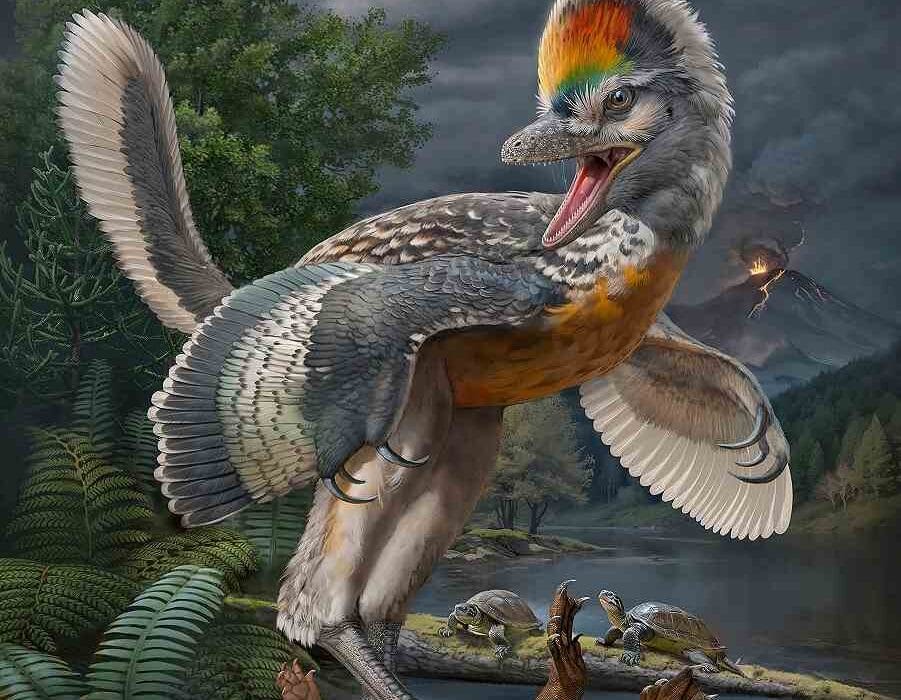
Researchers have identified a fundamental evolutionary link between brain size and offspring size across birds, mammals, and reptiles. The findings suggest that as brains became larger, animals invested more energy into each offspring—helping explain why some birds produce surprisingly large eggs that exceed the size of those laid by even the largest non-avian dinosaurs.
One of the most puzzling questions in vertebrate evolution begins with an apparent contradiction. Many non-avian dinosaurs grew to enormous sizes, yet the largest eggs ever laid by birds are larger than the biggest known eggs from their dinosaur relatives.
Now, a new study by researchers from Princeton University and the American Museum of Natural History offers an explanation that reaches far beyond eggs alone. According to the research, the answer may lie in the evolution of larger brains.
Published in Royal Society Open Science, the study found that species with relatively larger brains consistently produce fewer but larger offspring. The pattern appeared across mammals, birds, and reptiles, suggesting a shared evolutionary relationship between brain development and reproductive investment.
Bigger Brains Require Bigger Investments
Growing a large brain is energetically expensive. The researchers found evidence that species with larger brains compensate for those costs by investing more resources into each offspring.
In practical terms, that means producing larger eggs in egg-laying animals or larger newborns in species that give birth to live young.
The study indicates that this relationship is not limited to one branch of the animal kingdom. Instead, it appears to be a broad pattern shared across major groups of land-dwelling vertebrates.
Lead author Stephanie Lechki, a postdoctoral fellow at Princeton University, explained that the findings help resolve the mystery of unusually large bird eggs.
“At first glance, this seems counterintuitive,” Lechki said. “Many non-avian dinosaurs were enormous, yet even the biggest dinosaur eggs were smaller than the largest bird eggs. Our results suggest that the answer lies in brain evolution. As birds evolved larger brains, they also evolved larger offspring, which required larger eggs.”
A Pattern Shared Across Vertebrates
Animals have evolved dramatically different reproductive strategies.
Birds and mammals generally produce relatively few offspring, but each offspring tends to be larger and receives a greater share of parental investment. Reptiles, including most dinosaurs, often follow the opposite approach, producing many smaller offspring.
Scientists have long suspected that factors such as metabolism or brain size might help explain these differences. However, previous studies largely examined birds and mammals separately, making it difficult to determine whether a common evolutionary mechanism existed across vertebrates.
To address that gap, the researchers combined reproductive and anatomical data from mammals, birds, and reptiles into a single evolutionary framework.
The result was a strikingly consistent pattern: larger relative brain size was associated with larger offspring across all three groups.
This suggests that the relationship between brain growth and reproductive investment may be a fundamental feature of vertebrate evolution rather than a trend limited to specific lineages.
What Dinosaur Fossils Reveal
The findings also provide a broader context for some of the most important dinosaur reproductive fossils ever discovered.
Among them are nesting oviraptorosaurs unearthed during museum expeditions to the Gobi Desert in the 1990s. These fossils transformed scientific understanding of how certain dinosaurs reproduced and cared for their young.
According to study co-author Roger Benson, the new research helps place such discoveries within a much larger evolutionary framework.
“This work places those remarkable fossils into a much larger macroevolutionary picture,” said Benson, the museum’s Macaulay Curator of Dinosaur Paleobiology.
Rather than viewing dinosaur nests and eggs as isolated curiosities, the study suggests they may represent part of a broader evolutionary trend linking brain development to reproduction.
Ripple Effects Beyond Egg Size
The implications of the research extend beyond explaining why bird eggs became so large.
The researchers propose that increasing brain size may have triggered a chain of evolutionary changes during the transition from dinosaurs to birds.
If larger brains required larger offspring, and larger offspring required larger eggs, then other anatomical and behavioral traits may have evolved in response.
For example, larger eggs would require a wider pelvic canal to allow them to be laid. They could also demand more open and better-aerated nests to support incubation.
The study further suggests that larger offspring may have encouraged greater parental investment after hatching.
Taken together, these possibilities indicate that brain evolution may have indirectly influenced the development of nesting behavior, pelvic anatomy, and parental care in the lineage that eventually produced modern birds.
Challenges Remain
Despite the new insights, important questions remain unresolved.
Some aspects of reproduction are extremely difficult to reconstruct from fossils. One of the biggest challenges is determining how frequently extinct animals reproduced during a year.
Unlike bones or eggs, reproductive frequency rarely leaves direct physical evidence in the fossil record.
Because of this limitation, the researchers say future studies will investigate whether the same evolutionary patterns appear in living species that reproduce multiple times annually. They also plan to explore additional physiological factors that may influence reproductive behavior and reproductive frequency.
Why This Matters
This study provides a new explanation for one of the most surprising patterns in vertebrate evolution: why birds lay eggs that can be larger than those of much larger dinosaurs.
More importantly, it reveals a potentially fundamental connection between brain size, offspring size, and reproductive strategy across vertebrates. By linking these traits within a single evolutionary framework, the research offers a clearer picture of how major biological features evolve together rather than independently.
The findings suggest that the rise of larger brains may have shaped far more than intelligence alone. It may have influenced the size of offspring, the structure of nests, the anatomy of the pelvis, and even the evolution of parental care—helping guide the transformation from dinosaurs to the birds that inhabit the world today.