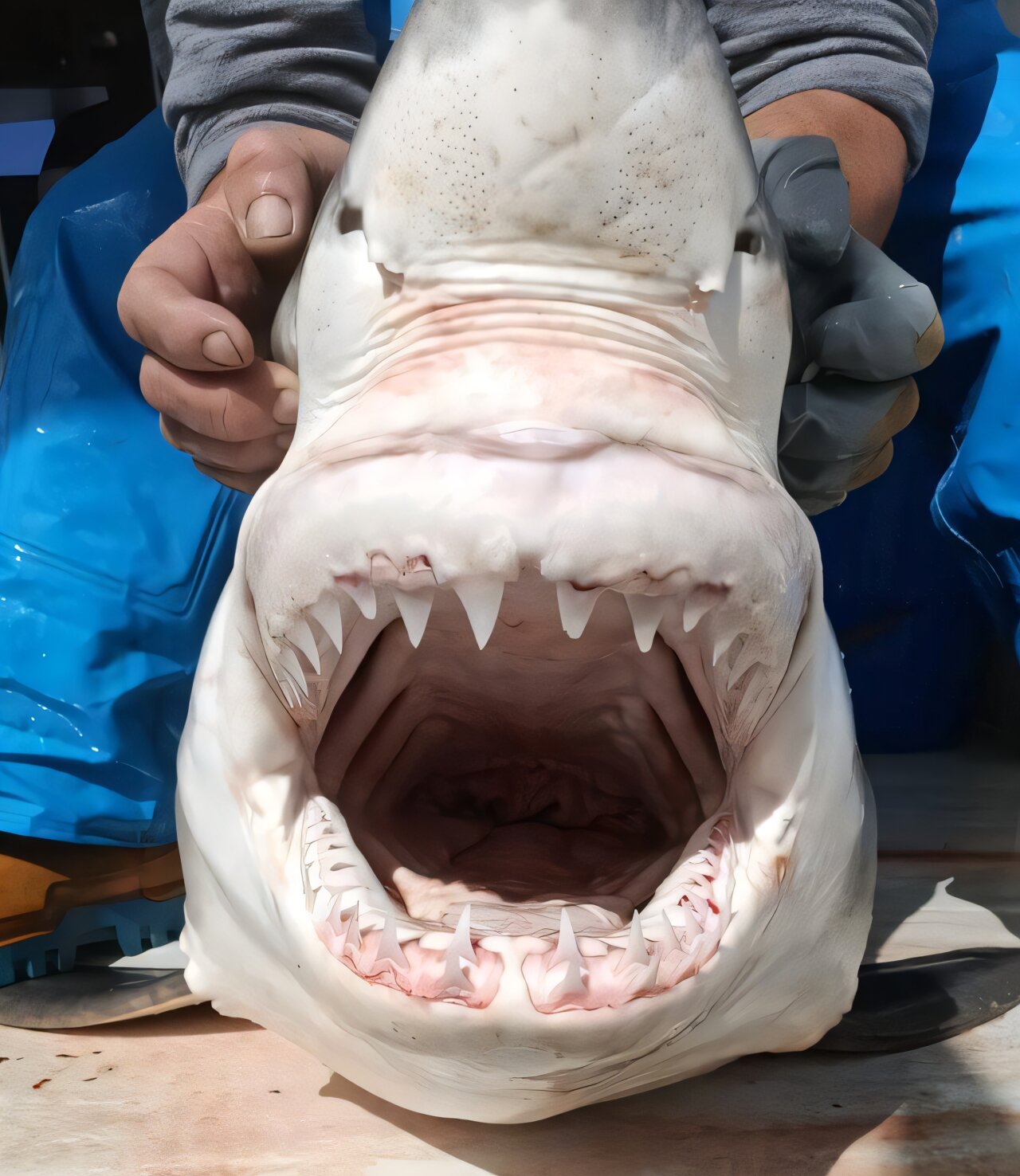
On April 20, 2023, something extraordinary surfaced in the nets of local fishermen off Spain’s eastern peninsula. Tangled among the usual catch was a juvenile great white shark, scientifically known as Carcharodon carcharias. It measured about 210 centimeters in length and weighed between 80 and 90 kilograms—still young, yet already powerful.
The encounter was accidental. No one had gone looking for a shark. And perhaps that is what made it so electrifying. In the Spanish Exclusive Economic Zone, such sightings are rare enough to feel almost mythical. The Mediterranean great white has long been described as a kind of marine phantom—present, but scarcely seen.
Instead of dismissing the moment as an isolated event, researchers saw it as a doorway into the past.
Echoes Across 160 Years of Silence
The unexpected capture prompted scientists to dig into history. They examined records stretching from 1862 to 2023, piecing together more than a century and a half of scattered observations. Their findings, now published in the open-access journal Acta Ichthyologica et Piscatoria, reveal a story that is quiet but persistent.
The Mediterranean great white shark may feel like a “ghost” population, but the data show it has never truly disappeared. Its presence has been sporadic, its appearances exceptional, yet it continues to move through these waters.
Still, the broader picture is sobering. The species is currently listed as Vulnerable on the IUCN Red List, with a declining population trend. Each confirmed sighting becomes more than a curiosity. It becomes evidence—proof that something fragile still survives.
A Young Shark, A Bigger Question
What made the April 2023 shark so important was not just its size, but its age. It was a juvenile.
Dr. José Carlos Báez, the study’s lead researcher, underscored why this matters. “Determining the presence of juvenile individuals is of particular importance,” he explained. The appearance of young sharks raises a profound question: could active reproduction be occurring in the region?
If juveniles are present, then somewhere, somehow, adults may be breeding in Mediterranean waters. That possibility transforms a rare sighting into a biological clue. It suggests not only survival, but renewal.
Fear, Mystery, and the Power of Knowledge
Great white sharks occupy a unique space in the human imagination. They are symbols of power, danger, and the unknown. The study invokes H.P. Lovecraft’s observation that the oldest and strongest emotion of humankind is fear, and that fear thrives on the unknown.
Dr. Báez argues that scientific clarity is the antidote. By shedding light on the biology and ecology of the great white shark, researchers can replace myth with understanding. Sightings may be rare, but each one helps illuminate the truth behind the legend.
This research confirms a continued, though infrequent, presence of white sharks in Spanish Mediterranean waters. They are not swarming the coastlines. They are not staging invasions. They are simply there—moving quietly through vast blue distances.
Guardians of the Sea
Beyond the drama, the study reminds us of something essential. Great white sharks are not merely icons of fear; they are apex predators with a fundamental role in marine ecosystems. As highly migratory pelagic species, they redistribute energy and nutrients across immense stretches of ocean.
They act as nature’s scavengers, consuming carrion and helping keep ecosystems clean. Even in death, their bodies sink to the seafloor, delivering a pulse of nourishment to deep-sea communities. Life feeds life, in cycles that extend far beyond the surface.
Why This Matters Now
The accidental capture of a juvenile shark in April 2023 was more than a fleeting encounter. It became a reminder that even elusive species leave traces—if we care to look. With populations declining and the species listed as Vulnerable, long-term observation programs are essential. By pairing direct sightings with advanced tracking methods, researchers hope to build evidence-based conservation strategies.
In a sea shaped by human activity, the question is no longer whether the great white belongs in the Mediterranean. The evidence shows it does. The real question is whether we will understand it well enough—and act quickly enough—to ensure it remains.
Sometimes, the most powerful discoveries arrive quietly, pulled from the water in a fisherman’s net.
Study Details
José Carlos Báez et al, New record of white shark, Carcharodon carcharias (Elasmobranchii, Lamniformes, Lamnidae), from the Mediterranean Spanish coast, Acta Ichthyologica et Piscatoria (2026). DOI: 10.3897/aiep.56.173786