A brilliant stellar death has appeared nearly 9,300 light-years from the center of its apparent host galaxy, providing the strongest optical evidence yet that a massive black hole can roam far outside a galaxy’s nucleus. The discovery not only confirms a long-standing prediction about wandering black holes left behind by galaxy mergers, but also suggests that future sky surveys could uncover dozens of these hidden objects every year.
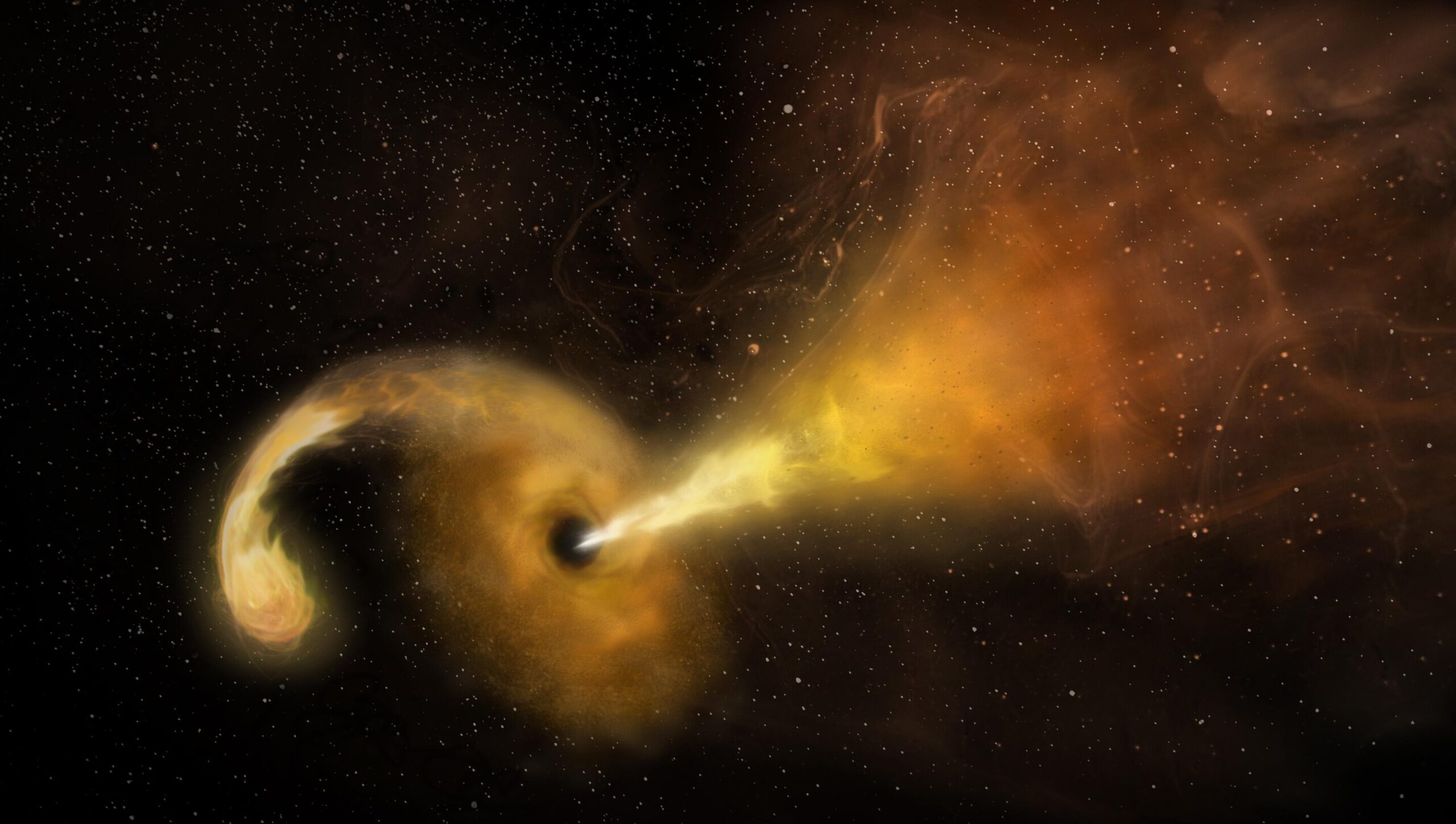
When a star drifts too close to a massive black hole, the black hole’s enormous gravity can rip it apart. The event, known as a tidal disruption event (TDE), creates an intense flare that can outshine an entire galaxy for months.
Nearly all of the roughly 200 known TDEs have been found at the centers of galaxies. That makes sense because astronomers believe most galaxies harbor a massive black hole in their nucleus. For years, searches for these dramatic explosions have therefore focused almost entirely on galactic centers.
But astronomers have also suspected that galaxies should sometimes contain additional black holes wandering far from the nucleus. Galaxy mergers can leave black holes displaced from the center, either because they have not yet settled into the merged galaxy or because gravitational interactions have kicked them outward. Finding one of these elusive objects has been extremely difficult.
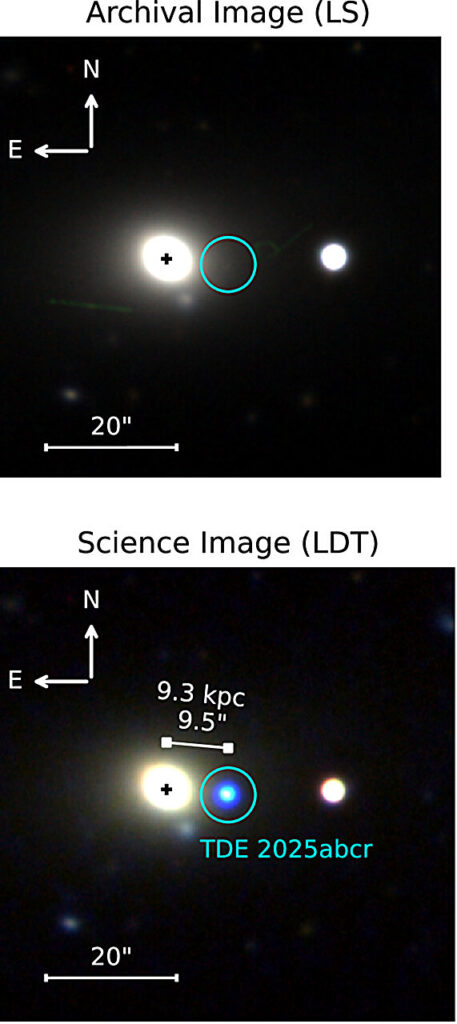
The newly identified event, TDE 2025abcr, may now provide exactly that evidence.
Rather than erupting from the center of its host galaxy, the flare appeared 9.5 arcseconds from the nucleus, corresponding to a projected distance of approximately 9.3 kiloparsecs, or about 30,000 light-years.
According to the researchers, this is the first optical tidal disruption event discovered in the outskirts of a host galaxy.
The discovery required looking where no one had searched before
The unusual event was not found by chance.
Instead, it emerged from a new search strategy built around a machine-learning system called tdescore. Previous searches largely rejected transients that occurred away from galaxy centers because such events were usually supernovae rather than TDEs.
The new version of the classifier deliberately ignored whether a transient appeared in a galactic nucleus. Instead, it relied almost entirely on how the object brightened and faded over time.
That seemingly simple change dramatically widened the search.
TDEs are extraordinarily rare compared with other cosmic explosions. Within large optical surveys, they account for only about 0.5% of all detected transients, making them easy to miss among the overwhelming number of supernovae and other variable objects.
TDE 2025abcr first attracted attention in early November 2025 because its light curve displayed several characteristics expected from a tidal disruption event. The source maintained an unusually high temperature, became hotter rather than cooler as it evolved, and fit poorly to models of a Type Ia supernova.
Follow-up observations quickly confirmed that this candidate deserved much closer attention.
Every wavelength told the same story
Astronomers assembled an extensive observing campaign spanning ultraviolet, visible light, X-rays, radio wavelengths, and near-infrared observations.
The optical light curve showed the transient gradually brightening for roughly four weeks before reaching maximum brightness on November 14, 2025.
Its color remained exceptionally blue throughout the observations, behavior that is typical of tidal disruption events.
Ultraviolet observations with NASA’s Swift spacecraft revealed a bright UV source clearly separated from the galaxy’s nucleus. When the researchers modeled the combined ultraviolet and optical emission, they found that a single hot blackbody reproduced the observations remarkably well.
The flare reached a peak temperature of approximately 30,200 kelvin, nearly five times hotter than the Sun’s surface, while its emitting region expanded to around 10¹⁴ centimeters across.
The event achieved a peak bolometric luminosity of approximately 4.7 × 10⁴³ erg per second.
Equally important was what the temperature did not do.
Many explosive transients cool substantially after reaching maximum brightness. Instead, TDE 2025abcr maintained an almost constant temperature over time, matching behavior commonly seen in known optical tidal disruption events.
The spectrum carried the unmistakable fingerprint of a tidal disruption event
Optical spectroscopy provided the strongest evidence for the event’s true nature.
Over multiple observing sessions using several telescopes, astronomers repeatedly detected a blue continuum accompanied by broad hydrogen emission lines and features from helium and nitrogen.
Those signatures closely matched the spectra of previously confirmed tidal disruption events belonging to the TDE-H+He subclass.
The researchers compared the spectra with the well-studied TDE 2021mhg and found strong similarities throughout the event’s evolution.
Taken together, the light curve, ultraviolet emission, and spectral features all pointed toward the same conclusion: a star had been torn apart by a massive black hole.
X-rays revealed an unusually fast-changing event
Swift’s X-ray telescope added another intriguing piece of the puzzle.
The observatory detected bright, very soft X-rays before the optical flare reached its peak. Such soft X-ray emission is considered one of the hallmark characteristics of tidal disruption events because it originates from extremely hot material falling toward the black hole.
However, the X-ray behavior quickly became unusual.
Within only about four hours, the soft X-ray brightness dropped by roughly a factor of three.
Although rapidly fading X-rays have been observed in some previous tidal disruption events, the researchers describe the decline in TDE 2025abcr as exceptionally rapid.
Later observations detected only a much fainter X-ray source, while the initial soft emission had largely disappeared.
The team notes that understanding this remarkable variability will require future investigation beyond the scope of the current study.
A giant galaxy appears to host a much smaller black hole far from its center
Understanding the host galaxy proved just as important as understanding the flare itself.
Using multiwavelength observations from several astronomical surveys, the researchers reconstructed the galaxy’s stellar population and estimated its stellar mass at approximately 1.5 × 10¹¹ solar masses, making it substantially more massive than the galaxies that typically host optical tidal disruption events.
From established galaxy scaling relations, such a galaxy should contain a central black hole weighing about 6.6 × 10⁸ times the Sun’s mass.
That presented a puzzle.
The brightness of TDE 2025abcr implies that the black hole responsible for destroying the star was dramatically smaller—about 1.2 million solar masses.
Those two estimates differ by more than two orders of magnitude.
If the flare had originated from the galaxy’s central black hole, the observations would have been difficult to reconcile. Instead, the offset location and inferred black hole mass strongly suggest that the disruption occurred around an entirely different black hole residing well outside the galaxy’s nucleus.
The black hole may be wandering—or hiding inside an almost invisible galaxy
The observations cannot yet determine exactly why this black hole is so far from the galactic center.
The researchers propose two leading possibilities.
One is that the black hole was once located in the galaxy’s nucleus but was dynamically ejected during interactions involving galaxy mergers or multiple black holes.
The other possibility is that it still occupies the center of an extremely faint dwarf galaxy that is currently merging with the larger host. Such a dwarf galaxy could have been stripped of nearly all its stars through tidal interactions, leaving behind little more than its central black hole.
Deep archival imaging revealed no visible galaxy at the transient’s location down to an absolute magnitude of about −12.8, effectively ruling out the presence of any relatively bright dwarf galaxy. However, an exceptionally faint remnant could still exist below the current detection limit.
The researchers suggest that future observations after the transient has completely faded could reveal whether any faint stellar system remains at the explosion site.
The event looks surprisingly ordinary despite its extraordinary location
One of the most striking results is that, aside from its location, TDE 2025abcr closely resembles ordinary optical tidal disruption events.
Its rise time, fading behavior, temperature evolution, and spectral appearance all fall comfortably within the range seen for previously known nuclear TDEs.
The main difference is its comparatively modest optical brightness. Even so, it remains considerably brighter than the optical counterpart associated with another recently reported off-nuclear TDE candidate discovered through X-rays.
In other words, if astronomers had ignored its position on the sky, the event would have looked very much like a typical tidal disruption event.
This discovery could be the beginning rather than an exception
The researchers estimate that highly offset tidal disruption events occurring more than about 3 kiloparsecs from a galaxy’s center must occur at a rate below 10% of ordinary nuclear TDEs.
Even so, the discovery has important implications for the future.
The team argues that the upcoming Vera C. Rubin Observatory, with its enormous sky coverage and unprecedented sensitivity, should detect many dozens of similarly offset tidal disruption events every year, with offsets large enough to resolve directly.
If that prediction proves correct, astronomers may soon have an entirely new way to map the hidden population of wandering black holes produced during the long history of galaxy mergers.
Rather than being rare curiosities, black holes roaming far from galactic centers could become routine discoveries, offering an entirely new window into how galaxies grow, merge, and reshape themselves over billions of years.
Publication details
Robert Stein et al, TDE 2025abcr: A Tidal Disruption Event in the Outskirts of a Massive Galaxy, The Astrophysical Journal Letters (2026). DOI: 10.3847/2041-8213/ae77f3