More than 10 billion light-years away, an unexpectedly massive and highly organized galaxy cluster is forcing astronomers to rethink how large cosmic structures formed. New observations from NASA’s James Webb Space Telescope reveal the most distant known galaxy cluster exhibiting strong gravitational lensing, exposing an unusually concentrated mass distribution that challenges leading models of cosmic evolution.
Something about the galaxy cluster XLSSC 122 immediately stood out to astronomers. Located more than 10 billion light-years from Earth, the cluster appears remarkably mature and well organized despite existing during a period when such massive structures were only expected to be beginning their assembly.
Now, a series of three studies based on observations from NASA’s James Webb Space Telescope (JWST) has revealed just how unusual this object really is. The findings show that XLSSC 122 is the most distant known galaxy cluster displaying strong gravitational lensing, offering researchers an unprecedented opportunity to measure its mass and probe the distribution of its hidden dark matter.
The results were presented at the 248th meeting of the American Astronomical Society and published in The Astrophysical Journal Letters.
A Rare Cosmic Alignment Reveals an Extraordinary Cluster
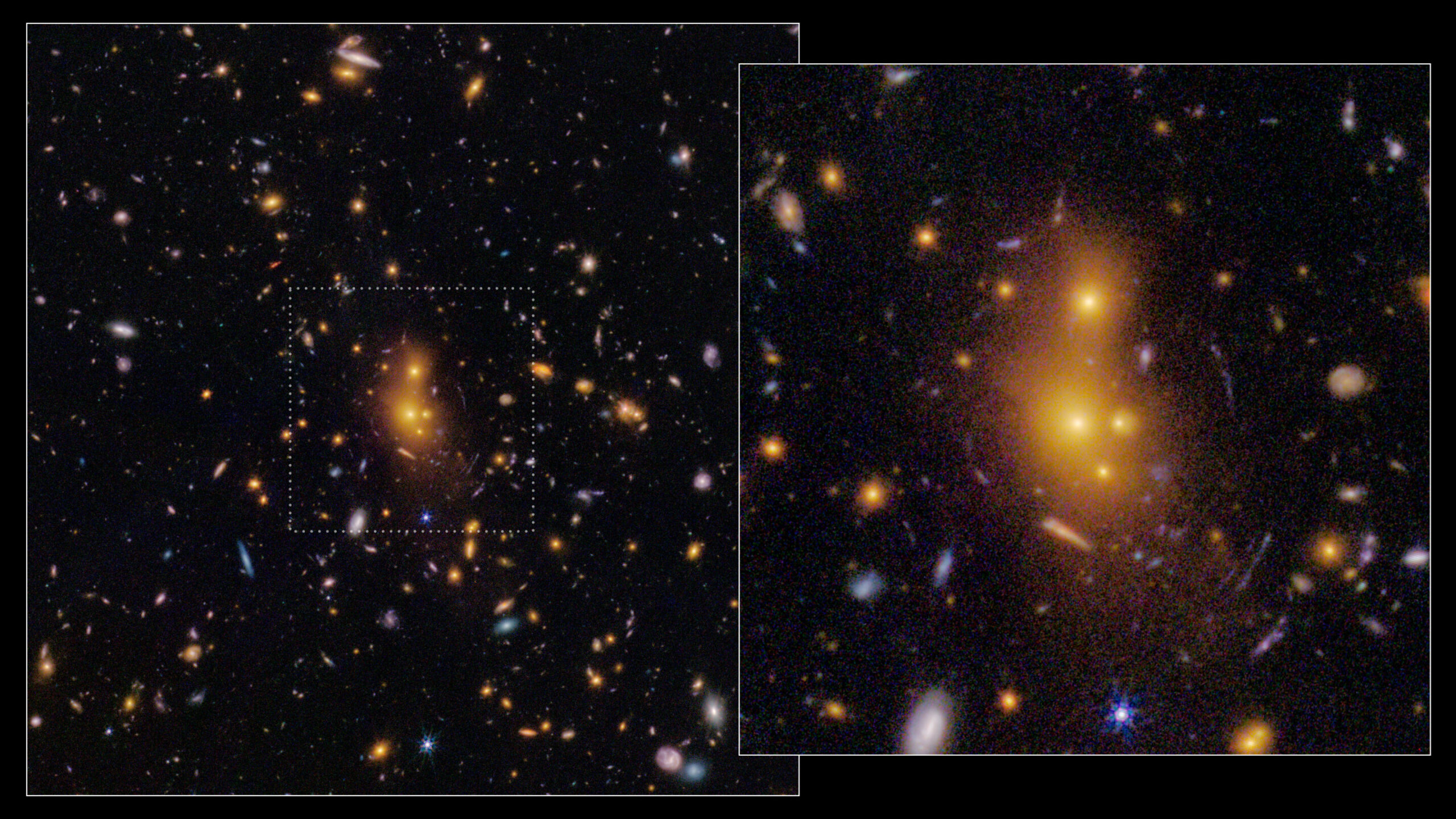
When researchers received the first JWST images of XLSSC 122, they discovered something unexpected. The cluster happened to be aligned with one or more galaxies located even farther away.
This alignment created a phenomenon known as strong gravitational lensing, in which the immense gravity of a massive object bends and magnifies the light from more distant galaxies. In JWST images, this effect appears as distinctive arcs of light surrounding the cluster.
According to lead author Kyle Finner of IPAC, the discovery immediately caught the team’s attention.
The observation established XLSSC 122 as the most distant galaxy cluster ever observed exhibiting strong lensing. More importantly, the phenomenon provided astronomers with one of their most precise measurements yet of the cluster’s mass distribution.
The timing is particularly significant because the cluster existed during cosmic noon, roughly 10 billion years ago, when the universe was experiencing its peak rate of star formation and galaxy clusters were beginning to form in large numbers.
Mass Concentrated Where It Shouldn’t Be
The lensing measurements revealed something even more surprising.
Researchers found that XLSSC 122 possesses an exceptionally concentrated mass distribution near its center. While massive galaxy clusters become increasingly concentrated over time, finding such a feature in a cluster this early in cosmic history was unexpected.
The discovery conflicts with conventional cosmological models, which predict a more gradual buildup of massive structures across the universe.
According to the researchers, XLSSC 122 appears to have formed unusually early and developed characteristics that current theories do not readily explain.
This concentrated mass makes the cluster an important test case for understanding how galaxies and larger structures emerged after the Big Bang.
JWST Opened a New Window Into the Early Universe
XLSSC 122 was first detected in 2014 through an X-ray survey conducted by the European Space Agency’s XMM-Newton spacecraft. Follow-up observations with the Hubble Space Telescope confirmed its distance of approximately 10.4 billion light-years and hinted that it was unusually evolved.
However, Hubble did not reveal definitive evidence of strong gravitational lensing.
That changed with JWST.
Its superior sensitivity and resolution allowed astronomers to detect the faint lensing arcs that had previously remained hidden. Those observations provided the level of detail necessary to study the cluster’s mass structure in ways that were not possible before.
Using Gravity to Map Invisible Dark Matter
One of the most important aspects of the discovery involves dark matter, the invisible substance believed to dominate the mass of galaxy clusters.
The stars, gas, and other visible material inside XLSSC 122 contribute only a small portion of the gravity responsible for the observed lensing. Most of the effect comes from dark matter.
Because dark matter cannot be observed directly, astronomers rely on its gravitational influence to infer its presence and distribution. Strong gravitational lensing offers one of the most powerful methods for doing exactly that.
By measuring how the cluster bends light from distant galaxies, researchers can effectively map where dark matter is concentrated without seeing it directly.
The unusually dense central region of XLSSC 122 therefore provides a valuable test of cosmological theories describing how dark matter shapes the large-scale structure of the universe.
Looking Beyond the Cluster’s Core
The team’s second study expanded the investigation using weak gravitational lensing, a subtler version of the same phenomenon.
Unlike strong lensing, weak lensing produces only slight distortions in galaxy shapes. Detecting those effects requires detailed statistical analysis, but it allows researchers to study much larger areas surrounding a galaxy cluster.
While strong lensing measured the cluster’s central region, weak lensing revealed conditions farther from the core.
Combining these observations with X-ray and radio data produced a more complete picture of XLSSC 122. The evidence suggests that the cluster is still actively merging, with galaxies continuing to come together even as the cluster already exhibits an unusually concentrated mass distribution.
The weak-lensing results reinforced the earlier finding that the cluster contains a remarkably dense central mass concentration.
The Earliest Known Intracluster Light
The third study focused on a faint glow known as intracluster light.
This diffuse light is produced by stars that drift freely between galaxies rather than remaining bound to any single galaxy. Using JWST, researchers detected what they describe as the earliest known example of intracluster light.
The discovery adds another piece to the story of XLSSC 122’s evolution.
The broad distribution of this light suggests that the cluster is undergoing a merger. Stars scattered during collisions between galaxies have not yet settled into the cluster’s central gravitational well.
Researchers also found an intriguing connection between the intracluster light and dark matter. Near the cluster’s center, the shape of the diffuse glow closely matched the dark matter concentrations revealed through strong lensing.
If similar patterns are observed in other clusters, intracluster light could become a valuable new tool for tracing hidden dark matter throughout the universe.
Searching for More Cosmic Outliers
Astronomers now hope to identify many more distant galaxy clusters similar to XLSSC 122.
Because JWST observes relatively small portions of the sky at a time, discovering these rare systems depends on large-scale surveys conducted in X-rays and radio wavelengths.
Researchers are particularly interested in finding additional clusters that display unexpectedly high mass concentrations or other signs of accelerated development.
If more examples emerge, the implications could be significant. Current cosmological models may need revision to account for galaxy clusters that appear to have formed and evolved much earlier than expected.
As JWST continues exploring the distant universe, scientists expect to gather data on dozens or even hundreds of these ancient structures, providing increasingly stringent tests of our understanding of cosmic history.
Why This Matters
XLSSC 122 is more than just a distant galaxy cluster. It represents a rare opportunity to examine how the universe built its largest structures during a crucial period of cosmic evolution.
The cluster’s record-breaking strong gravitational lensing, extreme central mass concentration, and earliest known intracluster light all point toward a system that appears unusually advanced for its age. If future observations uncover more clusters with similar characteristics, astronomers may be forced to reconsider key assumptions about how dark matter, galaxies, and galaxy clusters evolved over billions of years.
In that sense, XLSSC 122 is not simply an astronomical curiosity—it could become an important benchmark for testing the foundations of modern cosmology.