Fresh analysis of James Webb Space Telescope observations suggests the iconic Bullet Cluster may not require as much dark matter as previously believed—or potentially none at all under an alternative theory of gravity. Researchers say the findings, published in Physical Review D, could strengthen a decades-old rival explanation that has long struggled to account for this cosmic collision.
For years, the Bullet Cluster has stood as one of the strongest pieces of evidence supporting the existence of dark matter. Now, new observations and calculations are prompting scientists to take another look.
An international research team has reanalyzed the famous cosmic structure using recent data and images from the James Webb Space Telescope (JWST). Their results suggest that the unusual gravitational behavior observed in the Bullet Cluster can also be explained by an alternative framework that does not rely on dark matter in the way conventional models do.
The study, published in Physical Review D, raises fresh questions about one of modern astrophysics’ most widely accepted ideas.
A Cosmic Collision That Shaped a Scientific Debate
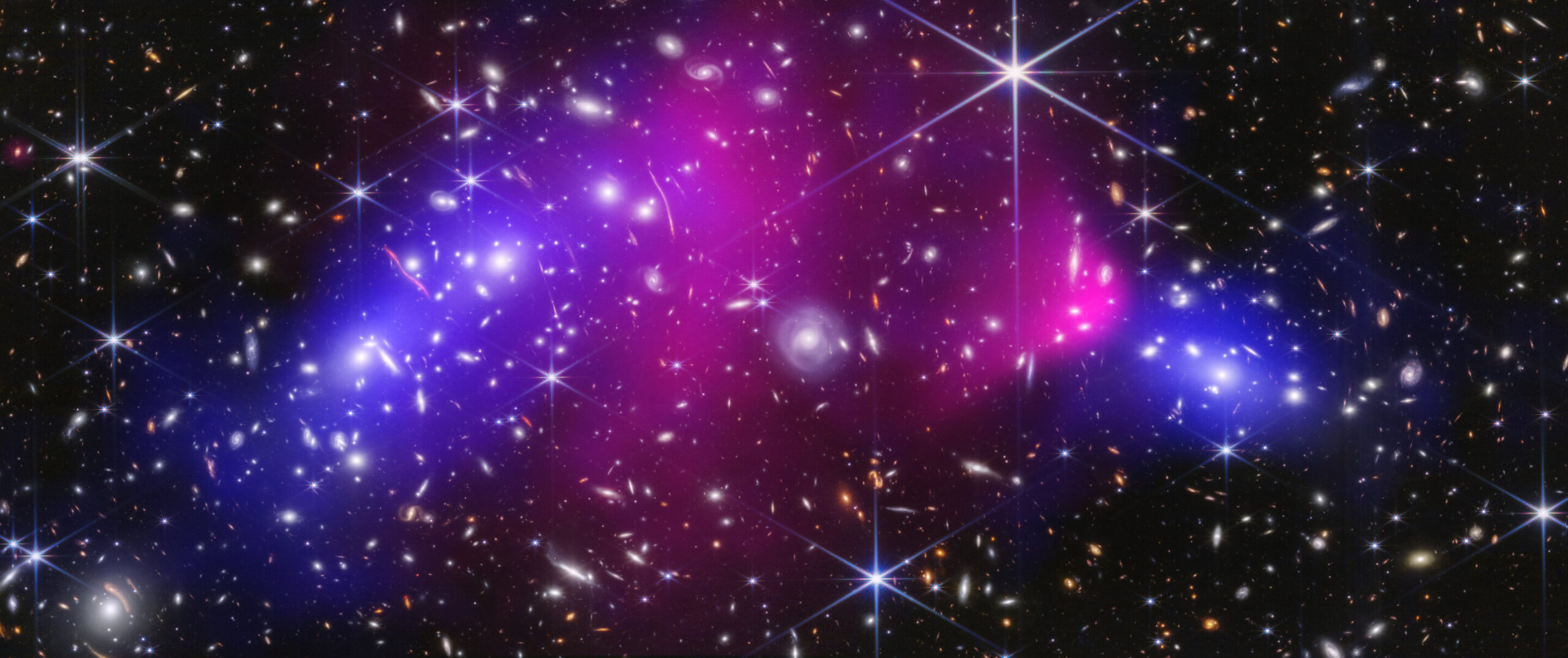
The Bullet Cluster was formed roughly 4 billion years ago when two enormous galaxy clusters collided at speeds exceeding 2,500 kilometers per second.
Each cluster contained hundreds of galaxies and vast amounts of matter. Although billions of stars were present, most of the visible matter existed as interstellar gas.
During the collision, the gas clouds from the two clusters slammed through one another. Friction significantly slowed them down and heated them to extremely high temperatures. Today, these hot gas clouds can be detected as diffuse structures using X-ray telescopes.
The galaxies themselves experienced a very different fate. Because the distances between stars are so immense, most stars passed by one another without direct interaction. As a result, the galaxies moved ahead while the gas lagged behind.
This separation created the distinctive structure known as the Bullet Cluster, consisting of two galaxy concentrations positioned on either side of two gas clouds.
Why the Bullet Cluster Became Famous
The Bullet Cluster gained extraordinary attention because of its apparent gravitational behavior.
Astronomers observed that galaxies located behind the cluster appeared distorted into crescent-like shapes. This phenomenon, known as gravitational lensing, occurs when massive objects bend light traveling through space.
According to conventional expectations, the strongest lensing effect should have appeared where the largest concentration of visible matter existed—in the hot gas clouds.
Instead, researchers found that the strongest lensing signal came from the regions occupied by the galaxy clusters themselves, even though these regions contained much less visible matter.
This discrepancy led scientists to conclude that a large amount of unseen mass must be present there.
“This observation has so far been considered evidence of the existence of dark matter,” explained Prof. Dr. Pavel Kroupa of the Helmholtz Institute of Radiation and Nuclear Physics at the University of Bonn.
Under the standard dark matter model, this invisible material exerts gravitational influence but does not interact significantly with ordinary matter. Consequently, unlike the gas clouds, it would not be slowed by friction during the collision and would remain aligned with the galaxies.
Revisiting an Alternative Explanation
Despite its widespread acceptance, dark matter has never been directly detected.
About four decades ago, Israeli physicist Prof. Dr. Mordehai Milgrom proposed an alternative idea known as Modified Newtonian Dynamics (MOND). Rather than introducing invisible matter, MOND modifies how gravity behaves under certain conditions.
The Bullet Cluster has long been viewed as a major challenge for MOND because many scientists believed the theory could not reproduce the observed lensing patterns.
The new study reaches a different conclusion.
“However, we show in our study that, on the contrary, the Bullet Cluster is actually particularly consistent with the MOND scenario,” said researcher Dong Zhang, who performed much of the study’s calculations.
James Webb Data Provides New Clues
The researchers argue that newer observations allow a more accurate accounting of the matter present within the clusters.
Data from the James Webb Space Telescope enabled a more precise estimate of the number of stars contained in the colliding galaxy clusters.
Scientists also know that the Bullet Cluster contains substantial amounts of heavy elements, including iron and oxygen. These elements are created inside massive stars through fusion processes.
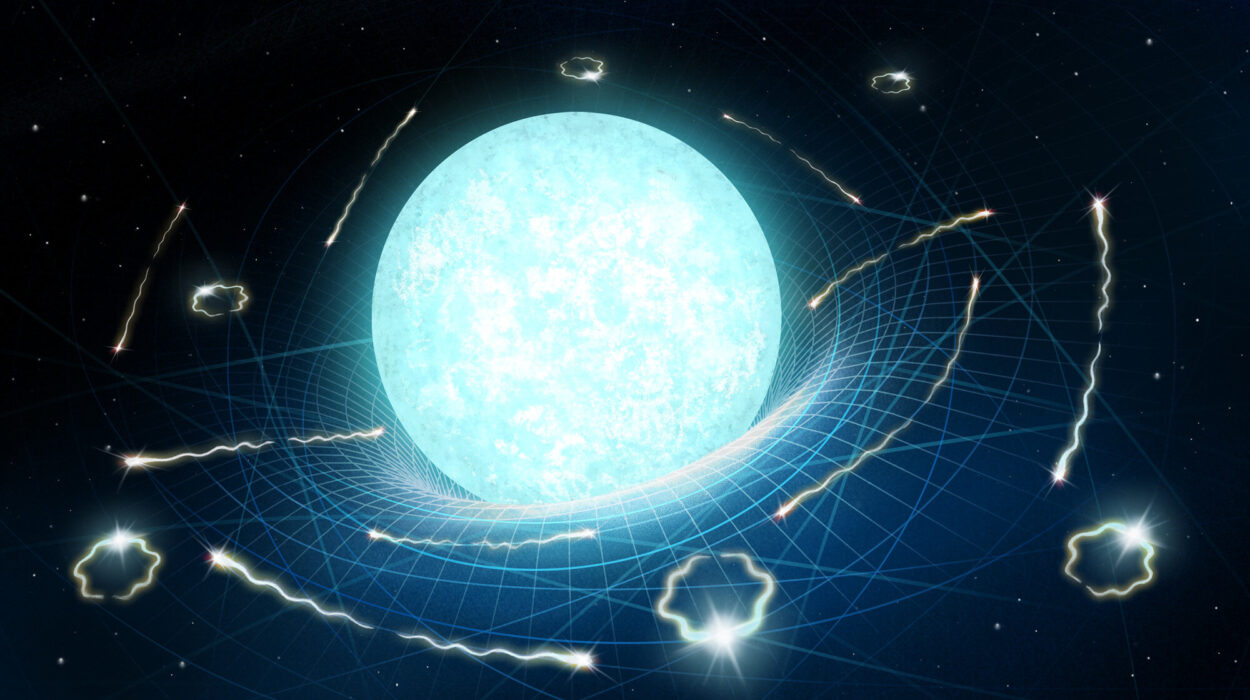
When such stars reach the end of their lives, they can leave behind neutron stars and black holes. Although these remnants are invisible to direct observation, they exert powerful gravitational effects.
According to the researchers, these stellar remnants may play a much larger role than previously appreciated.
“If massive stars eventually burn up, they become neutron stars or black holes,” Zhang explained. “Like dark matter, both are invisible and can only be detected by the huge gravitational forces that they exert.”
Explaining the Lensing Effect Without Large Amounts of Dark Matter
Using updated estimates of stars and stellar remnants, the team investigated whether the observed gravitational lensing could be reproduced.
Co-author Dr. Indranil Banik of the University of Portsmouth found that the lensing measurements can be explained using the newly calculated populations of visible stars, neutron stars, and black holes.
In the MOND framework, these compact remnants effectively take on part of the role often assigned to dark matter.
“The remnants of massive stars take on the role of dark matter to a certain extent in the MOND scenario,” Kroupa said.
The implications extend beyond MOND itself. The researchers argue that even if the standard dark matter model remains correct, the amount of dark matter required in the Bullet Cluster would need to be reduced substantially.
According to their analysis, the quantity could be lowered by approximately 50 percent compared with previous estimates.
Why This Matters
The Bullet Cluster has long occupied a central place in the debate over dark matter because it appeared to provide some of the clearest observational evidence for unseen mass in the universe. If new calculations can explain its gravitational effects using more accurately measured stars, neutron stars, and black holes, the case becomes more complex.
The study does not claim to provide direct proof against dark matter. Instead, it suggests that one of the most famous examples supporting dark matter may also fit an alternative explanation based on MOND. At the same time, the findings indicate that even conventional models may require significantly less dark matter than previously assumed.
By revisiting one of astrophysics’ most influential observations with improved data from the James Webb Space Telescope, the researchers have reopened an important scientific discussion about what is truly shaping gravity in some of the universe’s largest structures.