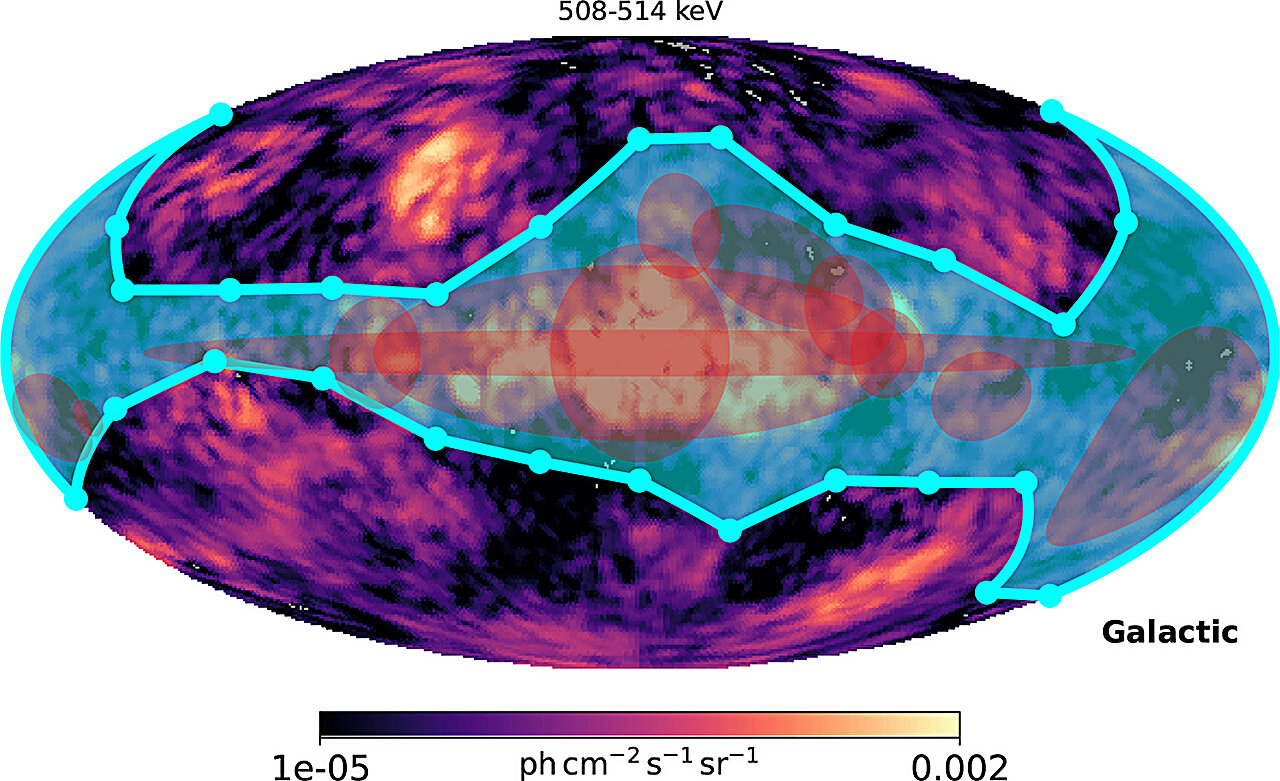
Faint patches of 511 keV gamma-ray emission appearing far above and below the Milky Way’s disk may point to something astronomers have never clearly detected before: positron annihilation beyond our own galaxy. If the signals prove to be real rather than imaging artifacts, they could reveal that nearby galaxies—and even gas clouds surrounding the Milky Way—are producing detectable amounts of antimatter-related radiation, opening an entirely new window on the high-energy universe.
For decades, astronomers have known that the center of the Milky Way shines brightly at an energy of 511 kiloelectron volts (keV). That specific energy acts like a fingerprint left behind when an electron meets its antimatter counterpart, a positron. The pair destroys itself in a process called annihilation, releasing gamma rays with a characteristic energy of 511 keV.
Although the Milky Way’s central bulge and disk have long been recognized as major sources of this radiation, a much more puzzling picture emerged after more than 20 years of observations by the European Space Agency’s INTEGRAL gamma-ray observatory. A detailed reconstruction of the sky revealed several much fainter hotspots well away from the crowded plane of our galaxy.
Those unexpected features became the focus of the new investigation. Rather than assuming they were simply imperfections in the reconstructed image, the researchers asked whether at least some of them might represent genuine astrophysical sources.
Looking for patterns in the sky
The team compared the locations of the mysterious 511 keV hotspots with two completely different kinds of cosmic structures.
One comparison involved high-velocity clouds—enormous collections of hydrogen gas moving around the Milky Way, including the long Magellanic Stream, which stretches across much of the southern sky after being pulled from the Magellanic Clouds.
The second comparison examined a catalog containing roughly 1,600 nearby galaxies within about 30 megaparsecs (nearly 98 million light-years).
The reasoning was straightforward. If the gamma-ray patches consistently lined up with known structures instead of appearing randomly across the sky, that would strengthen the case that they represent real signals rather than artifacts created during image reconstruction.
Two of the brightest hotspots line up with giant gas clouds
The strongest correspondence appeared in two enormous hydrogen structures.
One hotspot closely matched Complex C, a massive high-velocity cloud in the northern sky. Another aligned with dense portions of the Magellanic Stream in the south.
Using the reconstructed gamma-ray map, the researchers measured a 511 keV flux of about 9.1 × 10⁻⁵ photons per square centimeter per second from Complex C and roughly 4.9 × 10⁻⁵ photons per square centimeter per second from the Magellanic Stream region. Together, the two regions produced a combined flux of approximately 14.0 × 10⁻⁵ photons per square centimeter per second.
To evaluate whether these features could simply arise from random background fluctuations, the researchers repeatedly reconstructed the data using bootstrap sampling, while also generating background-only versions for comparison. According to their analysis, the combined signal from the two cloud regions was difficult to explain as background fluctuations alone.
Exactly where the positrons would originate, however, remains uncertain.
If the Magellanic Stream is being supplied mainly by positrons escaping from the Milky Way, then the amount of antimatter leaving our galaxy could be substantially larger than estimates based solely on annihilation occurring inside the Milky Way’s interstellar gas.
The authors suggest that the Galaxy’s overall positron production rate could potentially approach 10⁴⁴ positrons per second, roughly two to three times higher than estimates based only on annihilation measured within the interstellar medium.
They also note another possibility. The nearby Large and Small Magellanic Clouds themselves could contribute some of the observed emission, reducing the amount that would need to come from the Milky Way alone.
Several other hotspots appear to point toward nearby galaxies
Not every hotspot matched gas clouds.
Four additional regions corresponded surprisingly well with concentrations of nearby galaxies in the directions of Andromeda, Ursa Major, Hydra, and the Virgo region.
Individually, these signals were weak and carried large uncertainties. Their measured fluxes ranged from roughly 0.8 × 10⁻⁵ to 4.3 × 10⁻⁵ photons per square centimeter per second.
When combined, the four regions produced a total measured flux of about 10.1 × 10⁻⁵ photons per square centimeter per second.
Unlike the gas-cloud detections, however, these galaxy-region signals also came with systematic uncertainties of nearly the same size as the measured signal itself. That means the researchers cannot confidently rule out the possibility that the apparent emission results from background fluctuations.
Even so, the repeated alignment between faint gamma-ray hotspots and known galaxy concentrations encouraged the team to investigate whether many nearby galaxies could collectively account for the observations.
Hundreds of galaxies may each contribute a tiny amount
Rather than assuming a single bright source in each region, the researchers treated every nearby galaxy as a possible contributor.
Using a Bayesian hierarchical model, they estimated how much emission individual galaxies would need to produce so that, together, they matched the observed flux from each hotspot.
The model assumed that a galaxy’s positron annihilation brightness depends on its blue-band luminosity, a common measure related to its stellar population.
Their analysis found that the observed emission was broadly consistent with a relationship in which 511 keV brightness increases with galaxy luminosity, although much more slowly than a simple one-to-one scaling.
Under this model, galaxies would exhibit positron annihilation rates ranging from roughly 10⁴¹ to 10⁴⁵ positrons per second.
The calculations also highlighted several individual galaxies that could become detectable with more sensitive future instruments. Among the brightest predicted sources are Triangulum II, Ursa Major II, the Sextans dwarf spheroidal galaxy, M31 (the Andromeda Galaxy), M33, IC 10, and NGC 0185.
Most are expected to produce gamma-ray fluxes of at least 10⁻⁶ photons per square centimeter per second, while some dwarf galaxies could approach 2 × 10⁻⁵ photons per square centimeter per second.
Importantly, the predicted values remain below previously established observational upper limits, meaning they do not conflict with earlier measurements.
The researchers extended the idea to the entire universe
The study did not stop with nearby galaxies.
If many galaxies throughout the universe produce positron annihilation radiation, then the combined emission from billions of galaxies should contribute, at least slightly, to the cosmic gamma-ray background—the diffuse glow of high-energy radiation that fills the sky.
To estimate that contribution, the researchers built a cosmological model based on how the universe’s star formation rate has changed over cosmic history.
The calculation also incorporated several ingredients that shape positron annihilation spectra, including the familiar 511 keV line, radiation produced when positrons briefly form positronium, and higher-energy gamma rays created when fast-moving positrons annihilate before slowing down completely.
The predicted strength of the cosmological signal depends on several uncertain factors, including the Milky Way’s total positron production rate, the relationship between positron production and star formation, and the typical energies at which positrons are injected into space.
For many plausible assumptions, the resulting contribution to the cosmic gamma-ray background is only around the percent level.
Under more extreme assumptions—particularly if positrons are injected with energies of tens of megaelectron volts—the signature above several megaelectron volts could exceed 10% of the background.
The authors emphasize that many other astrophysical sources also contribute to the cosmic gamma-ray background, including Type Ia supernovae, kilonovae, processes occurring in intergalactic space, and radiation originating within the Milky Way itself.
Why the researchers remain cautious
Throughout the study, the authors repeatedly stress that the evidence is not yet definitive.
Image reconstruction from gamma-ray telescopes is inherently challenging, especially when searching for faint emission near much brighter sources. Although previous testing suggested that some hotspots persist under different reconstruction methods and background treatments, imaging artifacts cannot yet be excluded.
The nearby galaxy interpretation is particularly uncertain because the measured signals are weak and accompanied by large systematic uncertainties.
Even the apparent associations with the Magellanic Stream and high-velocity clouds, while more compelling, require independent confirmation.
The researchers therefore frame their work as an interpretation of intriguing patterns rather than a firm detection of extragalactic positron annihilation.
Future gamma-ray telescopes could settle the question
If the hotspots are genuine, future observatories should be able to test the idea directly.
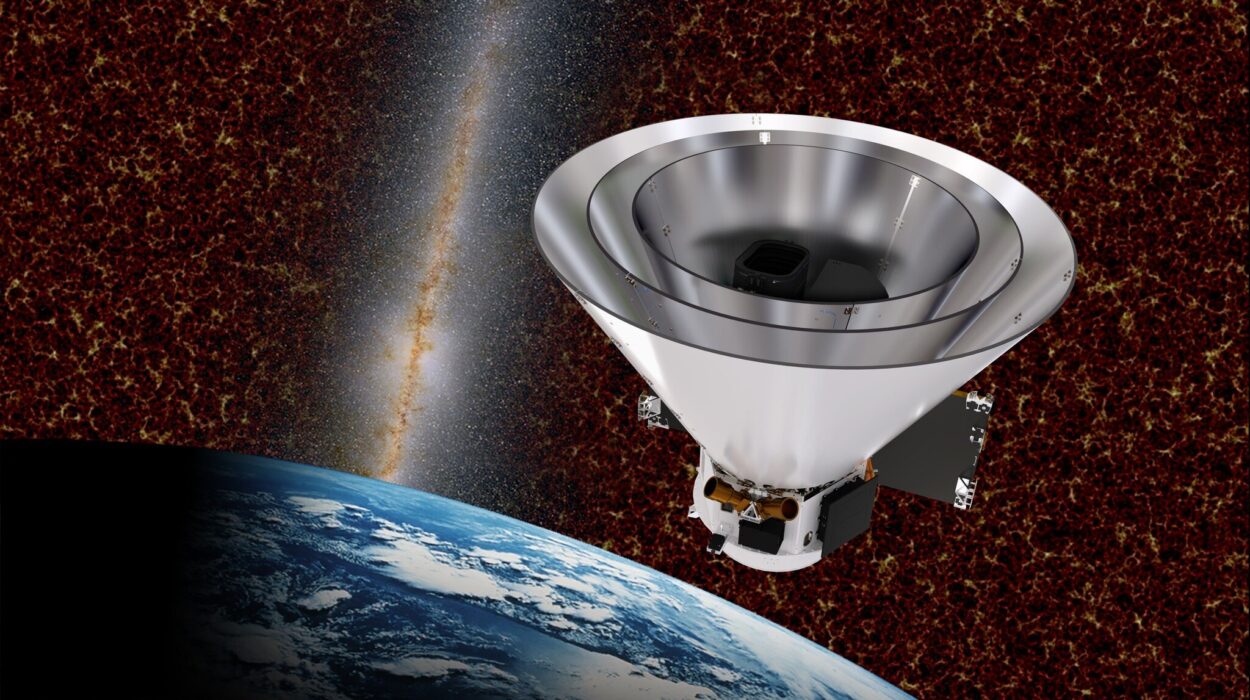
The researchers highlight the upcoming Compton Spectrometer and Imager (COSI) mission as a particularly promising instrument. With improved sensitivity in the MeV gamma-ray range, it could detect individual nearby galaxies emitting 511 keV radiation instead of only broad patches of excess emission.
Such observations would determine whether galaxies beyond the Milky Way truly produce detectable positron annihilation signals and whether the faint hotspots seen in today’s maps are the first glimpse of a much larger extragalactic population.
Confirmation would have consequences extending well beyond nearby galaxies. It would imply that positron production throughout the universe contributes measurably to the cosmic gamma-ray background and would provide astronomers with an entirely new way to study how antimatter behaves across cosmic distances.
For now, however, the researchers leave the possibility open. The hotspots could represent the first evidence of a previously unseen extragalactic gamma-ray signal—or they could still prove to be artifacts that disappear under sharper observations. Future measurements will determine which explanation survives.
Publication details
Thomas Siegert et al, Possible extragalactic positron annihilation signal, Astronomy & Astrophysics (2026). DOI: 10.1051/0004-6361/202659502