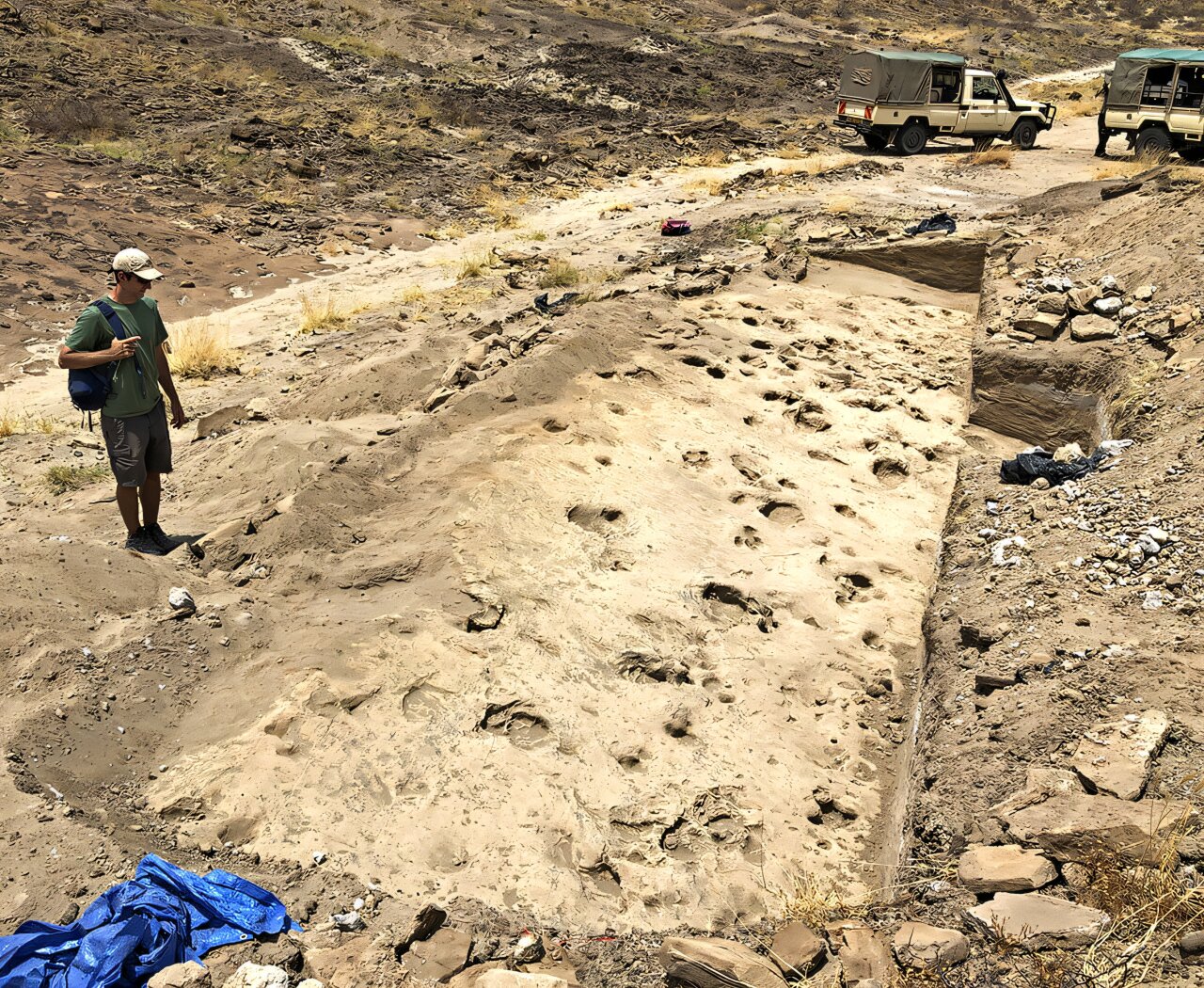
A 1.43-million-year-old surface of fossil footprints preserved beside an ancient Kenyan lake has captured an extraordinary snapshot of early human relatives walking across wet sediment, revealing unexpectedly large body sizes, distinctive foot mechanics unlike those of modern humans, and possible evidence that several adult males traveled together. The trackways provide one of the clearest behavioral records yet from the Early Pleistocene, preserving moments that unfolded over hours or days rather than the thousands of years represented by most fossil discoveries.
Most fossils tell scientists what an ancient body looked like after death. Footprints can do something different—they preserve movement, behavior, and interactions that happened in real time.
The newly described footprint site, known as GaJi10, lies within the Koobi Fora Formation in northern Kenya. The tracks were impressed into soft lake-margin sediment about 1.43 million years ago, only around 40 centimeters below a volcanic ash layer correlated with the Akait Tuff, which provides the site’s age.
The locality was first uncovered in 1978, when researchers discovered several hominin footprints among tracks left by other animals. Additional excavations in 2016 and 2023 dramatically expanded the known footprint surface, revealing a much larger collection than originally recognized.
The latest excavation documented 21 hominin footprints, including 14 that had never before been exposed. Together, the researchers concluded the tracks most likely represent eight different individuals.
The site preserves far more than human relatives alone. Across the excavated surface, scientists identified 146 additional animal tracks, including 67 hippopotamus, 64 bovid, 13 bird, and 2 equid footprints. The wide range of track sizes suggests multiple species were using the same lake-margin environment.
The footprints preserve an ancient landscape in remarkable detail
The geological setting is central to understanding why the footprints survived.
The researchers found that the tracks were made on a stable lake shoreline covered by only a few centimeters of water—probably somewhere between 2 and 10 centimeters deep. The soft silt was firm enough to hold detailed impressions but pliable enough for deep footprints, some reaching 12 centimeters in depth.
Soon afterward, the tracks were gently filled with fine sand under low-energy conditions rather than being washed away. The surrounding sediments show little evidence of erosion or drying, indicating the footprints were buried rapidly while the water level remained consistently high.
The broader rock sequence records a shallow lake environment that accumulated sediment quickly. Fish remains, freshwater snails, bivalves, and multiple footprint-bearing layers all point to a productive lakeshore that attracted many animals over time.
Unlike skeletal fossils that accumulate over thousands of years, these footprints capture a single brief episode on one ancient landscape.
The shape of the footprints tells a different story from modern human walking
The researchers used detailed 2D and 3D digital models of every hominin footprint to examine how the feet moved while walking.
One major analysis focused on the shape of the arch impressions preserved in the tracks. These measurements allowed the team to estimate how each foot rolled from heel to toe during walking.
Almost every measurable footprint fell outside the range expected for modern humans.
Instead of showing the foot mechanics typical of living people, the footprints resembled earlier fossil trackways previously attributed to Paranthropus boisei and even the much older Australopithecus afarensis footprints from Laetoli in Tanzania.
The researchers interpret this as evidence that the trackmakers walked with different foot mechanics than modern Homo. Their footprints suggest differences in the way the arch functioned during walking, potentially reflecting a flatter arch, a more flexible arch, or some combination of both.
Their big toes may also have moved differently
The footprints revealed another striking feature.
The impressions left by the hallux, or big toe, consistently angled farther away from the rest of the foot than is typical in modern human footprints.
With only one exception, every measurable footprint exceeded the upper range seen in experimental tracks made by living people. One footprint displayed a hallux angle approaching 40 degrees, exceeding values previously recorded among other Early Pleistocene footprints from East Turkana.
This pattern again matches earlier footprint evidence tentatively linked to P. boisei rather than Homo erectus.
The researchers suggest these wider toe positions may indicate differences in how the big toe functioned during push-off while walking. Although fossil foot bones remain too incomplete to establish a direct connection, available skeletal evidence does not contradict the possibility that P. boisei possessed different hallux anatomy and movement than early members of Homo.
Surprisingly slow walking preserved in the mud
Three continuous trackways preserved enough footprints for scientists to estimate walking speed.
Those calculations produced values between 0.32 and 0.50 meters per second, indicating slow walking.
The authors do not believe these unusually slow speeds necessarily represent the normal walking behavior of the trackmakers. Comparable Early Pleistocene footprint sites nearby preserve similar foot anatomy but substantially longer strides.
Because the mud conditions appear similar across the sites, the researchers suggest the GaJi10 individuals were simply moving slowly at that particular moment rather than belonging to an inherently slow-walking population.
The footprint sizes point to unexpectedly large individuals
Perhaps the most surprising finding came from estimating body size.
Using footprint dimensions and previously developed methods, the researchers calculated body height and body mass for seven individuals represented on the surface.
The results created an intriguing puzzle.
If the footprints belonged to Paranthropus boisei, as their foot anatomy appears to suggest, the estimated body sizes are much larger than previously inferred from skeletal fossils.
Assuming body proportions similar to Australopithecus, estimated heights ranged from 130.6 to 180.9 centimeters, while estimated body masses ranged from 39.8 to 74.6 kilograms.
Every estimated individual exceeded the average stature previously calculated for P. boisei, while four exceeded the largest previously published skeletal stature estimate. Most also exceeded published average body-mass estimates, with two surpassing the largest previously estimated individual body masses.
Such results would imply that P. boisei grew considerably larger—and displayed much greater variation in body size—than scientists had recognized from skeletal remains alone.
Or perhaps they belonged to Homo erectus
The evidence is not entirely straightforward.
If the footprints instead belonged to Homo erectus, their estimated body sizes fit much more comfortably within expectations for that species.
Under human-like body proportions, estimated heights ranged from 154.5 to 180.5 centimeters, while body masses ranged between 55.0 and 79.6 kilograms.
Although many of these estimates still lie above previously published averages for H. erectus, they mostly remain within the known range.
This creates the central uncertainty of the study.
The internal footprint anatomy consistently resembles tracks previously attributed to P. boisei, but the body sizes appear more compatible with H. erectus.
Resolving that contradiction remains difficult because confidently identified foot skeletons from both species are extremely rare.
The footprints hint at social behavior
Beyond anatomy, the arrangement of the tracks provides unusual behavioral evidence.
Five separate trackways head westward, while only one individual moved east.
The westbound trackways share similar orientations and show little evidence of crossing over one another, suggesting multiple individuals walked across the landscape at roughly the same time.
Because the estimated body sizes are generally larger than average for either candidate species, the researchers propose the group likely included multiple adult males.
If the tracks belong to P. boisei, they would represent rare direct evidence that several adult males occupied the same lakeshore simultaneously and may even have been traveling together. At minimum, the footprints indicate these individuals tolerated one another in close proximity.
If the tracks instead belong to H. erectus, they would similarly support previous ideas that this species sometimes formed groups containing multiple adult males, although smaller footprints suggest females or younger individuals may also have been present.
Unlike skeletal fossils, which reveal anatomy but rarely behavior, the footprints preserve individuals moving across the same place during essentially the same moment in time.
Why the lakeshore mattered
The researchers argue that the footprints also strengthen evidence that these ancient hominins regularly used productive lake-margin habitats.
The surrounding sediments indicate shallow water environments where edible aquatic plants, shellfish, fish, and other resources would have been available.
The authors note that previous evidence has suggested P. boisei depended heavily on water-rich habitats and consumed large amounts of C4 plants, including the possibility that wetland sedges such as papyrus formed an important part of its diet.
The footprints place hominins directly within precisely the environments where those foods would have grown.
For H. erectus, the lakeshore may have offered additional opportunities, including aquatic foods alongside plants. Nearby archaeological sites preserve cut-marked animal bones and evidence that hominins exploited both terrestrial and aquatic resources during roughly the same period.
The researchers suggest H. erectus may have ranged more widely across the landscape while P. boisei focused more heavily on dependable lakeshore resources. Even so, repeated footprint discoveries from East Turkana indicate the two species likely encountered one another regularly in these habitats.
Important uncertainties remain
The authors emphasize that the taxonomic identity of the trackmakers cannot yet be established with certainty.
While footprint shape favors P. boisei, the large body-size estimates raise the possibility that the tracks belong to H. erectus instead.
Another possibility, though considered less likely, is that the footprints represent an as-yet unrecognized hominin species.
The researchers also examined whether erosion, preservation, or sediment conditions could have distorted the footprints enough to create misleading anatomical patterns. They argue that rapid burial, careful selection of well-preserved tracks, and extensive experimental comparisons make such explanations unlikely, although they acknowledge unknown taphonomic influences cannot be ruled out entirely.
A growing record of life in the Early Pleistocene
The GaJi10 footprints add to an expanding collection of Early Pleistocene track sites from East Turkana that record ancient hominins moving through the same landscapes over hundreds of thousands of years.
Unlike bones, these traces preserve anatomy, movement, behavior, environmental context, and even the possibility of social interactions within the same snapshot of time.
The authors conclude that continued discoveries and improved methods for distinguishing footprint types may allow scientists to identify which hominin species left particular trackways, reconstruct how they shared ancient environments, and better understand the biological and behavioral differences that allowed multiple hominin species to coexist across the Early Pleistocene.
Publication details
Hatala, Kevin G., Insights into hominin body size, locomotion, and behavior from Early Pleistocene trackways in northern Kenya, Proceedings of the National Academy of Sciences (2026). DOI: 10.1073/pnas.2530996123. doi.org/10.1073/pnas.2530996123