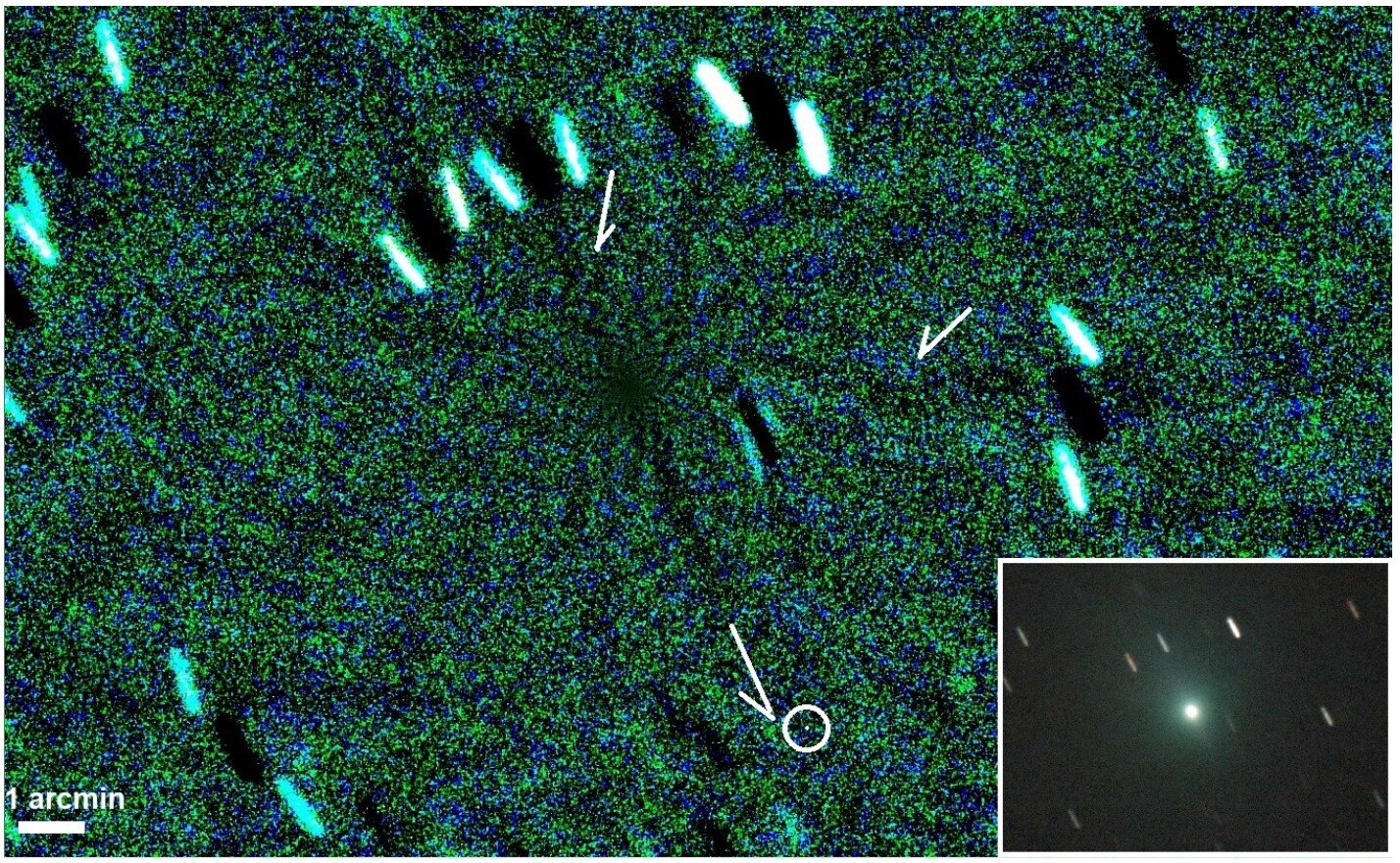
In the vast expanse of space, comets are often seen as the time capsules of the cosmos—frozen remnants of the early solar system, holding secrets of how planets and stars formed billions of years ago. But a recent visitor to our solar system has upended our expectations and offered a thrilling glimpse into the unknown. This comet, designated 3I/ATLAS, is only the second confirmed interstellar comet to pass through our celestial neighborhood. As scientists tracked its journey from July to November 2025, they discovered something extraordinary: the comet might be covered in erupting icy volcanoes—and it’s unlike anything we’ve seen before.
What makes this comet particularly fascinating is its pristine nature. Having never ventured close enough to a star to be altered by radiation or intense heat, Comet 3I/ATLAS is like a cosmic fossil. It carries the same characteristics as when it first formed billions of years ago in its original star system, long before it was propelled on its journey through the cosmos. This provides a rare opportunity to study a celestial object that has been untouched by the forces that shape comets in our own solar system.
The Ice Volcanoes Erupting from Deep Space
From the moment Comet 3I/ATLAS approached our sun, astronomers noticed something remarkable. As the comet neared about 2.5 times the Earth’s distance from the sun, it began to brighten, not in a sudden, explosive flare, but through a sustained, steady increase in brightness. This wasn’t like an unexpected burst of energy from a dying star, but rather a gradual surge that revealed something much more intriguing: the comet’s icy surface was coming to life.
The team of scientists studying the comet believes that the increase in brightness was due to cryovolcanism—volcanic activity driven by water ice instead of molten rock. As the comet approached the warmth of the sun, its surface began to heat up, causing water ice to vaporize and escape into space. This global activation of the comet’s icy layer suggests that, unlike many comets in our solar system, 3I/ATLAS doesn’t have a thick dust mantle to protect it. This exposed surface allowed the cryovolcanism to unfold across the entire comet, erupting in a way that defied traditional expectations.
“It’s like a cosmic ice volcano,” said one of the researchers, marveling at how this comet was behaving so differently from the icy bodies typically found in our own solar system. “The presence of these eruptions is a sign that this comet is doing something very special.”
A Metal-Rich Core Beneath the Surface
But the wonders didn’t stop there. When the scientists examined the reflected light from the comet, they found something unexpected: its composition didn’t match the icy, rock-laden bodies typical of comets. Instead, it resembled a rare class of meteorites known as carbonaceous chondrites. These meteorites, known for their high metal content—including iron and nickel—hinted at something more metal-rich beneath the comet’s icy exterior.
This discovery could challenge everything we thought we knew about comet formation. Comets are generally believed to be made primarily of ice, with small amounts of rock and metals mixed in. The prevailing theory is that they form in the cold, distant regions of a solar system, where the sun’s heat is too weak to affect the icy bodies. But Comet 3I/ATLAS, with its metal-rich interior and icy eruptions, suggests that there may be far more complexity in the way comets form than previously understood.
The team proposes that as the comet’s surface warmed under the sun’s rays, water ice began to melt and seep into the interior. As this liquid interacted with the metal grains inside, it triggered a chemical process that not only fueled the comet’s cryovolcanism but also released gases like carbon dioxide. This surprising chemical reaction might explain why the comet is so active, with its internal metals essentially acting as an energy source for the eruptions.
A New Understanding of Comet Evolution
For astronomers and planetary scientists, this discovery is a game-changer. Comet 3I/ATLAS’s unusual behavior raises profound questions about the way comets form and evolve. While we had long believed that comets were mostly ice and rock, fueled by the sun’s heat, this interstellar traveler challenges that assumption.
As the study’s authors note, “Interstellar visitors like 3I/ATLAS continue to challenge and refine our understanding of planetary-system formation and the chemical evolution of small bodies.” The presence of metals and cryovolcanism suggests that the building blocks of comets—perhaps even those that seeded our own solar system—could be far more diverse than we had imagined.
The findings raise intriguing possibilities for how other star systems might have developed, and what the chemical building blocks of planets and moons in those systems might look like. Could other interstellar comets, like 3I/ATLAS, be carrying new kinds of materials that could shape the evolution of planets in other parts of the galaxy?
Why This Research Matters
The study of Comet 3I/ATLAS is more than just a captivating story of cosmic curiosity—it is a stepping stone in our understanding of the universe. By examining this pristine, interstellar object, scientists are learning about the early building blocks of star systems and the ways in which celestial bodies can behave in unexpected ways. This knowledge could help us refine our models of planet formation, the chemical evolution of small bodies, and even the potential for life elsewhere in the universe.
Moreover, the discovery of metal-rich cryovolcanism may open new avenues for exploring how life might exist in extreme environments, where heat is generated not by a star, but by internal chemical reactions. If life can thrive in such conditions on Earth—or in icy moons like Europa or Enceladus—could there be similar possibilities on other icy worlds across the galaxy?
Comet 3I/ATLAS is a reminder that the universe is full of surprises. Every comet that visits our solar system offers a glimpse into a far-off world, a fragment of another star system’s history. And with each discovery, we move a step closer to understanding the complex, interconnected cosmos we are all a part of.
More information: Josep M. Trigo-Rodríguez et al, Spectrophotometric evidence for a metal-bearing, carbonaceous, and pristine interstellar comet 3I/ATLAS, arXiv (2025). DOI: 10.48550/arxiv.2511.19112