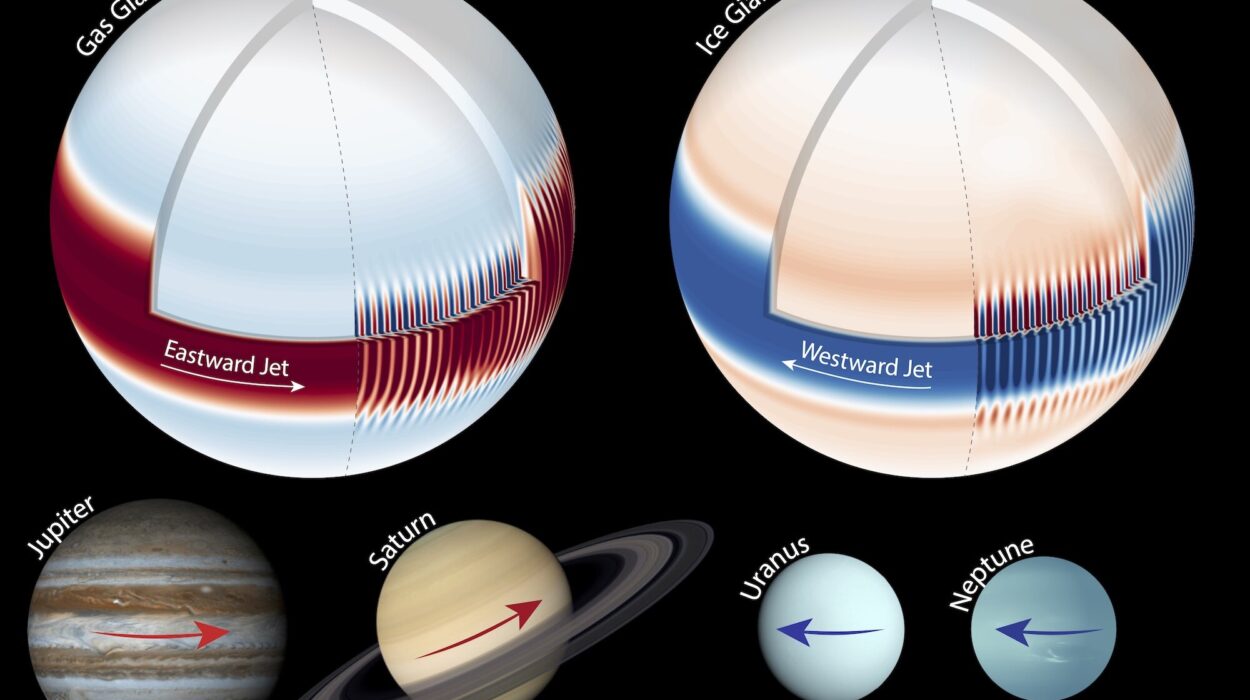
For over three decades, a puzzle has lingered in the dark corners of space science. It all began in 1986 when NASA’s Voyager 2 spacecraft, during its historic flyby of Uranus, detected a bizarre and unexpected phenomenon—a radiation belt of electrons surrounding the planet that was far stronger than anything scientists had anticipated. This strange discovery left researchers scratching their heads. What could explain such an intense, out-of-place radiation belt at a planet that was unlike any other in our solar system?
Fast forward to today, and a team of scientists from the Southwest Research Institute (SwRI) believes they might have finally cracked the case, offering an explanation that could change the way we view space weather and planetary radiation systems.
The Voyager 2 Surprise
When Voyager 2 made its lone pass by Uranus, it wasn’t just collecting stunning images of the icy giant and its moons. The spacecraft also made some unsettling discoveries about the planet’s radiation environment. The electron radiation levels it recorded were far higher than expected, based on models derived from other planetary systems. Scientists could only speculate as to how Uranus could sustain such a powerful radiation belt.
The planet Uranus itself was already an anomaly. With its odd tilt, peculiar magnetic field, and distant position in the outer solar system, it’s a place that is difficult to study, even with the most advanced spacecraft. So when Voyager 2’s readings appeared to defy everything that was known about planetary radiation belts, the mystery grew even deeper. For almost four decades, scientists were left with a major question: What on Earth—or in this case, Uranus—could possibly cause such an intense radiation belt?
A New Theory Emerges
Dr. Robert Allen, a scientist from SwRI and lead author of the new research, is the one who has brought fresh perspective to the puzzle. “Science has come a long way since the Voyager 2 flyby,” he said, reflecting on the years of data and breakthroughs that have since occurred. The team at SwRI decided to take a different approach, examining Voyager 2’s data through the lens of modern space weather knowledge, especially what has been learned from Earth’s radiation belts.
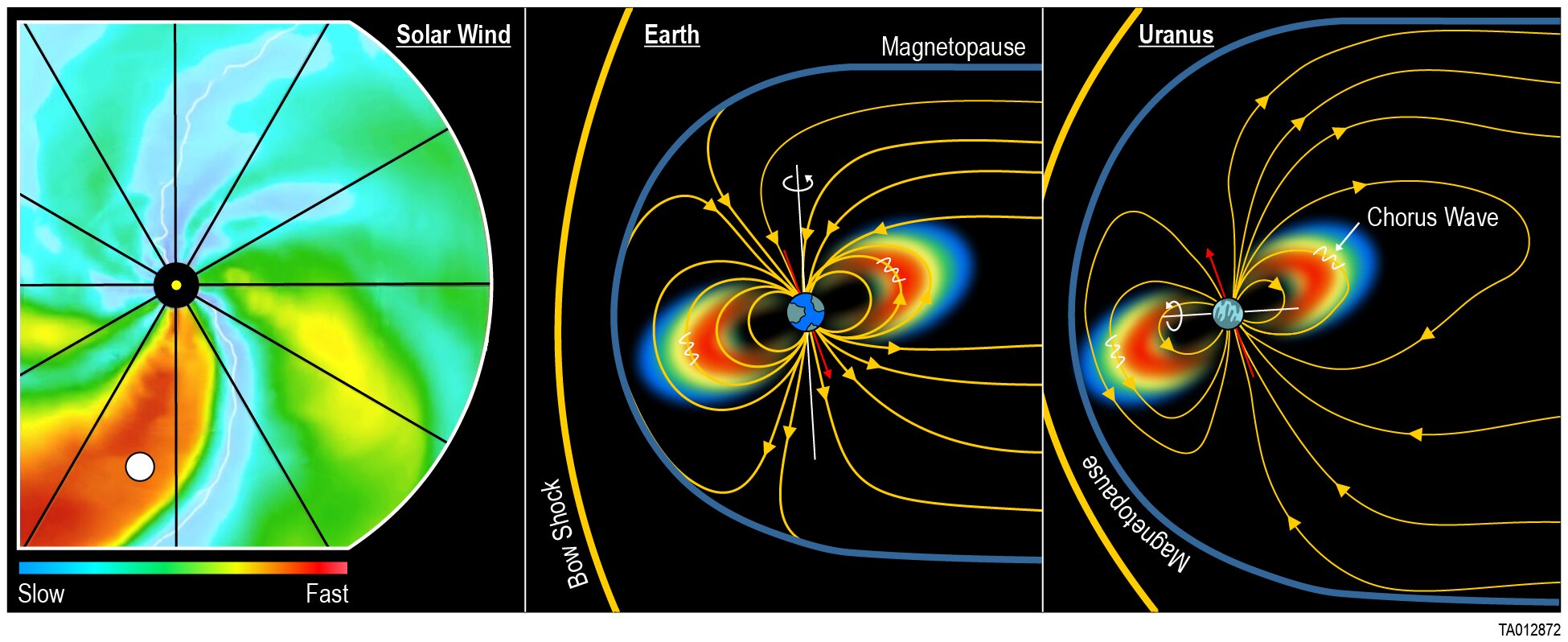
Their theory? A powerful solar wind structure, known as a co-rotating interaction region (CIR), might have been passing through the Uranian system when Voyager 2 made its flyby. CIRs are regions of space where streams of solar wind, moving at different speeds, collide and create shockwaves. These shockwaves can accelerate particles, creating high-energy radiation belts. And this, according to Allen and his team, could explain the unexpectedly strong electron radiation that Voyager 2 observed.
This is a big shift from what scientists thought back in 1986. At the time, it was believed that the waves Voyager 2 had detected were likely to scatter the trapped electrons, causing them to be lost to Uranus’s atmosphere. But what Allen’s team has since learned is that under the right conditions, those same waves can actually do the opposite—they can accelerate the electrons, feeding them additional energy.
A Similar Event on Earth
The breakthrough came with another unexpected observation. In 2019, Earth experienced a rare space weather event that caused its own radiation belts to undergo rapid acceleration. Dr. Sarah Vines, a co-author of the study, explained: “In 2019, Earth experienced one of these events, which caused an immense amount of radiation belt electron acceleration.” The similarity between this recent event and what Voyager 2 saw at Uranus was too strong to ignore.
The new study suggests that the same mechanism responsible for the electron acceleration on Earth could have been at play around Uranus during Voyager 2’s flyby. If a CIR was indeed passing through the Uranian system, the high-frequency waves it generated would have been capable of adding substantial energy to the electron radiation belt, explaining why Voyager 2 recorded such unusually high energy levels.
Opening the Door to More Questions
While the findings offer a tantalizing solution to one of space science’s oldest mysteries, they also raise even more questions. As Dr. Allen points out, “This is just one more reason to send a mission targeting Uranus.” The researchers believe there’s much more to learn about the intricate dynamics of the Uranian system and how it compares to other planets in our solar system, particularly Neptune.
The discovery of a similar radiation environment around Uranus raises broader questions about the role of space weather in shaping the radiation belts of distant planets. Could the same phenomenon be occurring on other planets in the outer solar system? What does this tell us about the unique environments on Uranus and Neptune? And how does this newfound understanding change the way we think about space weather and planetary systems across the universe?
For now, the answers are still unclear, but the clues uncovered by the SwRI scientists offer a fascinating glimpse into the forces at work in one of the most enigmatic regions of our solar system. As our understanding of space weather continues to evolve, one thing is certain: Uranus has much more to reveal.
Why This Research Matters
The findings from this study are important for several reasons. First, they help to demystify a major scientific puzzle that has confounded researchers for nearly four decades. But more importantly, they demonstrate the power of comparative analysis in science. By applying modern knowledge of Earth’s radiation belts and space weather events to data from a far-off planet, scientists have managed to reframe our understanding of Uranus and its surroundings.
These insights also have profound implications for future space exploration. Understanding the radiation environments around planets like Uranus and Neptune is crucial for planning future missions to these distant worlds. With the possibility of missions targeting these planets on the horizon, the findings from this study will guide the design of spacecraft and instruments, ensuring they can withstand and study these powerful radiation environments.
As we look to the stars, this research opens new doors to understanding the hidden mechanics of distant planets, shedding light on the complex interplay of forces that shape not only our solar system but also the many others scattered throughout the cosmos. It’s a reminder that even the smallest bits of data—collected years ago—can hold the key to unlocking some of the greatest mysteries of the universe.
More information: R. C. Allen et al, Solving the Mystery of the Electron Radiation Belt at Uranus: Leveraging Knowledge of Earth’s Radiation Belts in a Re‐Examination of Voyager 2 Observations, Geophysical Research Letters (2025). DOI: 10.1029/2025gl119311