Gamma-ray observations from several massive galaxy clusters have produced a narrow signal at about 43 billion electron volts, matching a signature expected from WIMPs, one of the leading candidates for dark matter.
Dark matter has never been detected directly, even though its gravitational effects provide evidence that it exists. It is thought to account for roughly 85% of all mass in the universe, influencing how galaxies rotate and how galaxy clusters remain bound by gravity.
Now, a team led by Yi-Zhong Fan of the Chinese Academy of Sciences has identified a gamma-ray feature that may offer a particularly interesting clue about what dark matter could be made of.
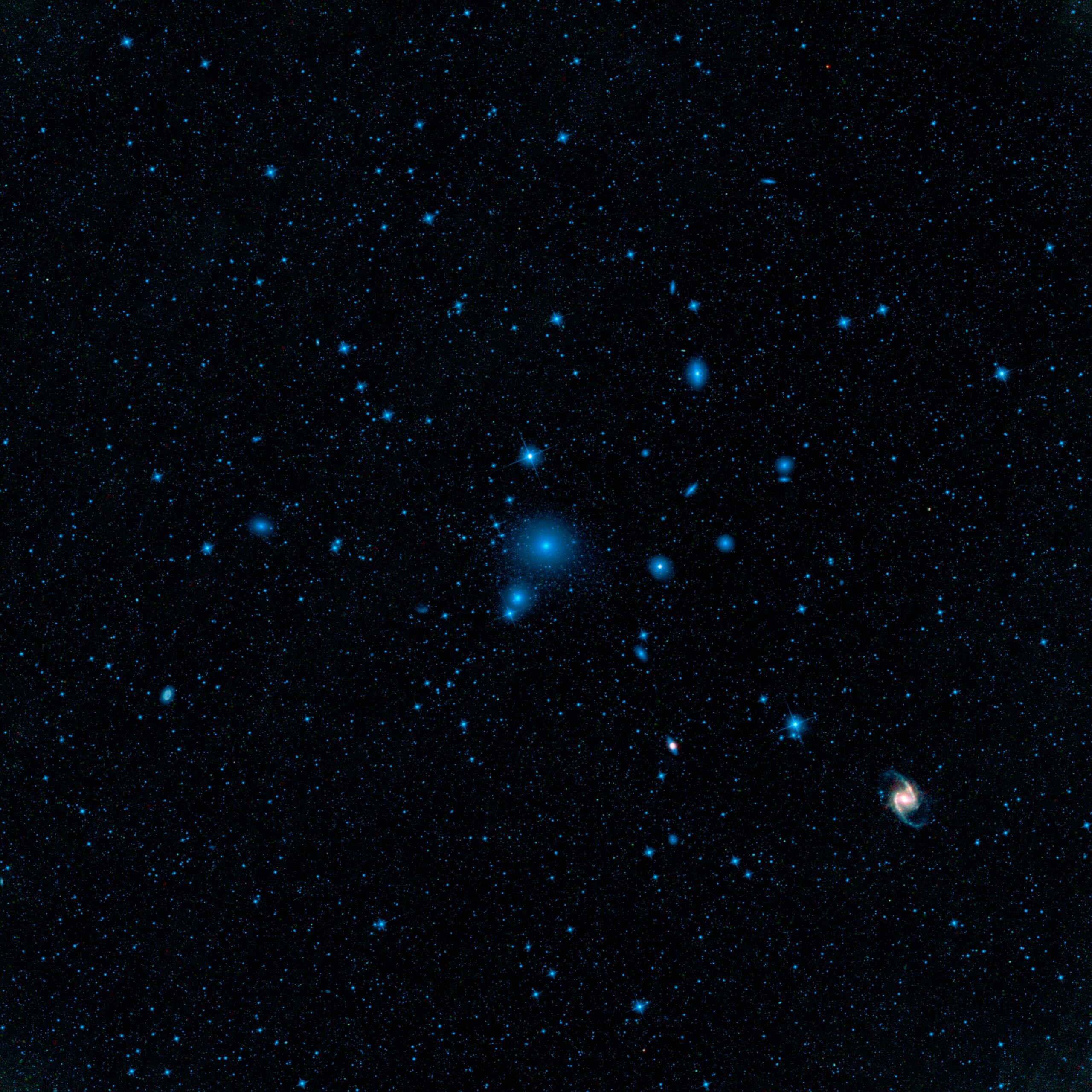
The researchers examined more than 15 years of observations from the Fermi Gamma-ray Space Telescope, focusing on 13 nearby massive galaxy clusters. Their analysis picked out a narrow gamma-ray line at an energy of around 43 billion electron volts.
The feature was strongest in the Virgo, Fornax and Ophiuchus clusters, which are expected to contain the densest concentrations of dark matter among the systems examined.
Why WIMPs could produce this kind of signal
WIMPs, short for weakly interacting massive particles, are hypothetical particles that would interact only weakly with ordinary matter and light while still producing gravitational effects.
WIMPs have long been considered a possible explanation for dark matter because particles with suitable masses and interaction strengths could exist in an abundance that would account for the missing mass.
Their possible interactions also provide a way to search for them. WIMP collisions and annihilations are expected to produce particles across a broad range of energies. Such signals could be difficult to distinguish from ordinary cosmic background radiation.
A narrow line concentrated at one energy would be different. According to the researchers’ calculations, the feature they detected would be difficult to produce through known astrophysical processes. Its characteristics instead match the type of signal expected from WIMP annihilation.
The strongest signals came from three clusters
The gamma-ray feature did not appear equally strongly across all 13 galaxy clusters examined.
The clearest signals came from Virgo, Fornax and Ophiuchus. These clusters are expected to contain particularly dense concentrations of dark matter, making them important parts of the analysis.
The researchers also looked toward the center of the Milky Way. A similar signal detected there in the past was initially mistaken for evidence of dark matter before being attributed to an error involving the telescope.
This time, the researchers did not find an equivalent instrumental problem at the center of our galaxy. That reduced the likelihood that the newly identified feature was simply the result of a telescope error.
It did not, however, establish that the signal came from dark matter.
The signal has not been confirmed
One reason the researchers remain cautious is that the strength of the gamma-ray feature changed over time. It declined around 2016 and later increased again.
Because of this variation, the team did not describe the observation as a confirmed detection of WIMPs. Instead, they considered it a strong enough hint to justify additional observations.
The researchers hope a future instrument could provide that test. Fan’s team has proposed a theoretical Very Large Area Gamma-ray Space Telescope that could be used to examine the signal more closely.
If the signal is ultimately confirmed as being produced by WIMP annihilation, it could provide the first direct look at the particles responsible for the observation. For now, the 43-billion-electron-volt feature remains a promising but unconfirmed dark matter signal.
The study was published in Physical Review Letters.