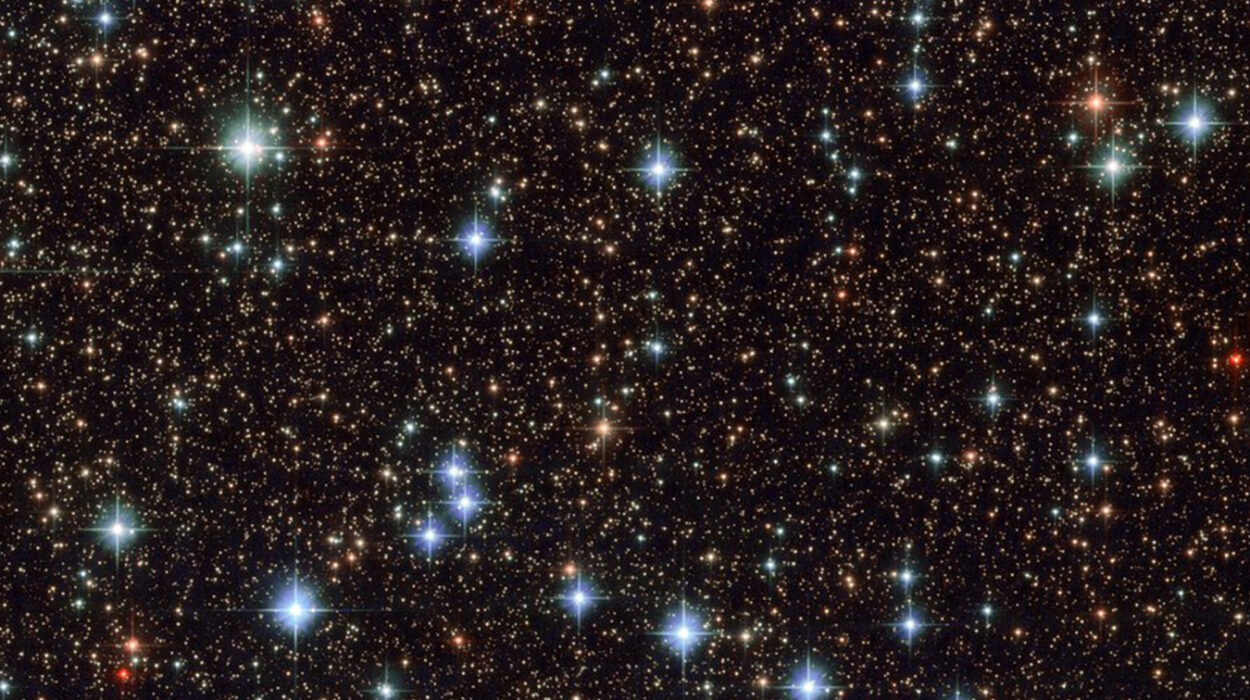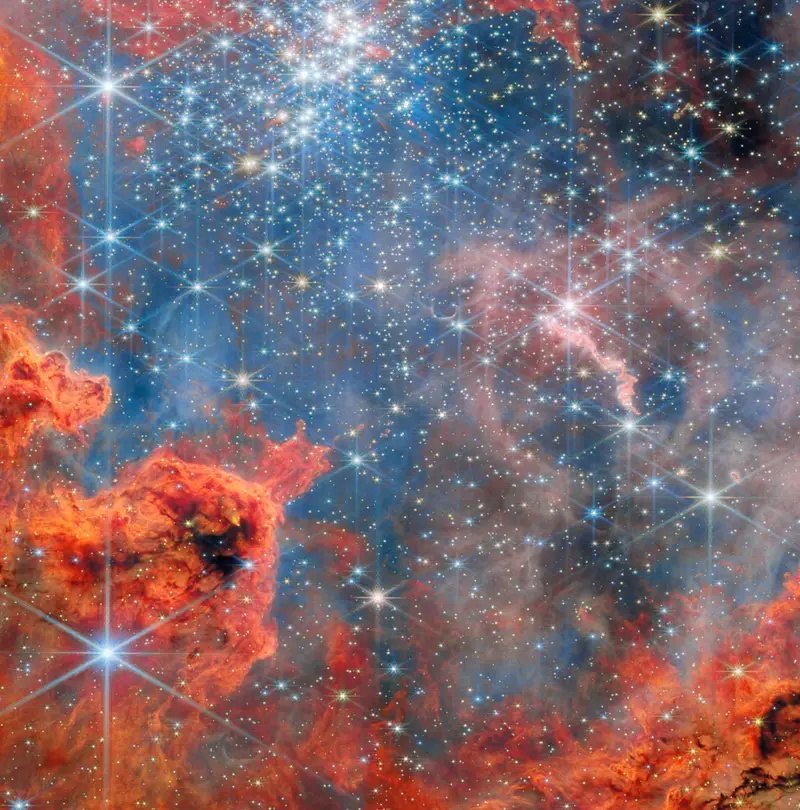
At first glance, the scene feels almost celebratory, as if the universe itself has strung lights across a dark sky. Glowing clouds billow in warm oranges and reds, while thousands of stars sparkle like scattered confetti. This is not a holiday display, but the final ESA/Webb Picture of the Month for 2025, and it captures a place where stars are being born in abundance. The subject is Westerlund 2, a dense star cluster tucked inside a vast stellar breeding ground known as Gum 29, far beyond Earth’s reach.
Westerlund 2 lies about 20,000 light-years away in the constellation Carina, also called the Keel. Even at that distance, the region shines with startling clarity in the new image created from data collected by the James Webb Space Telescope. What looks festive is, in reality, a portrait of extreme youth and power. This is a stellar nursery caught in the act, filled with energy, motion, and change.
Meeting Westerlund 2, a Giant in a Small Space
Westerlund 2 may span only between 6 and 13 light-years across, but within that relatively compact space lives an extraordinary concentration of stars. The cluster hosts some of the Milky Way galaxy’s hottest, brightest, and most massive stars. These are not gentle neighbors. Their intense light and radiation dominate the region, shaping everything around them.
The cluster is not new to astronomers. It once held the honor of being the Hubble Space Telescope’s 25th anniversary image in 2015. Now, a decade later, Webb has returned to the same region with sharper eyes and a broader range of infrared vision. What Webb sees goes deeper into the dust and gas, revealing details that were previously hidden.
This image combines observations from Webb’s Near-Infrared Camera and its Mid-Infrared Instrument. Together, they allow astronomers to peer through obscuring material and capture both the blazing stars and the cooler structures that surround them. The result is a scene that feels alive, layered with activity from foreground to background.
Young Stars That Shape Their World
Near the top of the image sits the bright heart of Westerlund 2, packed tightly with young, massive stars. These stars are brilliant not just in appearance but in influence. Their powerful radiation floods the surrounding space, shaping the entire scene like sculptors working in light and heat instead of stone.
Below and around this core, clouds of gas glow in deep oranges and reds. These are not static formations. They form sculpted walls and tangled structures, shaped by constant pressure from the cluster above. The radiation from the massive stars pushes into the surrounding material, eroding it in some places and compressing it in others. Where the light strikes most strongly, the gas glows. Where it thins, softer blues and pinks drift through the scene like wisps of smoke.
Threaded throughout the view are countless tiny stars that are just beginning to shine. Some are still wrapped in the gas and dust from which they formed, visible only because Webb can detect their faint infrared light. These newborn stars tell a quieter story within the larger drama, one of gradual emergence amid overwhelming energy.
A Crowd of Stars Near and Far
Not every bright point in the image belongs to Westerlund 2. Scattered across the field are many stars that lie much closer to Earth. These foreground stars stand out with sharp, star-shaped patterns created by Webb’s optics. Their crisp appearance contrasts with the softer, glowing forms of the distant gas clouds and embedded young stars.
This mixture of near and far adds depth to the image, reminding viewers that the universe is layered and complex. What looks like a single flat scene is actually a vast stretch of space, with objects separated by immense distances yet captured together in one frame.
Taken as a whole, the image becomes a vivid portrait of a stellar nursery in action. The intense energy from newborn stars is not merely lighting up the region; it is actively carving dramatic shapes into the surrounding nebula. This energy drives an ongoing cycle of star formation, influencing what will form next and how long the process will continue.
The Smallest Residents Come Into View
Beyond its visual impact, the new image of Westerlund 2 carries scientific weight. For the first time, Webb’s observations have revealed the full population of brown dwarfs in this extremely massive young star cluster. These objects, which include bodies as small as about 10 times the mass of Jupiter, had remained hidden until now.
Brown dwarfs occupy a curious place in astronomy. They are neither full-fledged stars nor planets, and finding them in such a crowded, energetic environment is a challenge. Webb’s sensitivity allows astronomers to identify these faint objects amid the glare of massive stars and glowing gas.
The same data has also enabled researchers to find several hundred stars surrounded by disks in various evolutionary states. These disks are the material left over from star formation, and they are crucial to understanding how planetary systems take shape. By observing many disks at different stages within a single, massive cluster, astronomers can begin to piece together how such disks evolve under intense radiation and crowding.
A Survey Years in the Making
This image was developed using data from Webb’s program #3523, led by M. Guarcello, as part of the Extended Westerlund 1 and 2 Open Clusters Survey, known as EWOCS. The goal of this survey is to study massive young star clusters in detail, using Webb’s capabilities to uncover populations of stars and substellar objects that were previously beyond reach.
By focusing on both Westerlund 1 and Westerlund 2, the survey provides a broader context for understanding how stars form and evolve in some of the most extreme environments in the Milky Way. The image released as the Picture of the Month is a public window into that deeper scientific effort, turning complex data into a story that can be seen and felt.
Why This Picture Matters
This research matters because it shows star formation not as an abstract process, but as a living, ongoing event shaped by powerful forces and delicate beginnings at the same time. The image of Westerlund 2 reveals how massive stars can dominate their surroundings, carving glowing walls out of gas while smaller stars and brown dwarfs quietly emerge in their shadows.
By uncovering the full population of brown dwarfs and hundreds of disk-bearing stars, these observations deepen our understanding of how stars and planetary systems form in crowded, energetic clusters. They show that even in the presence of intense radiation, disks can survive in various stages, offering clues about how planets might form in such environments.
Perhaps most importantly, the image captures a moment in the long cycle of stellar birth and change. It freezes a dynamic region where light, gas, and gravity interact on vast scales, reminding us that the Milky Way is not a static backdrop but a galaxy still actively creating new worlds. Through Webb’s eyes, Westerlund 2 becomes more than a beautiful picture. It becomes evidence of how the universe continues to build itself, star by star.