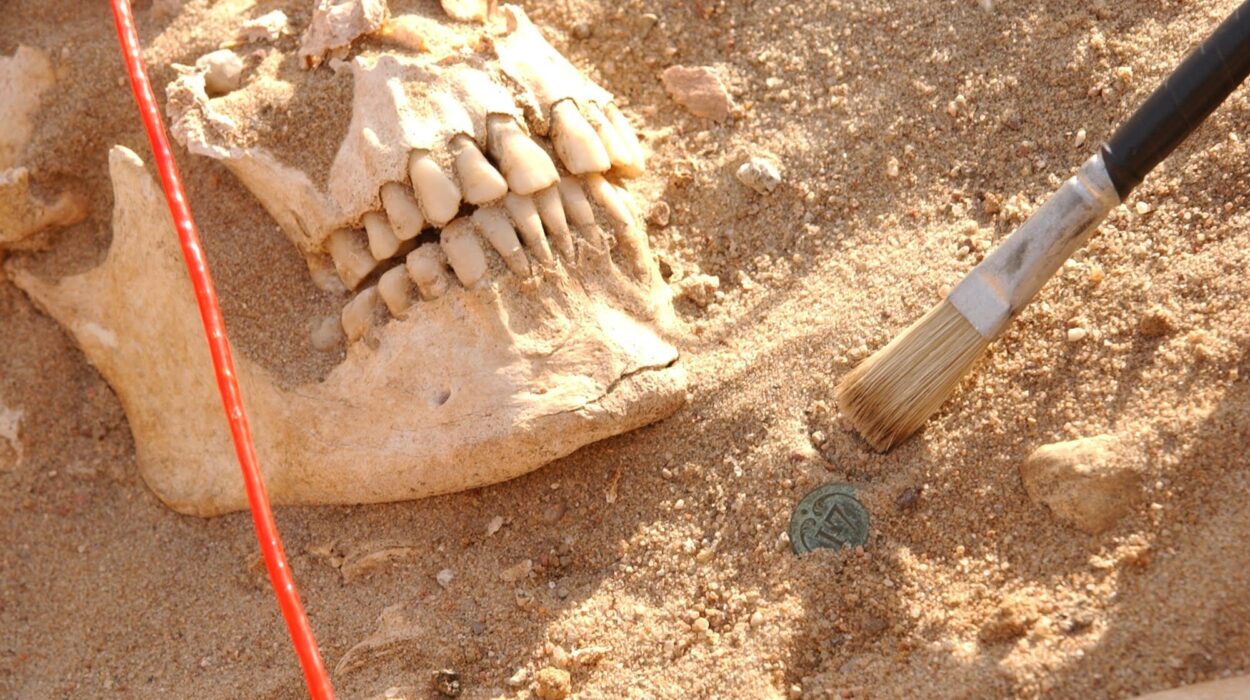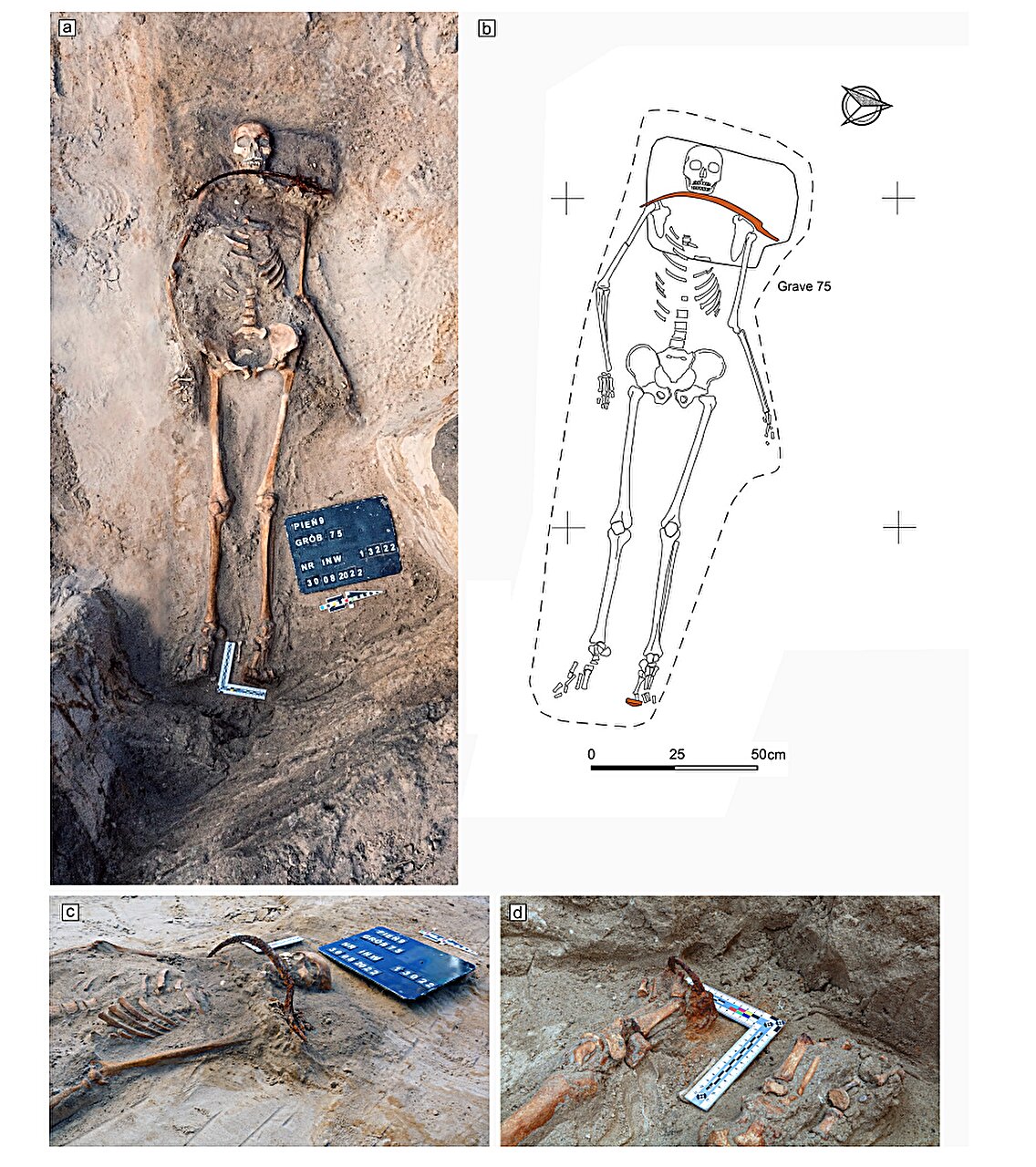
When archaeologists uncovered Grave 75 at a cemetery in Pień, Poland, they found the remains of a young woman buried with an iron sickle laid across her neck and a triangular padlock attached to her left big toe. Evidence from her bones, teeth, DNA, textiles and the disturbed soil suggests the unusual burial was part of an attempt to protect the living from someone they feared might return from the dead.
The grave was excavated in 2022 by researchers from the Institute of Archaeology at Nicolaus Copernicus University. The woman was between 17 and 19 years old when she died.
A curved iron sickle had been placed directly over her neck, with its blade facing toward her throat. An iron padlock was attached to the big toe of her left foot.
The arrangement was not the only sign that the burial had been deliberately altered. The soil inside the grave was disturbed and mixed, while the position of the bones indicated that the burial had been reopened before the body had completely decomposed. At that stage, soft tissue was still holding the joints together.
The researchers found evidence that the woman’s left arm had been pulled toward the northeast. They interpret this disturbance, together with the placement of the sickle, as evidence that someone returned to the grave and altered the burial.
The sickle’s handle had decayed, but analysis showed that it had been made from birch wood. The study notes that birch was historically believed to have magical properties that could protect people from evil spirits.
The sickle and padlock were consistent with anti-demonic burial practices intended to prevent the dead from returning or harming the living.
Evidence of wealth and hardship
Other clues point to a woman whose life was more complicated than the unusual burial alone might suggest.
Tiny metallic threads were found near her skull. They were made of pure silver and gold-gilded wire and came from a luxurious silk headwear cap. Because such materials were extremely expensive in the 17th century, the researchers concluded that she likely came from a wealthy family.
Her diet, however, appears to have been poor in animal protein. Carbon and nitrogen isotope measurements placed her among adults from the cemetery who consumed very little animal protein. The researchers interpret this as evidence that she experienced periods of malnutrition despite her apparent social status.
Radiocarbon dating placed her burial most likely between 1620 and 1674 CE, with a 52.6% probability.
DNA analysis added another unusual detail. Her maternal genetic lineage was haplogroup J1c2c1, a rare lineage with origins in Scandinavia that is virtually absent among modern Slavic populations.
Her childhood teeth told a different part of the story. Isotope analysis indicated that she had grown up locally in Pień rather than arriving there from a distant region.
A strange mark on her bones
The researchers also found a distinct green stain on the woman’s palate and neck bones.
At first, they considered whether the discoloration might have come from a coin. But the composition of the metal did not match historical coins, and scans did not reveal a coin in the area.
The researchers therefore proposed that a copper-containing object or medicinal substance may have been deliberately pushed deep into her mouth or nasal passage around the time of her death.
The evidence does not establish exactly what caused the green staining, but it provides another unusual feature associated with the burial.
Why the grave was treated this way
The combination of the sickle, padlock and deliberate reopening of the grave fits a broader pattern of burials sometimes described by archaeologists as “vampiric” or “anti-vampiric.”
Such burials could include measures intended to prevent the dead from rising again, including decapitation, heavy stones placed over bodies or iron stakes.
Several hundred examples have been identified across Central and Southeastern Europe, dating from the post-medieval period into modern times. Burials from the 16th through 18th centuries, however, have received relatively little attention in archaeological literature.
For the researchers, Grave 75 offered an opportunity to examine one of these practices using physical evidence rather than relying only on later folklore.
The wider historical setting also provides context for the fears surrounding the dead. During the 17th century in the Polish-Lithuanian Commonwealth, disease, famine and other misfortunes could severely affect communities. The study connects such circumstances with the practice of blaming the dead for problems affecting the living.
A cemetery outside the village
The cemetery itself adds another clue to how the woman and others buried there may have been viewed.
The site does not appear on historical maps and contains no Catholic crosses or devotional objects. The researchers therefore identify it as having Protestant connections.
It was also located away from the village near a crossroads. The researchers suggest that it may have functioned as a false cemetery, a place where people who were feared or rejected by the community could be buried.
Taken together, the archaeological evidence points to a burial that was deliberately changed after the woman’s death. Her grave was reopened while the body was still decomposing, and the sickle and padlock were placed in positions consistent with practices intended to prevent the dead from returning.
The study uses the physical evidence from Grave 75 to reconstruct the life and burial of a young woman whose story was not preserved in written records.
The study was published in the Journal of Archaeological Science: Reports.