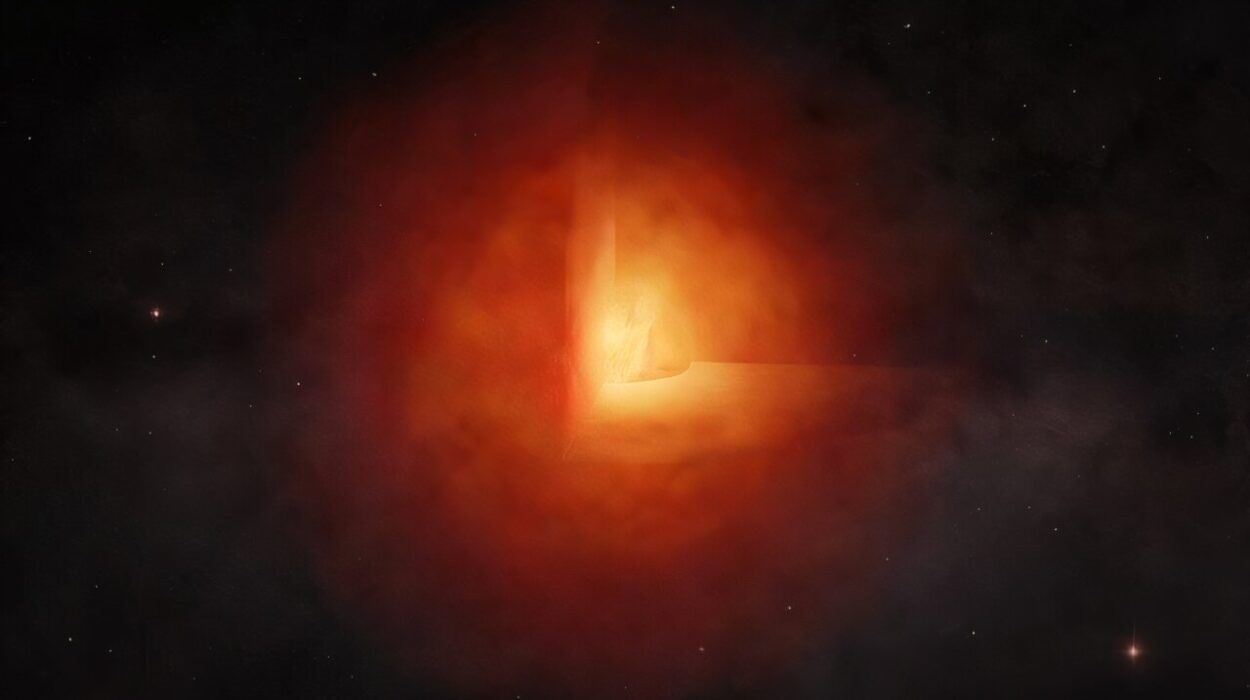
The gas that helps build giant planets does not disappear from young planetary systems in one uniform way. New James Webb Space Telescope observations of 72 young, sun-like stars show that strong magnetic winds dominate earlier stages, while atomic winds driven by stellar radiation become more important as the systems age and their disks thin.
Young stars are surrounded by disks of gas and dust from which planets form. But these disks gradually lose their gas, limiting the time available for planets to grow.
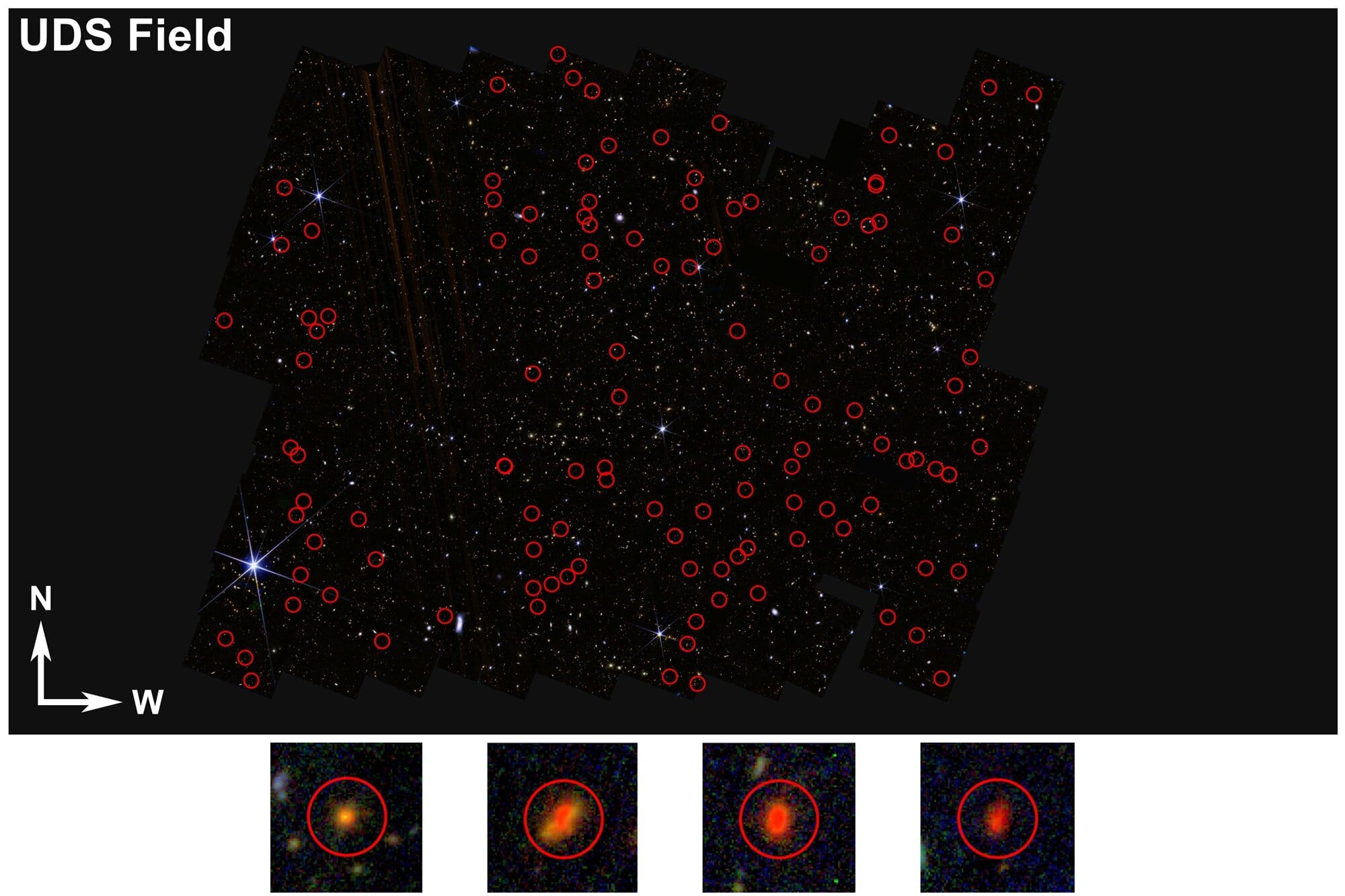
The new observations provide a way to trace that process across many young systems. Led by Naman Bajaj of the University of Arizona and co-authored by SETI Institute scientist Uma Gorti, the research examined archival observations from JWST’s Mid-Infrared Instrument, or MIRI.
The 72 systems represent different stages in the early development of planetary systems. Taken together, they allow researchers to compare how gas outflows change as the systems become older.
The researchers focused on two signatures of escaping gas: molecular hydrogen and ionized neon. JWST’s sensitivity allowed them to distinguish broad molecular hydrogen winds from the jets and winds associated with neon.
The observations found extended emission from molecular hydrogen and ionized neon in 66 of the 72 disks. Molecular hydrogen winds had conical shapes in 46 systems, while fast-moving neon jets appeared in 40. Every system with a neon jet also showed evidence of a wind traced by molecular hydrogen or oxygen.
Stronger magnetic outflows appear earlier
The younger systems in the sample are still actively sending material onto their stars. In these systems, the observations show strong jets along with broad winds containing both molecular and atomic gas.
These outflows are consistent with winds driven by magnetic fields in the disk. Gas can move along magnetic field lines away from the disk, carrying mass and angular momentum with it.
The results fit with predictions made in earlier work. In 2020, a team led by Ilaria Pascucci of the Lunar and Planetary Laboratory studied how jets and winds change during the early evolution of planetary systems. At the time, before JWST, molecular hydrogen could not be observed directly. The researchers had predicted that molecular winds should exist and could be strong enough at earlier ages to block X-ray photons.
The new JWST observations directly trace molecular hydrogen and confirm those predictions.
Radiation becomes more important as disks age
The pattern changes as the systems develop. When less material is falling onto the star, the jets become weaker and the winds become predominantly atomic.
At this stage, the material surrounding the star has become thin enough for high-energy radiation from the star to reach the disk. That radiation can heat the disk gas until it escapes, a process known as photoevaporation.
Gorti has studied the evolution and dispersal of protoplanetary disks, including the role of ultraviolet and X-ray radiation in driving photoevaporative winds. The new observations connect that work with direct observations of gas outflows across dozens of young systems.
The results indicate that disk dispersal is not controlled by a single process throughout a planetary system’s early development. Instead, the systems move from an earlier phase marked by strong, magnetically driven jets and winds toward a later phase in which atomic winds, including photoevaporative winds, become more important.
The timing matters for giant planets
The changing winds also determine how long the disk can supply gas to forming planets. The gas in these disks is the main material available for building the thick atmospheres of giant planets such as Jupiter and Saturn.
If the gas disappears too early, there may not be enough time for those atmospheres to develop.
“Planet formation is therefore a race against time,” Bajaj said. “Gas giants like Jupiter must assemble their massive atmospheres while the disk is still substantial enough to supply them, before winds and jets carry that raw material away into space.”
The researchers now want to determine how much gas these winds remove as the systems evolve and where within the disks the escaping material originates. Those measurements could help establish how quickly the gas available for planet formation is lost and where different kinds of planets can form before that gas is gone.
The new work follows an earlier JWST observation by Bajaj, Gorti and colleagues in 2024, which captured gas being carried away from the planet-forming disk around the young star T Cha. The newer study extends the investigation from one system to dozens, allowing the changing balance among jets, molecular winds and atomic winds to be examined across different stages of early planetary-system development.
The study was published in The Astronomical Journal.