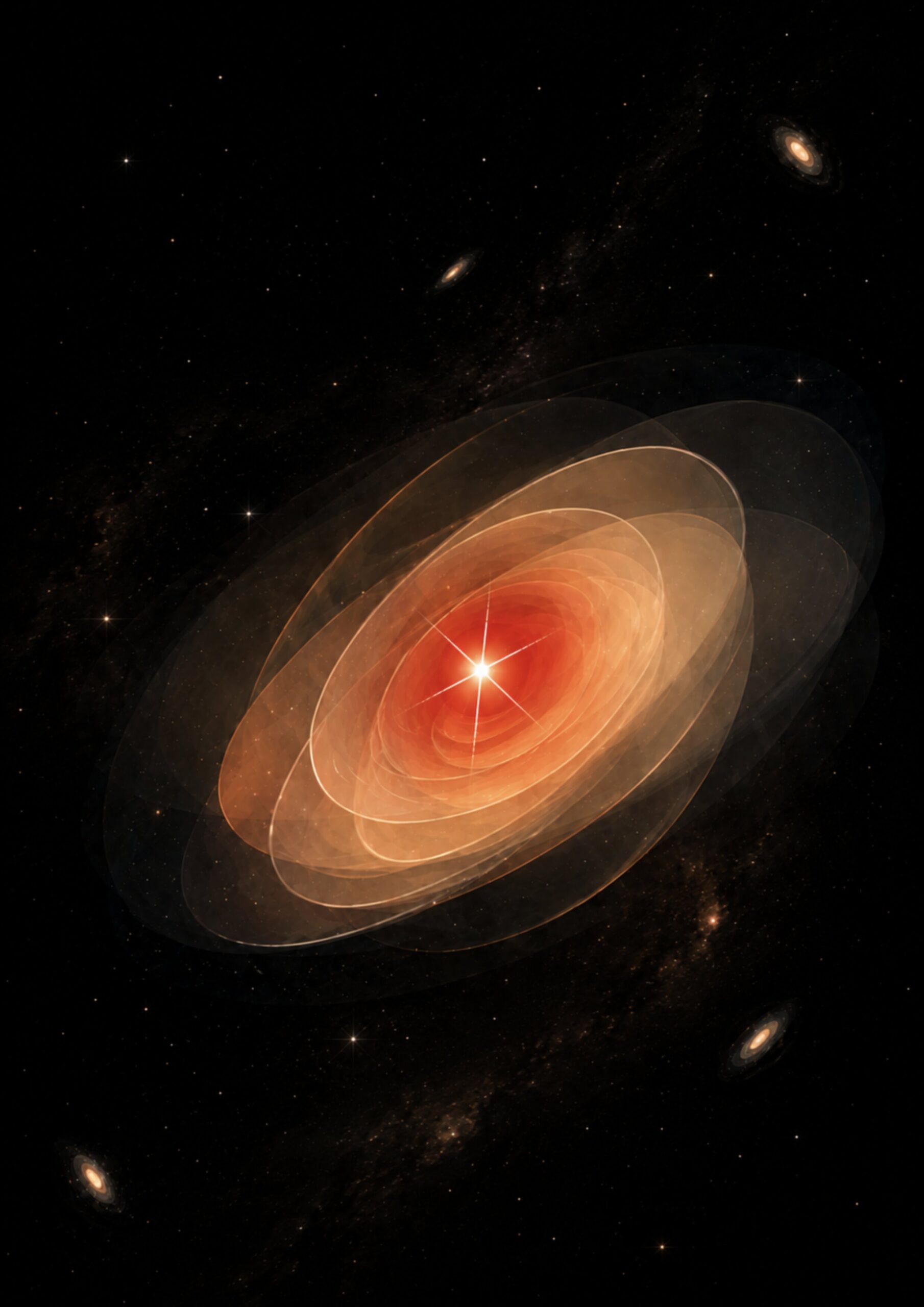
Little red dots, among the faint and puzzling objects seen in the distant universe, may be embedded in small, dense galaxies rather than existing as isolated points of light. New observations suggest these galaxies have total masses of about 1 billion Suns and that the little red dots sit at their centers.
Little red dots are small, red objects observed at great distances from Earth, but their nature and the source of their light are still uncertain.
Earlier observations found signs of material around some little red dots at ultraviolet wavelengths. That material may indicate the presence of galaxies. But there has been much less evidence of surrounding material in optical light, which provides a clearer view of stellar mass.
Xuheng Ding, Lilan Yang and their colleagues looked for that faint optical signal by combining James Webb Space Telescope images of 217 little red dots. When the images were analyzed together, the researchers detected extended emission beyond the central objects that was too faint to be clearly seen in individual images.
The galaxies appear unusually compact
The researchers modeled the combined data and found that the extended light is likely produced by star-forming galaxies. In this interpretation, the little red dots occupy the centers of those galaxies as supermassive black holes.
The galaxies have average radii of about 210 parsecs, or roughly 685 light-years. They are about 2.5 times more compact than other star-forming galaxies with similar masses observed during a comparable period in the universe’s history.
The estimated total masses of the galaxies are around 1 billion times the mass of the Sun.
The result describes the sample as a whole
The observations support the idea that little red dots are associated with compact star-forming galaxies rather than being simply isolated points of light. The researchers say this provides clues about how the objects developed during the first billion years after the Big Bang.
But the faintness of the surrounding emission limits what can be concluded about individual little red dots. The extended light could not be detected around most objects separately, so the results describe the average properties of the full sample.
The researchers say further work is needed to confirm the sample spectroscopically by analyzing the objects’ light and verifying their distances.
The study was published in Nature Astronomy.