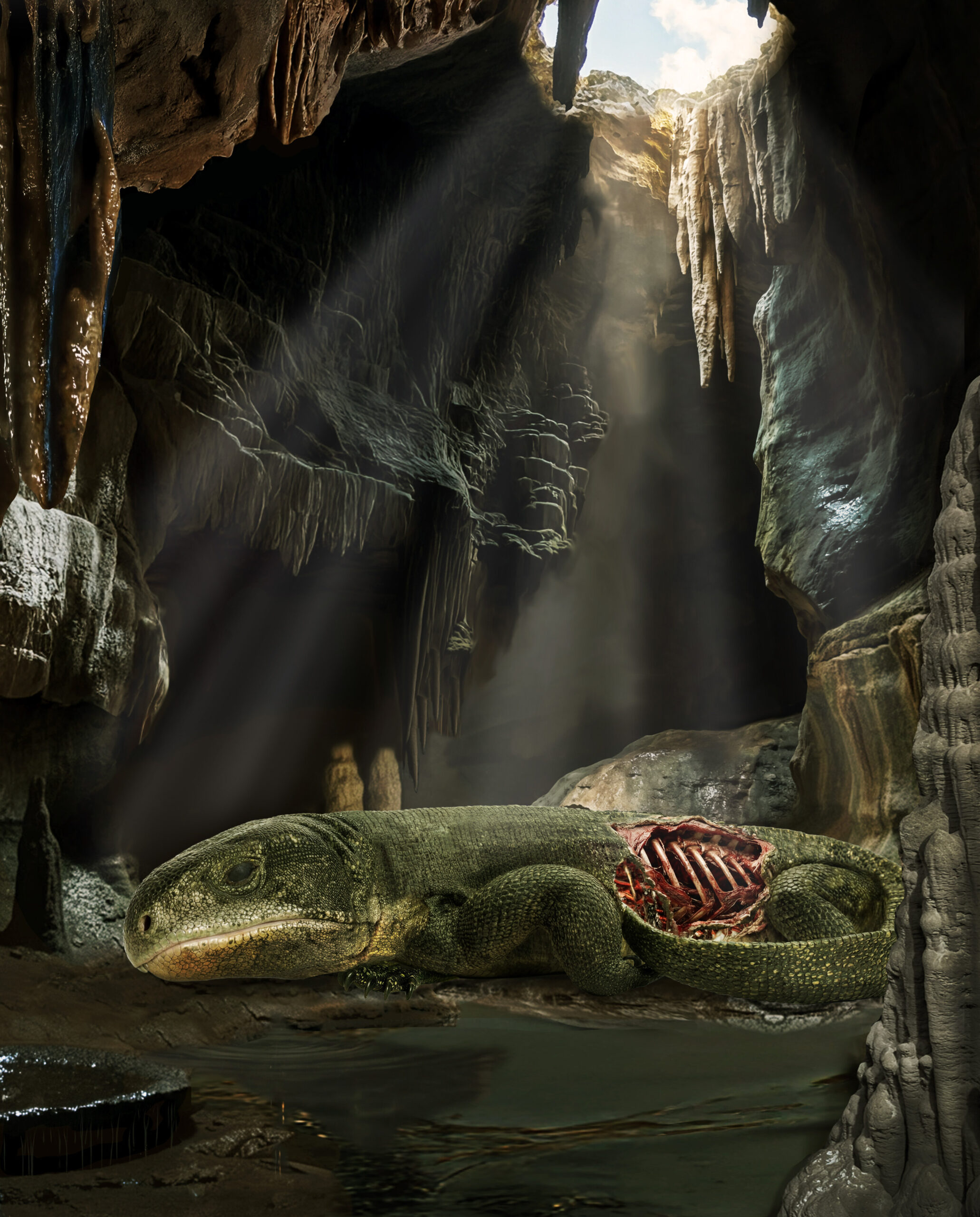
Long before the first dinosaur ever shook the earth with its stride, a small, unassuming creature lived among the damp crevices of what is now Oklahoma. This animal, known to science as Captorhinus aguti, was no giant; it was a lizard-like pioneer barely a few inches long, scurrying through the undergrowth of the early Permian period roughly 289 million years ago. While its size was modest, its contribution to the history of life was monumental. It held within its tiny frame a mechanical secret—an evolutionary “engine” that would eventually power every breath taken by the lions, eagles, and humans of the future.
For centuries, the transition of life from water to land was viewed through the lens of bone and tooth. But a remarkable discovery in a unique cave system near Richards Spur has changed that narrative. Here, a mummified fossil was found, frozen in a death pose with its arm tucked neatly beneath its body. Unlike the flattened, dusty skeletons usually pulled from the earth, this specimen was preserved in three dimensions, encased by the unique chemistry of oil-seep hydrocarbons and oxygen-free mud. This “time capsule” didn’t just save the bones; it trapped the very soft tissues of the creature, offering a glimpse into the internal machinery of a world nearly 300 million years old.
A Wrinkle in the Fabric of Time
The breakthrough began when researchers, led by Ethan Mooney and Professor Robert R. Reisz, turned to advanced technology to see what the naked eye could not. Using neutron computed tomography (nCT) at a specialized facility in Australia, they peered through the rock without ever touching the fragile remains. As the digital layers of stone were stripped away on the computer screen, a stunning image emerged. Wrapped around the torso of the animal was a delicate, textured layer of scaly skin.
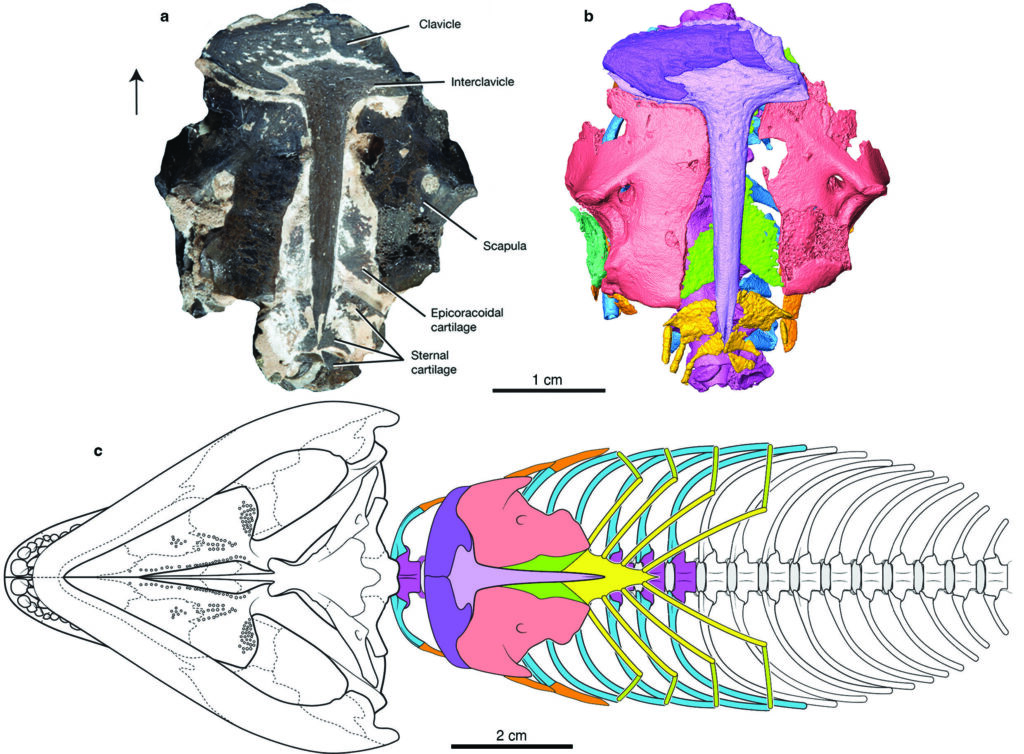
This wasn’t a mere impression in the mud. It was the skin itself, preserved with an accordion-like texture and concentric bands that stretched from the torso up to the neck. To the researchers, the pattern looked hauntingly familiar, resembling the scales found on modern worm lizards. This “mummified” state allowed the team to see the animal as it truly was: a living, breathing organism rather than a collection of mineralized parts. The skin was the first clue that they were looking at a masterfully preserved specimen, but the real treasure lay deeper, within the architecture of the chest.
The Mechanical Leap to the Land
To understand why this find is so significant, one must look at how life used to breathe. Before the rise of amniotes—the group that includes reptiles, birds, and mammals—the land was dominated by amphibians. These creatures were limited by their biology, relying on pumping air through their mouths and throats or absorbing oxygen through their moist skin. While functional, these methods were inefficient, restricting animals to slower, less active lifestyles.
The discovery of three Captorhinus specimens at Richards Spur revealed a radical departure from that ancient “gulping” method. By examining these fossils, the team identified a segmented cartilaginous sternum, sternal ribs, and intermediate ribs. They found the physical connections between the ribcage and the shoulder girdle, marking the first time in the fossil record that a complete breathing apparatus of an early amniote could be reconstructed.
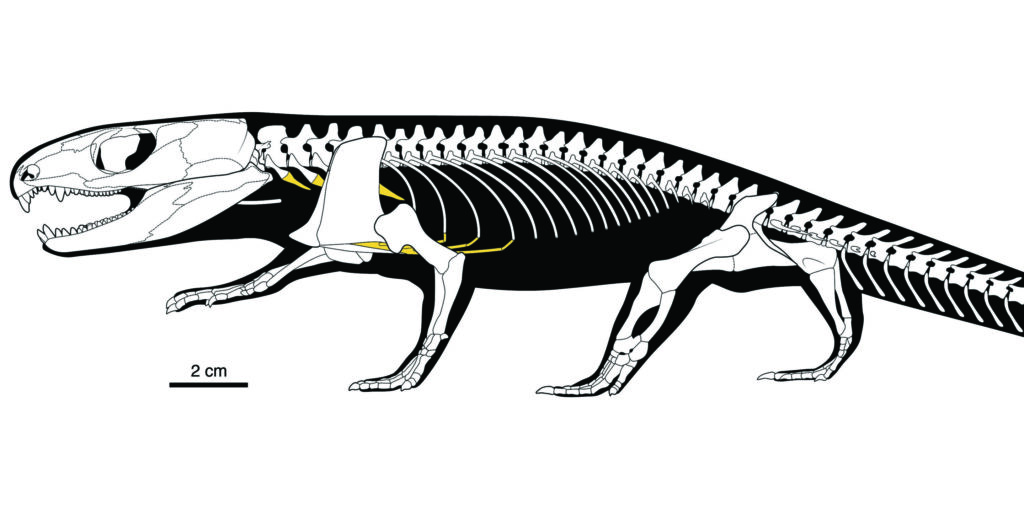
This was the birth of costal aspiration breathing. Instead of gulping air, Captorhinus used the muscles between its ribs to expand and compress its chest cavity. This movement created a vacuum that drew air deep into the lungs, allowing for a much more powerful exchange of oxygen and carbon dioxide. It was a “game-changer” in the truest sense, providing the high-octane fuel needed for a more active, terrestrial existence. It was this very innovation that allowed the ancestors of modern animals to finally turn their backs on the water and conquer the heart of the continents.
Ghostly Echoes in the Molecules
As if finding the oldest breathing system weren’t enough, the fossil held one final, microscopic surprise. The team utilized synchrotron infrared spectroscopy to analyze the chemical makeup of the remains. What they detected sent shockwaves through the scientific community: remnants of original proteins were still present within the bone, cartilage, and skin.
These are not just impressions of molecules, but the organic remnants of the animal itself. Finding such delicate biological material in fossils from the Paleozoic era is almost unheard of. In fact, these protein remnants predate the previous record-holder—a dinosaur fossil—by nearly 100 million years. This discovery has dramatically expanded the boundaries of what paleontologists thought was possible, proving that under the right conditions, the very “stuff” of life can endure for hundreds of millions of years.
Why This Ancient Breath Matters
The story of Captorhinus aguti is more than just a tale of a tiny lizard in a cave; it is the origin story of our own biology. This research matters because it identifies the ancestral condition for the rib-assisted respiration that keeps us alive today. By pinpointing when and how this system evolved, scientists can better understand the explosive diversification of early amniotes.
This evolutionary leap was the foundation for the dominance of vertebrates on land. Without the high-efficiency lungs enabled by the ribcage musculature found in this tiny creature, the massive dinosaurs, the soaring birds, and the active mammals of today might never have existed. The Captorhinus fossils, now housed at the Royal Ontario Museum, serve as a bridge across deep time. They remind us that the simple act of taking a breath is a gift from a small, scaly pioneer that figured out how to inhale the future nearly 289 million years ago.
Study Details
Robert Reisz, Mummified early Permian reptile reveals ancient amniote breathing apparatus, Nature (2026). DOI: 10.1038/s41586-026-10307-y. www.nature.com/articles/s41586-026-10307-y