Imagine a landscape far removed from the modern industrial silhouette of Saxony-Anhalt. Picture a sprawling, vibrant lake basin in Central Europe during the Last Interglacial period, some 125,000 years ago. This was a world of giants, where massive European straight-tusked elephants—beasts weighing more than ten tons—roamed the shorelines alongside herds of deer, cattle, and horses. In the midst of this abundance lived the Neanderthals, a population of resourceful hominids whose survival was traditionally thought to depend almost entirely on the risky, high-stakes hunting of these mega-mammals.
Yet, a new discovery at the Paleolithic site of Neumark-Nord suggests that these ancient people were looking at the world with a far more nuanced eye than we previously imagined. Among the remains of fallen titans, researchers have uncovered the modest fragments of the European pond turtle (Emys orbicularis). These small, shelled creatures are rewriting the story of Neanderthal ingenuity, revealing a side of their lives that involved careful craftsmanship, ecological flexibility, and perhaps even the playful or practical contributions of children.
A Curious Discovery Among the Giants
For years, the site of Neumark-Nord has been a goldmine for archaeologists, yielding well over 100,000 animal bones and fragments. The sheer scale of the findings paints a picture of a “fat factory,” where Neanderthals systematically extracted lipids and marrow from the bones of large prey. In a place where a single elephant could provide a mountain of meat and fat, the presence of a one-kilogram turtle seems like a statistical anomaly. Why would a hunter capable of taking down a ten-ton elephant bother with a tiny reptile?
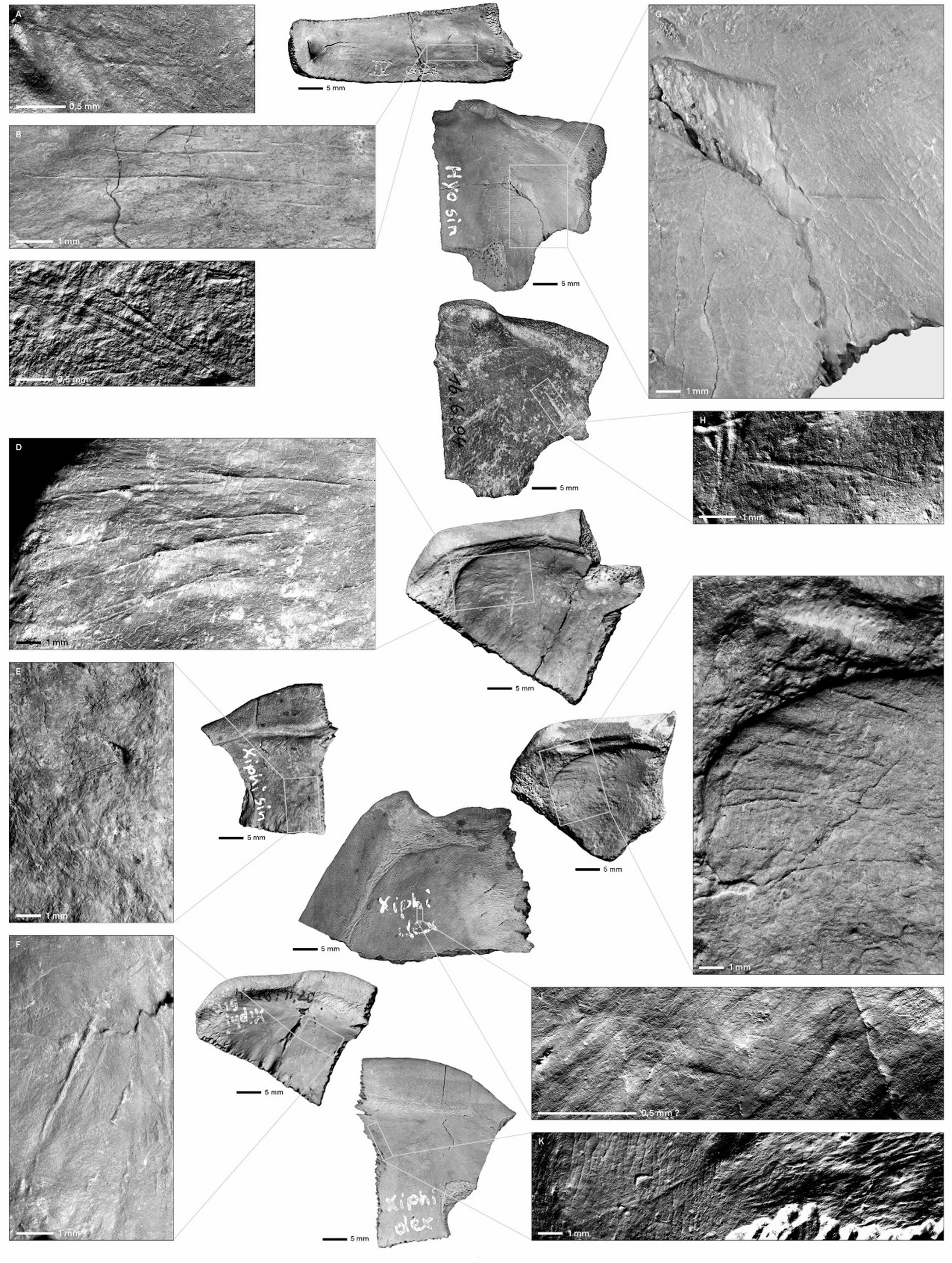
This was the question facing an international research team led by Professor Dr. Sabine Gaudzinski-Windheuser and her colleagues from Johannes Gutenberg University Mainz, Monrepos/Leiza, and Leiden University. By focusing on 92 fragments of turtle shell, the team began to see a pattern that went beyond simple opportunistic scavenging. Through the lens of high-resolution 3D scanning, the microscopic history of these shells began to emerge. The researchers found distinct cut marks located on the inner surfaces of the carapaces, indicating a level of precision that suggests the turtles weren’t just crushed or tossed into a fire. Instead, they were carefully butchered.
The Delicate Art of the Ancient Scraper
The evidence carved into the bone tells a story of systematic processing. Neanderthals used stone tools to detach the limbs and remove the internal organs of the European pond turtles. But it was the cleaning process that truly caught the researchers’ attention. The shells weren’t just emptied; they were thoroughly scrubbed and prepared. This level of effort suggests that the carapace—the upper shell—was the ultimate prize, rather than the meat inside.
Because Neumark-Nord was a site of caloric surplus, where food from massive herbivores was plentiful, the researchers believe we can virtually rule out the idea that these turtles were a primary food source. When you have enough elephant fat to feed a clan, a few ounces of turtle meat is hardly worth the effort of a precision cleaning. Instead, the team proposes that these shells were being repurposed. Once cleared of their inhabitants, the sturdy, bowl-shaped carapaces likely served as small containers or scoop-like implements. In a world before pottery or plastic, a durable, lightweight, and naturally waterproof vessel would have been a prized piece of technology.
Small Hands in a Wide World
One of the most humanizing aspects of this research is the theory of who might have been doing the hunting. While the “big game” hunters were likely focused on the dangerous task of trapping horses or elephants, the European pond turtle offered a different kind of opportunity. These reptiles are relatively easy to catch, making them the perfect target for the younger members of the group.
The researchers suggest that children may have been the primary hunters of these turtles. Engaging in the hunt allowed the youth to contribute to the community’s toolkit while learning the essential skills of observation and capture. This shifts our view of the Neanderthal camp from a group focused solely on the brutal struggle for calories to a community with a complex social structure where even the smallest members had a role to play. The turtles might have been a “starter prey,” teaching the next generation how to interact with their environment before they moved on to larger, more dangerous animals.
More Than Just a Meal
The discovery at Neumark-Nord also challenges our understanding of the Neanderthal diet and culture. While the shells were likely used as tools, there are other possibilities rooted in the study of later indigenous peoples. It is possible the turtles were sought out for their specific taste or even for an assumed medicinal value. This suggests a level of cultural complexity—a preference for certain flavors or a belief in the healing properties of nature—that we often fail to attribute to our ancient relatives.
This research provides the first concrete evidence that Neanderthals hunted and processed turtles north of the Alps. Previously, such behavior was mostly associated with the Mediterranean region, where turtles are more abundant. Finding this practice in the heart of Central Europe proves that Neanderthals were not just specialists in cold-weather survival or big-game hunting; they were ultimate generalists, capable of adapting their strategies to whatever the local ecosystem provided.
Why This Ancient Craft Matters
This research matters because it shatters the “brute” stereotype of the Neanderthal. By proving that they valued a one-kilogram turtle in a world of ten-ton elephants, scientists have shown that Neanderthal survival strategies went far beyond simple caloric maximization.
It reveals a people who possessed ecological flexibility, looking at a turtle and seeing not just a snack, but a potential tool, a medicine, or a teaching moment for their children. It shows us that they had the foresight to clean and reuse materials, creating a sustainable “plastic-free” toolkit from the world around them. Ultimately, these 125,000-year-old shell fragments serve as a reminder that the human story has always been about more than just finding enough to eat—it has always been about curiosity, innovation, and the clever repurposing of the world we inhabit.
Study Details
Sabine Gaudzinski-Windheuser et al, Shell game: Neanderthal use of the European pond turtle (Emys orbicularis) in the Last Interglacial landscape of Neumark-Nord (Germany), Scientific Reports (2026). DOI: 10.1038/s41598-026-42113-x