In the unforgiving expanse of Sudan’s Bayuda Desert, a region long overlooked by archaeologists, an extraordinary discovery has shed light on ancient burial practices, offering rare insights into a civilization that thrived over 3,500 years ago. A seemingly ordinary burial found at site BP937 has left researchers with more questions than answers, inviting us into a world of mystery and ritual long buried beneath the sands.
Dr. Monika Badura and her team of researchers, working as part of the “Prehistoric Communities of the Bayuda Desert” project, have uncovered a solitary grave that provides an intimate glimpse into the life and death of a man who lived during the early second millennium BC. Situated near the Marawi Dam in northern Sudan, the burial at BP937 has ignited a fresh wave of interest in the Bayuda Desert, a place that had been largely unexplored until the 21st century.
The Enigmatic Burial
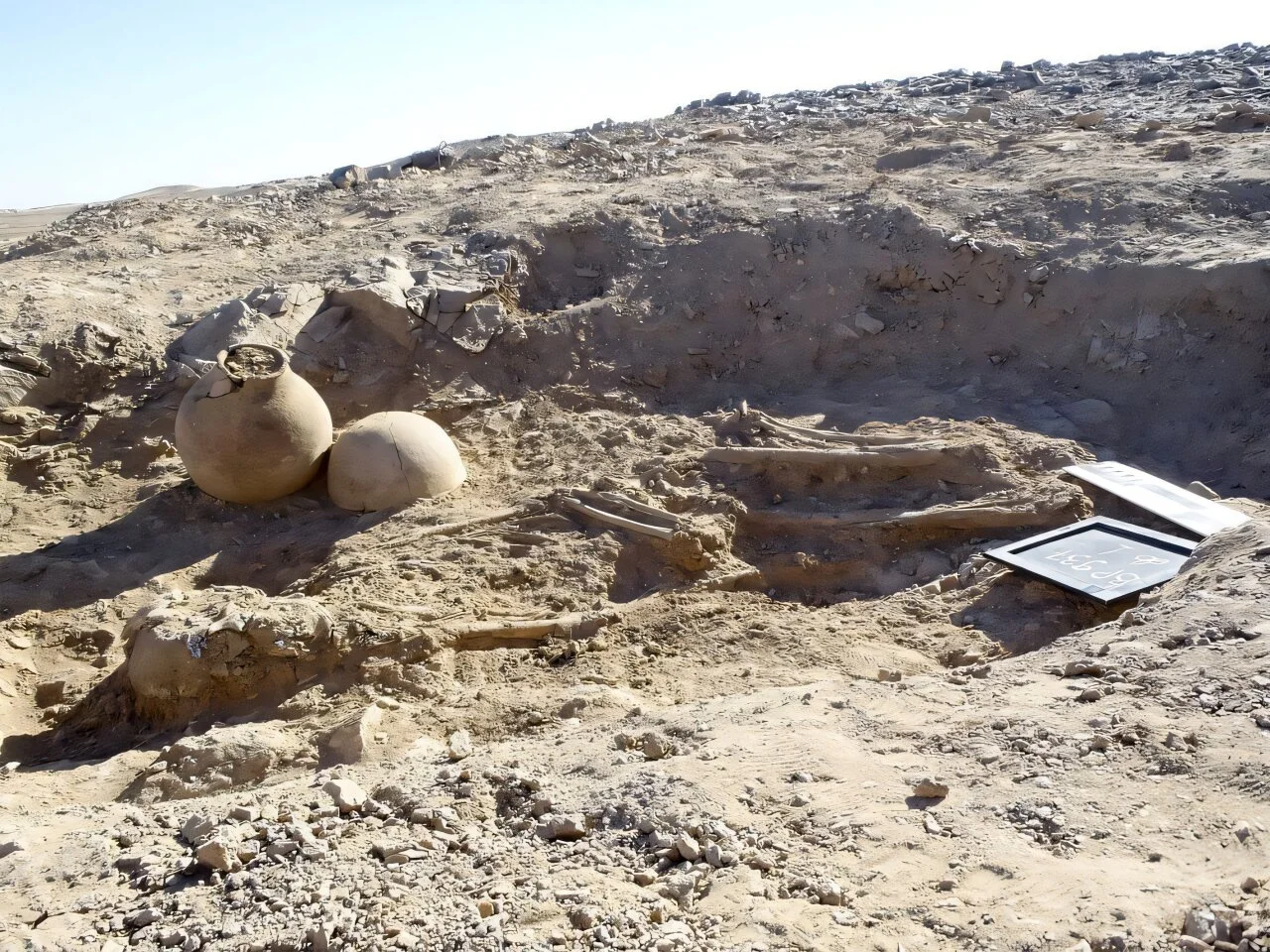
At first glance, the burial may seem unremarkable: the remains of a 30-40-year-old man, laid to rest with a few humble grave goods. Yet, as the team of researchers from the University of Wrocław and the Archaeological Museum in Gdańsk began their analysis, the burial began to reveal secrets about the man, his life, and his society that were anything but ordinary.
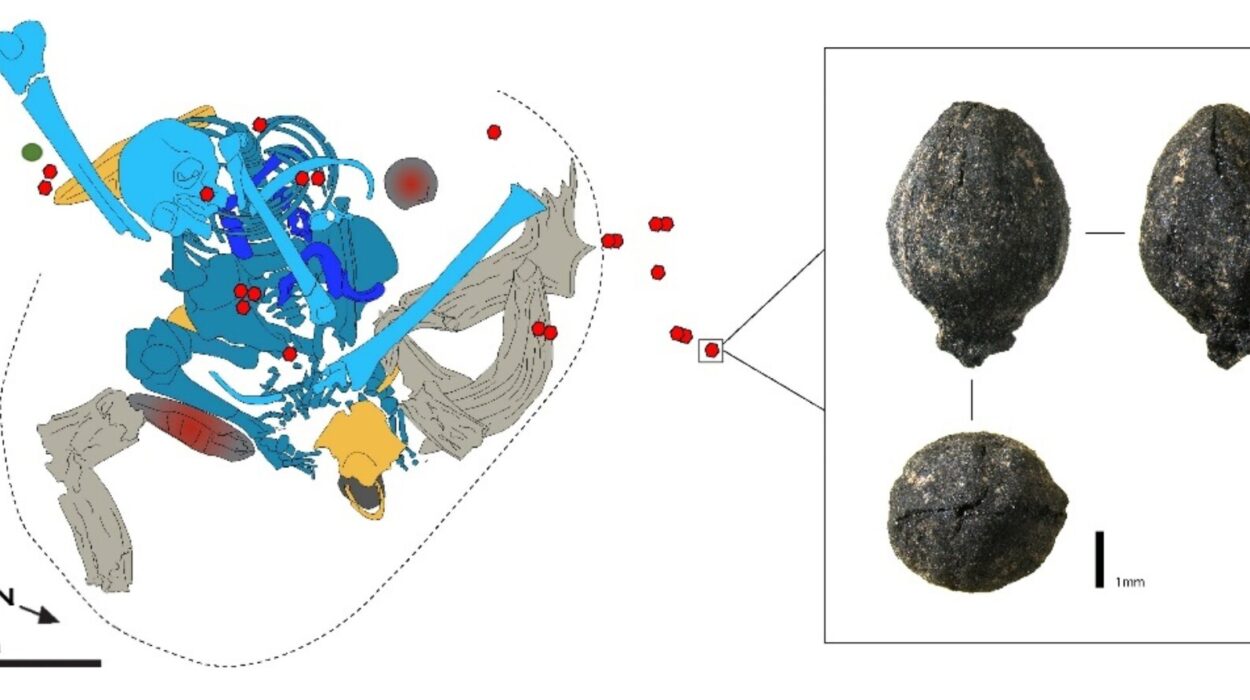
The man, estimated to have been around 164 cm (5 feet 4 inches) tall, was of robust build, his bones showing signs of hard physical labor. Flattened vertebrae and changes in his ankle bone indicated a life of strenuous work, perhaps in agriculture or construction. However, there were other, more troubling signs. Inflammation and thickening of the skull’s bone tissue suggested that he may have suffered from illness, nutritional deficiencies, or trauma. His death, though, was not without ceremony.
The burial included two clay vessels and a striking collection of 82 faience beads. These beads, found near his neck, are typical of the Kerma culture in Nubia, and their distinctive blue hue speaks to a far-reaching network of trade and cultural exchange during this period. But it is the items alongside these beads—the vessels—that set this burial apart as something truly unique.
The Mysterious Vessels
The first vessel found with the man was an upside-down bowl. Such bowls have been found in many Kerma burials, a symbol perhaps of the “emptying of life,” a ritual practice designed to ease the deceased’s transition from the world of the living to the realm of the ancestors. But it’s the second vessel that truly piques the curiosity of researchers. This jar, adorned with a faded black stripe, was unlike anything found in other Kerma contexts.
Inside the jar were the remains of a bonfire—charred animal bones, insect remains, and even coprolites, the fossilized remnants of human waste. Dr. Henryk Paner, one of the study’s authors, pointed out the rarity of this find: “To date, we do not know of a similar case related to the Kerma culture in the literature, and this is precisely what makes our discovery mysterious and even unusual.” This jar, likely part of a funeral feast or a ritual involving fire, opens the door to a practice that has never been documented elsewhere in Kerma burials.
A Ritual Lost to Time
The discovery of fire in the burial ritual is especially significant. Dr. Paner explains that fire’s role in Kerma culture burials has not been widely explored, making this find all the more important. Fire, often seen as a transformative force in ancient cultures, could have held symbolic meaning in the Kerma burial ceremonies. The idea that the man may have been laid to rest after a ritual that involved lighting a fire—perhaps in tribute to the dead or as part of a communal feast—adds a layer of complexity to the funeral rites of this ancient society.
As Dr. Paner elaborates, “The importance and use of fire in the burial rituals of the Kerma culture are not well documented or described. Therefore, we considered the case described in our article to be a relatively rare discovery of material evidence of a burial ceremony, where a ceremony associated with the lighting of a fire and likely a funeral feast of some kind was first held.”
The jar containing remains of a bonfire is not just a curiosity; it is a window into the spiritual and cultural practices of the time, hinting at ceremonies that blended both physical and symbolic elements of life and death.
The Clues to a Forgotten Environment
Beyond the human remains and ritual objects, the burial also provided valuable environmental clues that allowed the researchers to reconstruct the ancient landscape. Analysis of the charcoal from the jar revealed the presence of drought-resistant species like Acacia and Ziziphus, plants that may have thrived in the area at the time. The remains of seeds and grasses pointed to a once-thriving grassland environment, different from the arid desert we see today.
In an unexpected twist, the discovery of Cleonini beetles—known to feed on amaranth plants—indicates that the region may have once been more humid and biologically diverse than it is now. These tiny clues paint a picture of a far richer ecosystem in the distant past, one that supported both human and animal life.
While the evidence points to a once more vibrant and humid environment, the area surrounding the burial site is now a vast and desolate desert. This stark contrast between the ancient landscape and the present-day environment adds a haunting dimension to the discovery, reminding us of the passage of time and the changing climate.
A Glimpse Into the Past, and What Comes Next
As the team continues their research, more revelations are expected. Although the ongoing conflict in Sudan has made it difficult to carry out further excavations, Dr. Paner and his colleagues plan to conduct additional analyses of the materials recovered from the burial. There is still much to learn from the bones, the beads, and the mysterious contents of the jar.
What makes this discovery particularly compelling is not just the tangible objects found within the grave, but the stories they tell. This burial is not merely a static relic of the past, but an active participant in the long, unfolding narrative of human life and death. The vessel filled with fire and the faience beads are not just artifacts—they are symbols of a world we can only begin to imagine. As researchers continue to analyze the site, they may uncover even more pieces of a puzzle that connects us to an ancient people who lived and died in the shadows of the Nile.
Why This Research Matters
This discovery in the Bayuda Desert does more than fill in a blank in the archaeological record. It introduces new questions and perspectives about a civilization that left behind few written records, making every find that much more significant. Understanding the rituals, the environment, and the daily lives of people from this era helps us not only appreciate their world but also see the ways in which ancient societies were connected—through trade, culture, and shared rituals.
As Dr. Paner and his team continue to study the remains and artifacts, they open up a dialogue with a civilization that, until recently, was largely forgotten. The burial at BP937 is a reminder of the richness of human history, waiting to be uncovered, one artifact at a time. And as we continue to ask questions about this ancient people’s lives and practices, we uncover more about ourselves, and our enduring connection to the past.
More information: Monika Badura et al, A mysterious burial from the Kerma Culture (second millennium BC) in the Bayuda Desert of Sudan, Azania: Archaeological Research in Africa (2025). DOI: 10.1080/0067270x.2025.2586362