Deep in the heart of the cosmos, there exists a fascinating and rare phenomenon: a planetary nebula named PHR J1724-3859. Unlike the fiery explosions of supernovae or the quiet, steady glow of distant stars, planetary nebulae are the final breath of a dying star. They are expanding shells of gas and dust, expelled into space as a star transitions into a white dwarf or red giant. But PHR J1724-3859 stands out not just because of its beauty, but because it may hold the key to a much rarer discovery—a connection to an ancient star cluster.
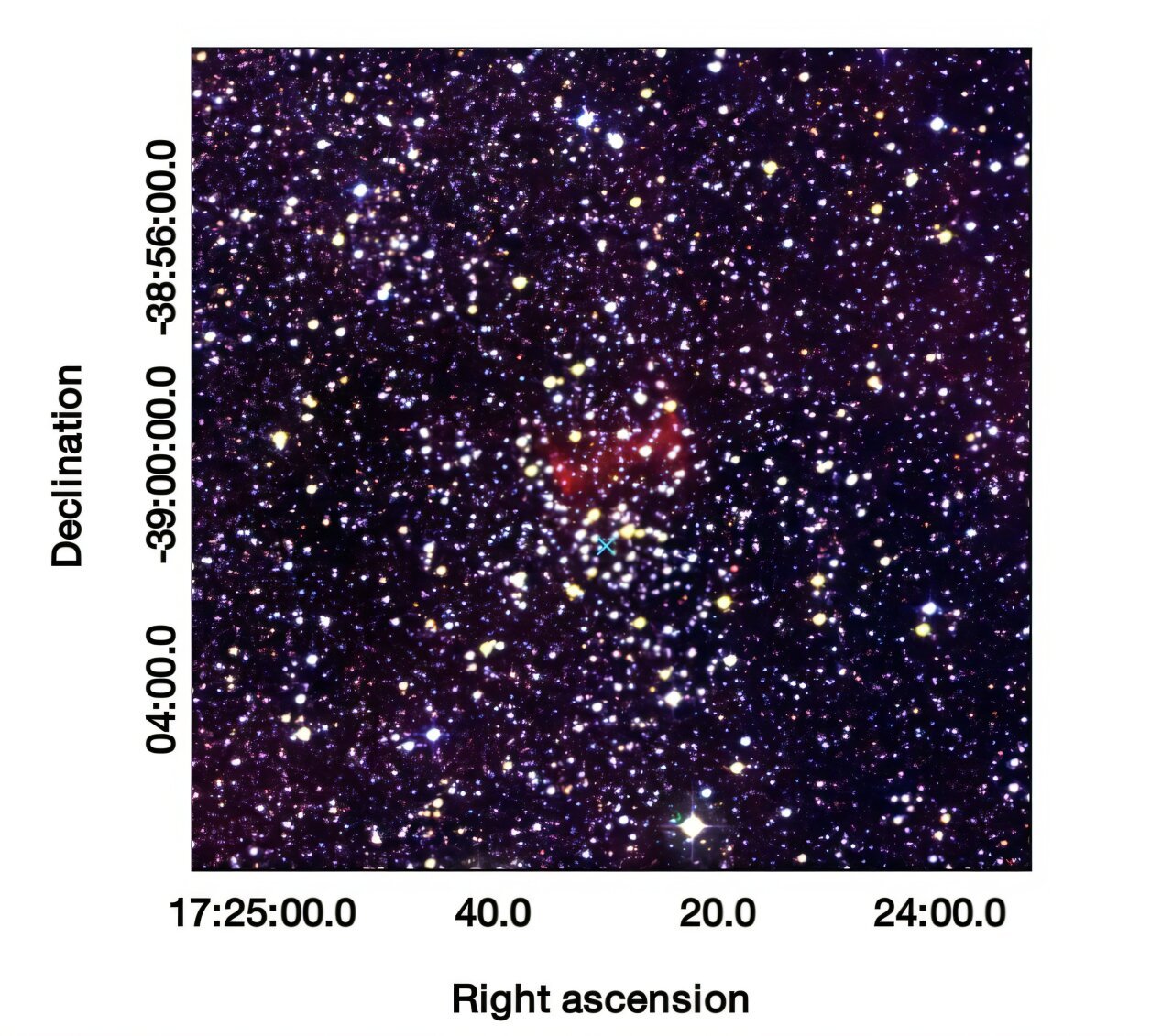
For years, astronomers have been intrigued by the idea that PHR J1724-3859 might be linked to the open star cluster known as Trumpler 25. This hypothesis had been floating around since the nebula’s initial discovery in 2005. However, verifying such a distant and tenuous relationship is no easy feat. To unlock the mystery, a team of astronomers led by Vasiliki Fragkou, from the Federal University of Rio de Janeiro, Brazil, embarked on a study using data from two powerful observational tools: the SuperCOSMOS Hα Survey (SHS) and the Gaia satellite. What they found, published on November 19, would not only confirm their suspicions but also expand our understanding of these celestial objects.
The Search for a Celestial Connection
PHR J1724-3859, a bipolar planetary nebula, is located about 7,200 light-years from Earth. It spans a massive 5.8 light-years in size, making it a particularly interesting subject for study. This nebula is characterized by its low surface brightness and high excitation, meaning it shines brightly in certain wavelengths, offering astronomers a rich source of data to analyze.
Previous observations hinted that PHR J1724-3859 might belong to Trumpler 25, an open star cluster roughly 7,800 light-years away from Earth. Open clusters are groups of stars that were formed from the same molecular cloud, meaning they share a common origin and are bound by gravity. If PHR J1724-3859 were indeed a member of this cluster, it would be an extremely rare example of a planetary nebula physically associated with a star cluster—something astronomers rarely see.
To explore this possibility, Fragkou and her team turned to the SHS and the Gaia satellite’s Data Release 3 (DR3) to compare the data. “Archival narrow-band imaging data (SHS), together with the latest Gaia DR3 cluster data were used for imaging and photometry,” the researchers wrote in their study. In simple terms, they combined detailed images and measurements from both sources to study the nebula and the star cluster more closely, comparing their properties.
Connecting the Dots: Evidence of a Cosmic Link
As they sifted through the data, a clear pattern began to emerge. The nebula’s mean systemic radial velocity was about -20.0 km/s, which was strikingly similar to Trumpler 25’s velocity of -25.5 km/s. In the cosmic sense, this proximity in speed suggested that both objects might be moving through space together.
But that wasn’t all. The study also revealed that both PHR J1724-3859 and Trumpler 25 shared a similar “reddening” value—0.92 for the nebula and 0.85 for the star cluster. This measure, known as interstellar reddening, refers to the way light from distant objects is scattered and absorbed by the dust and gas between us and them. Similar reddening values further hinted that PHR J1724-3859 might indeed be part of Trumpler 25, as they would both be experiencing the same amount of dust interference in the space between us.
The final piece of the puzzle came when the astronomers compared the positions of the nebula and the cluster. PHR J1724-3859 was found to be very close to the core of Trumpler 25, providing further evidence of a connection. The proximity of the nebula to the cluster, combined with these other factors, led the team to a groundbreaking conclusion: “PHR J1724-3859 is a highly probable member of Trumpler 25.”
What Does This Discovery Mean?
This discovery is more than just a confirmation of a distant cosmic link. It marks a rare addition to a small group of known open-cluster planetary nebula associations—celestial relationships that have puzzled astronomers for years. Only a handful of such connections have been observed, making this a significant contribution to the field of stellar evolution.
But what makes this nebula so compelling is its star. The study revealed that the progenitor of the central star of PHR J1724-3859 had a mass of around 5.12 solar masses—about five times the mass of our Sun. Now, however, that star has shrunk to a mere 0.95 solar masses. This transformation is the hallmark of stars at the end of their life cycle, shedding their outer layers to form the nebula while leaving behind a white dwarf at the core.
Further measurements showed that the nebula has an effective temperature of 250,000 K, which is incredibly hot, and an age of around 23,000 years. These figures are consistent with what we would expect from a planetary nebula at this stage of its evolution.
The Importance of Understanding Planetary Nebulae
Understanding planetary nebulae like PHR J1724-3859 is important for a number of reasons. They provide a snapshot of the end stages of stellar evolution, helping us better understand the life cycles of low-to-intermediate mass stars—those that make up the majority of stars in the universe. Moreover, by studying nebulae that are associated with star clusters, astronomers can learn more about how stars evolve in different environments and what role star clusters play in shaping the universe.
Planetary nebulae also contribute to the chemical evolution of galaxies. As stars expel their outer layers, they enrich the surrounding space with heavy elements, which are later incorporated into new stars, planets, and other celestial bodies. This process of recycling is crucial for the formation of complex structures in the universe, including life as we know it.
The discovery of PHR J1724-3859’s connection to Trumpler 25 also suggests that there may be other nebulae out there, waiting to be discovered, that share similar relationships with star clusters. Each new discovery helps us build a more complete picture of the universe, one where even the most distant stars and nebulae are part of an interconnected cosmic dance.
Why This Matters
This research matters because it helps us understand the universe in a deeper, more interconnected way. By revealing the relationship between a planetary nebula and a star cluster, scientists are not just mapping individual objects in space—they’re uncovering the broader cosmic processes that govern the life and death of stars. These findings enrich our knowledge of stellar evolution and provide critical insights into the formation and transformation of the building blocks of the universe. In the vastness of space, even the most subtle connections—like the one between PHR J1724-3859 and Trumpler 25—are part of the grand story of how our universe came to be.
More information: Vasiliki Fragkou et al, PHR~J1724-3859: A Bipolar Planetary Nebula in Open Cluster Trumpler 25, arXiv (2025). DOI: 10.48550/arxiv.2511.15115