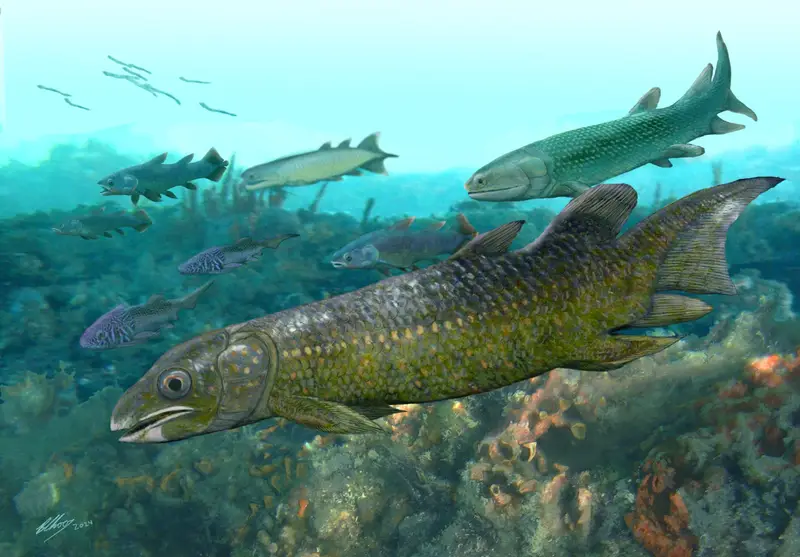
Over 400 million years ago, a world of strange, armored fish thrived in the warm, shallow seas that would one day become Australia. Among them swam the earliest relatives of land animals—lungfishes, creatures whose slow movements and peculiar anatomy hinted at the first steps toward life on land. Today, scientists are peeling back layers of time to uncover their secrets, revealing stories hidden in fossilized skulls and delicate inner ears, stories that have remained silent for nearly half a billion years.
In the far north of Western Australia, the Gogo Formation, a Devonian reef often called Australia’s first “Great Barrier Reef,” has long been a treasure trove of ancient life. The site has yielded some of the oldest and most complete lungfish fossils, including specimens so fragmented and mysterious that early researchers could hardly imagine what they held. One such specimen, collected over a decade ago, had puzzled paleontologists since its discovery in 2010. Some even speculated it might represent an entirely new kind of fish, never before seen in science.
Bringing Fossils to Life with Technology
Enter the modern era of paleontology. Using CT scanning and computed tomography, researchers at Flinders University have transformed what was once a confusing slab of rock into a vivid digital reconstruction of a prehistoric brain. Dr. Alice Clement, lead author on the study, explains that high-tech imaging allowed her team to see both the external and internal cranium in remarkable detail. Previous interpretations, she notes, had likely misread the fossil—its impressions once viewed upside down and backwards now revealed a complex and intricate brain cavity.
Co-author Hannah Thiele added her own careful touch, examining the inner ear of the lungfish and comparing it with other fossils from the Gogo reef. This single data point, she emphasizes, enriches the broader narrative of lungfish evolution, illustrating not just how these ancient fish lived, but how they were slowly developing the anatomical traits that would one day make tetrapods, the first land-dwelling vertebrates, possible. Each scan, each analysis, peels back another layer of mystery from a creature that existed in the oceans long before the first forests grew on land.
A Fish from Distant Seas
While Australia yielded one piece of the puzzle, another emerged from thousands of miles away in South China. Here, paleontologists uncovered the skull of Paleolophus yunnanensis, a lungfish that swam the seas of Yunnan some 410 million years ago. This species represents a fascinating snapshot of evolution: a moment between the earliest appearance of lungfishes and their later explosion into countless forms.
Dr. Brian Choo of Flinders University describes the find as “an unprecedented look at a lungfish from a time when the group was just beginning to develop the feeding adaptations that would define them for millions of years to come.” The skull reveals features both familiar and new when compared to other primitive lungfishes like Diabolepis in southern China, Uranolophus in Wyoming, and Australia’s own Dipnorhynchus. Each comparison highlights the rapid evolutionary diversification of lungfishes during the Devonian, a period when small anatomical tweaks could ripple across the tree of life.
Connecting Oceans and Continents
Together, these two discoveries—one from Australia and one from China—draw a remarkable picture of lungfish evolution. On one side of the ancient world, the Gogo reef preserves a snapshot of lungfish diversity in Gondwana, the supercontinent that included present-day Australia. On the other, Yunnan’s fossil seas record the early experiments of lungfishes in distant waters, highlighting patterns of growth, adaptation, and survival.
Through these fossils, researchers are tracing the story of a lineage that would bridge the gap between water and land. The lungs and fins of these Devonian fish, often overlooked in their murky habitats, were the precursors to the limbs of tetrapods. And as paleontologists refine digital images and explore subtle cranial features, they uncover not only what these creatures looked like but how they lived, sensed the world, and slowly prepared for life beyond the water.
Why These Discoveries Matter
At first glance, a fossilized lungfish might seem remote from our daily lives. But each skull, each scan, connects us to our deepest biological roots. Lungfishes are our closest living relatives in the water, and studying their ancient forms helps illuminate the very origins of life on land. By understanding the structures of Devonian lungfishes—how their skulls, brains, and inner ears functioned—scientists gain a clearer picture of the evolutionary innovations that eventually led to humans, amphibians, and all land vertebrates.
These discoveries also remind us that evolution is not a straight path but a web of experimentation, adaptation, and survival across oceans and continents. Every enigmatic fossil, from a crushed Australian specimen to a 410-million-year-old Chinese skull, is a portal into the past, a silent witness to the creativity of life as it unfolded. And with modern technology, researchers are finally able to listen—to see what these ancient fish have to tell us about the journey from sea to land, from fins to fingers, from prehistoric waters to the world we walk today.
Study Details
Hannah S. Thiele et al, DecipheringCainocara enigmafrom the Late Devonian Gogo Formation, Australia, Canadian Journal of Zoology (2026). DOI: 10.1139/cjz-2025-0109
Tuo Qiao et al, A new fossil fish sheds light on the rapid evolution of early lungfishes, Current Biology (2026). DOI: 10.1016/j.cub.2025.11.032