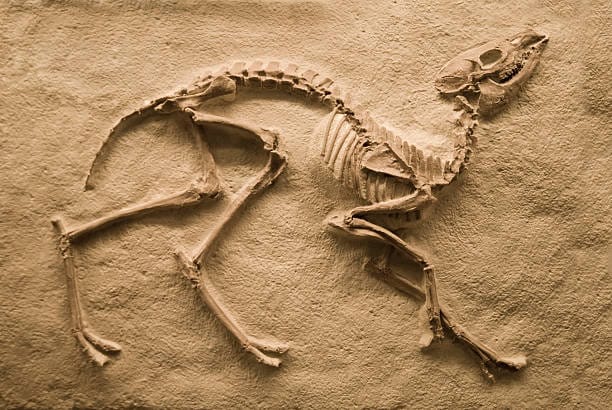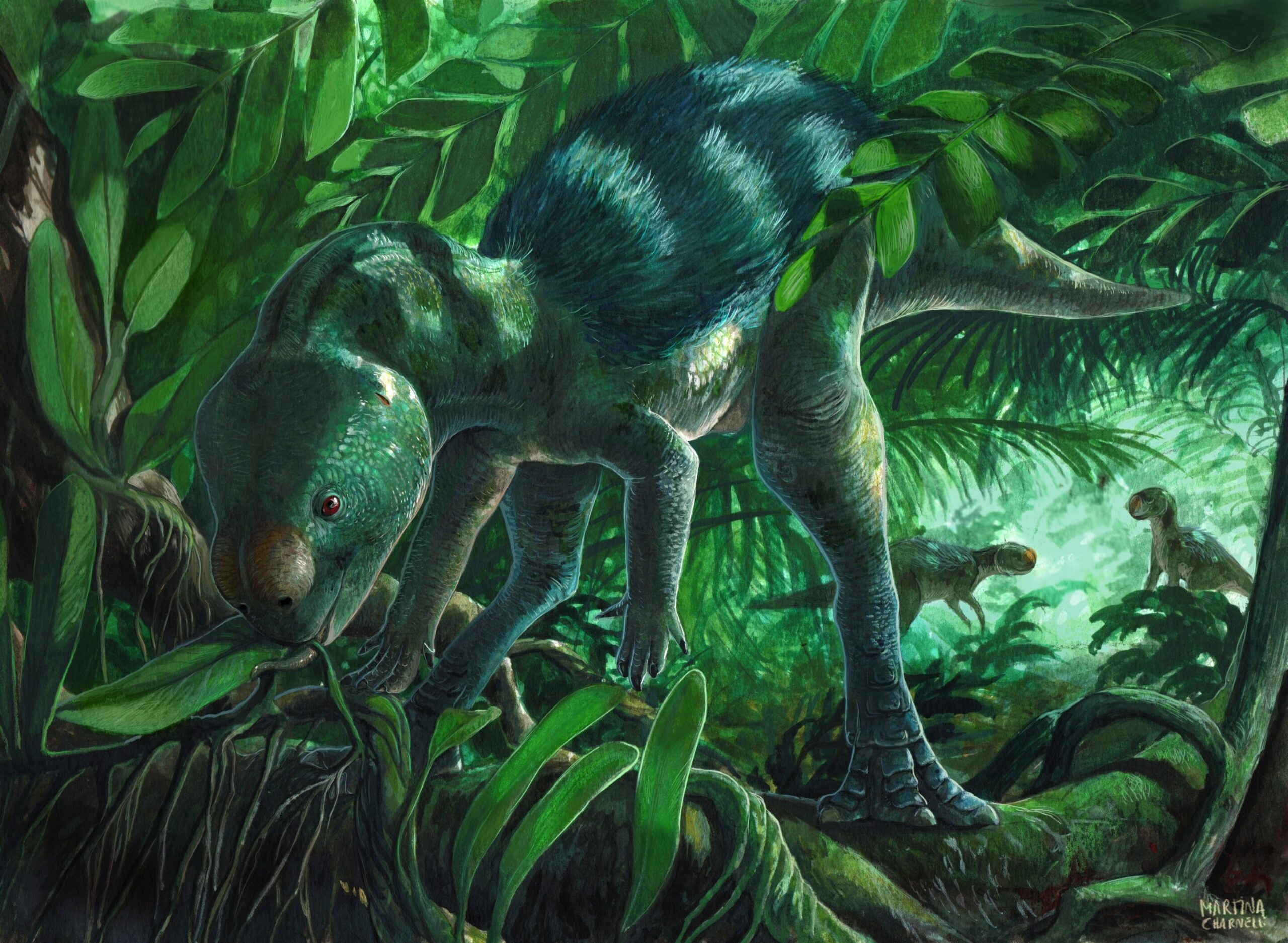
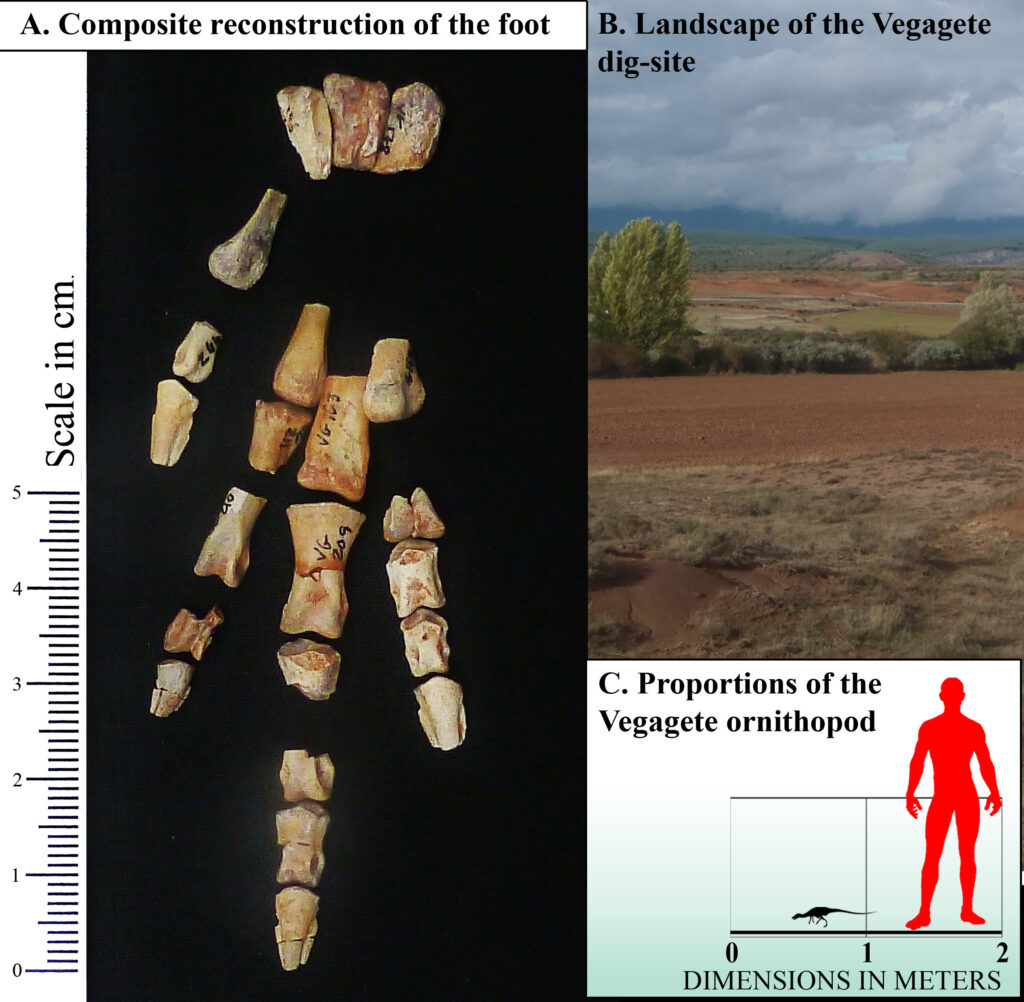
The bones were astonishing the moment they emerged from the rock. Not because they were massive or fearsome, but because they were almost unbelievably small. From a site called Vegagete in Burgos, Spain, palaeontologists found the remains of a dinosaur that, even fully grown, measured barely half a meter long. It was the kind of discovery that makes experts pause, squint, and ask whether their expectations have been quietly misleading them all along.
The dinosaur has now been named Foskeia pelendonum, and its story is far bigger than its body. Described by an international research team led by Paul-Emile Dieudonné of the National University of Río Negro in Argentina, Foskeia comes from the Early Cretaceous and belongs to the ornithopods, a group of plant-eating dinosaurs. The study, published in Papers in Palaeontology, reveals something startling: this tiny animal carried a skull that was not simple or primitive, but highly derived, packed with unexpected anatomical innovations.
Dieudonné recalls the shock of first encountering it. “From the very first moment anybody sees this animal, one is staggered by its extreme smallness,” he says. And yet, size turned out to be the least interesting thing about it.
Bones That Whispered Something Was Different
The fossils represent at least five individuals, all discovered by Fidel Torcida Fernández-Baldor of the Dinosaur Museum of Salas de los Infantes. Even before detailed analysis began, Torcida sensed that these remains were unusual. Their minute size was impressive enough, but what followed was more disruptive. As the bones were studied, they began to challenge long-held ideas about how certain dinosaurs evolved and spread.
What emerged from the stone was not a scaled-down version of something familiar. Foskeia was not a simplified echo of larger ornithopods. Instead, its skull told a stranger story, one filled with twists that did not fit neatly into existing evolutionary boxes.
The name Foskeia itself reflects this surprising nature. Drawn from ancient Greek, fos means “light,” a nod to the dinosaur’s lightweight, compact body, while skei, derived from boskein, means “foraging.” Together, they sketch the image of a small, agile plant-eater. The species name pelendonum honors the Pelendones, a Celtiberian tribe once living in regions near modern-day Burgos, Soria, and perhaps La Rioja, grounding this tiny dinosaur firmly in its geographic and cultural landscape.
A Skull That Refused to Be Simple
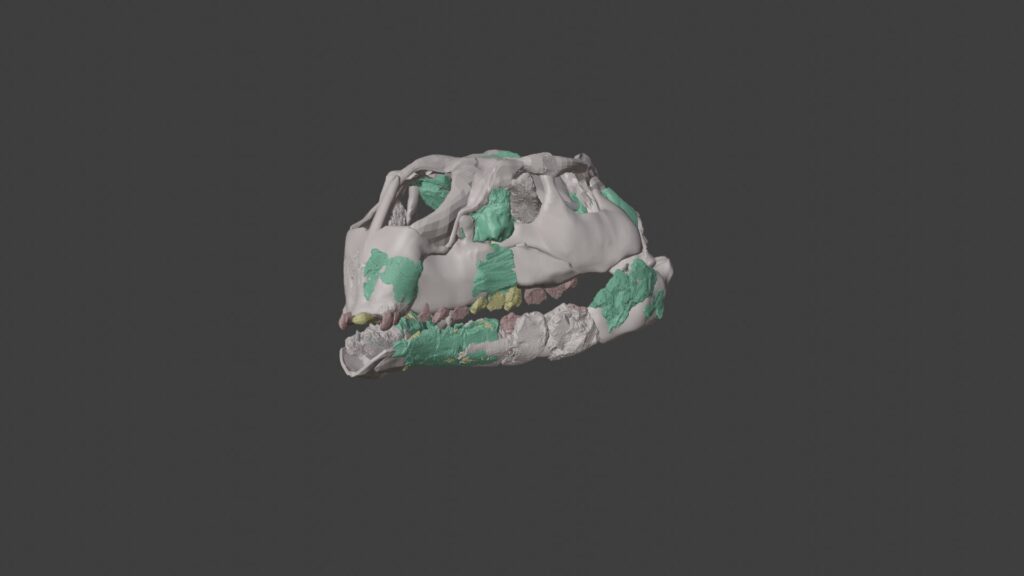
One of the most striking aspects of Foskeia is its head. In evolutionary terms, small size is often associated with simplicity, but Foskeia defies that pattern. Its cranium shows unexpected anatomical innovations, features that suggest a complex evolutionary history rather than a modest one.
Marcos Becerra of the Universidad Nacional de Córdoba emphasizes this point clearly. “Miniaturization did not imply evolutionary simplicity—this skull is weird and hyper-derived,” he says. The word “weird” here is not casual. In palaeontology, weird anatomy often signals that an animal is doing something evolutionarily important, occupying a position that can reshape how scientists understand relationships between species.
Other researchers echoed this sense of disruption. Táabata Zanesco Ferreira from the Universidade Federal do Rio de Janeiro stresses that Foskeia cannot be dismissed as a miniature version of a better-known dinosaur. “This is not a ‘mini Iguanodon,’ it is something fundamentally different,” she says. Foskeia stands on its own branch, not as a footnote but as a clue.
Growing Up Tiny, Living Fast
To understand whether this dinosaur was genuinely small or simply a juvenile, scientists turned to histological studies, examining the microscopic structure of its bones. These analyses were supervised by Dr. Koen Stein of Vrije Universiteit Brussel, and the results were decisive.
The largest specimen showed bone microstructures indicating that it was a sexually mature adult. This confirmed that Foskeia was not a baby of a larger species, but an adult that lived its entire life at this diminutive scale. Even more intriguing, the bone tissues suggested a metabolic regime approaching that of small mammals or birds, hinting at a lively, active lifestyle.
Stein explains why this matters. “Knowledge of growth and development is essential if we want to compare the anatomy of Foskeia with other species. Young individuals are prone to changes in anatomical features as they grow.” Without this confirmation, Foskeia’s odd skull might have been dismissed as a juvenile phase. Instead, it stands as a genuine evolutionary design.
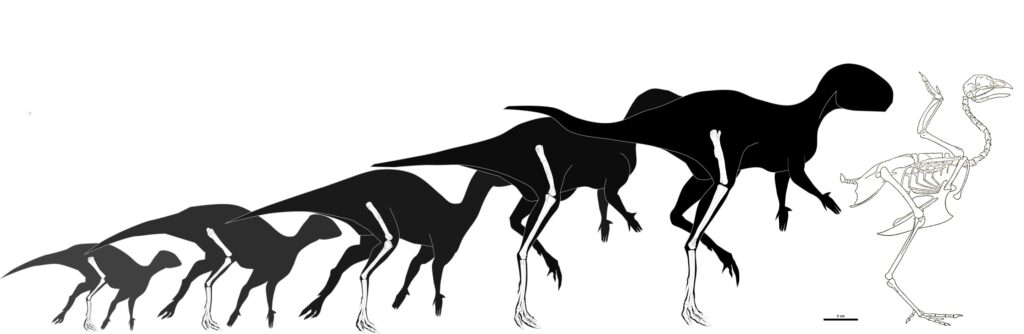
Growth trajectory of Foskeia pelendonum, compared to an adult chicken. This trajectory is based on differently sized bony elements and their histology. Note the proportionally smaller forelimbs in the more mature individuals. Credit: Dieudonné et al. 2026
Despite its size, Foskeia was no passive browser. Evidence from its anatomy suggests specialized dentition and a lifestyle that involved shifting posture during growth, likely relying on bursts of speed to navigate its environment. This was a dinosaur adapted to move quickly, perhaps darting through dense vegetation rather than towering above it.
Filling a Gap No One Expected to Be So Small
Beyond its anatomy, Foskeia carries weight because of where it sits on the dinosaur family tree. A new phylogenetic analysis places it as sister to the Australian Muttaburrasaurus within Rhabdodontomorpha, and it expands the European clade Rhabdodontia. In simpler terms, this tiny dinosaur helps anchor a broader evolutionary story that stretches across continents.
Thierry Tortosa of the Sainte Victoire Natural Reserve captures the importance of this placement. “Foskeia helps fill a 70-million-year gap, a small key that unlocks a vast missing chapter,” he says. That gap represents a long stretch of time in which the evolutionary history of certain herbivorous dinosaurs was poorly understood. Foskeia, despite its modest size, slots neatly into that missing space.
The analysis also revived a long-debated idea in dinosaur evolution: Phytodinosauria, a grouping in which plant-eating dinosaurs form a natural evolutionary unit. According to Dieudonné, “In our results, the plant-eating dinosaurs… form a natural group called Phytodinosauria.” He is careful to add that this hypothesis needs further testing, but Foskeia has already helped bring it back into serious discussion.
When Weird Anatomy Rewrites Trees
For Penélope Cruzado-Caballero of the Universidad de La Laguna, Foskeia’s importance lies in how precisely its strangeness reshapes scientific models. “Its anatomy is weird in precisely the kind of way that rewrites evolutionary trees,” she says. Evolutionary trees are not static diagrams; they change as new evidence emerges. Foskeia is one of those pieces of evidence that forces lines to be redrawn.
What makes this particularly striking is that such a revision comes not from a giant, headline-grabbing dinosaur, but from one so small it could easily have been overlooked. Its presence suggests that Europe’s herbivorous dinosaurs were experimenting with body plans and lifestyles in ways that scientists had not fully appreciated.
Dieudonné sums it up with a broader reflection. “These fossils prove that evolution experimented just as radically at small body sizes as at large ones,” he says. The message is clear: size does not limit evolutionary creativity.
Why This Tiny Dinosaur Changes the Big Picture
Foskeia pelendonum matters because it challenges a quiet assumption that has long shaped dinosaur research: that the most important evolutionary stories are written by the biggest animals. This tiny ornithopod shows that small-bodied dinosaurs can carry deeply informative, even revolutionary, traits.
By confirming that Foskeia was a mature adult with a complex skull and an energetic metabolism, the research underscores how misleading appearances can be. It also highlights the importance of careful growth studies, without which this dinosaur’s true nature might never have been recognized.
Perhaps most importantly, Foskeia reminds scientists to pay attention to what Dieudonné calls “the humble, the fragmentary, the small.” In doing so, it opens new paths for understanding how herbivorous dinosaurs evolved, diversified, and spread across ancient landscapes. Sometimes, the key to a vast missing chapter is not a giant skeleton, but a handful of tiny bones whispering a story that waited millions of years to be heard.
Study Details
Papers in Palaeontology (2026). DOI: 10.1002/spp2.70057