In a quiet laboratory at the University of Strathclyde, something extraordinary is taking shape. Not the kind of breakthrough that flashes across headlines in a single moment, but the kind that quietly redefines the boundaries of what science can achieve. Here, physicists and computer scientists are crafting mirrors that could withstand the searing intensity of the most powerful lasers ever built. But these aren’t ordinary mirrors; they are made from plasma, the same ionized gas that makes up more than 99.9% of the visible universe, and they promise to shrink optical technology from tons of fragile glass to something no bigger than a few millimeters.
High-power lasers have long been engines of ambition. They promise tools for healthcare, advanced manufacturing, and even nuclear fusion—dreams that once belonged to science fiction. Yet, building these tools has always come with a paradox: the more powerful the laser, the larger and heavier the mirrors need to be. Right now, mirrors that safely reflect extreme laser pulses stretch over one meter, and future designs could require ten meters or more, weighing tons and costing a fortune. In other words, progress has been shackled by the very physics these researchers are trying to harness.
The Promise of Plasma
This is where plasma enters the story. Unlike glass or metal, plasma is almost impervious to the destructive intensity of a laser. It can endure pulses that would shatter conventional optics in an instant. The challenge is not its survival, but its reflection. How can a layer of gas, swirling with charged particles, be shaped to reflect light efficiently and predictably? For decades, the problem seemed almost insurmountable—until a fresh approach bridged physics with artificial intelligence.
By combining machine learning algorithms with advanced computer simulations, the team has discovered a way to design these plasma mirrors in a fraction of the time traditional methods require. As Slav Ivanov, the study’s lead author, explains, a conventional design approach might iterate hundreds of thousands or even millions of times to produce a viable mirror. Each iteration demands prototypes, testing, and adjustments. Machine learning, however, can cut this process down to dozens of iterations, rapidly finding an optimal configuration.
A Mirror That Surprises Its Makers
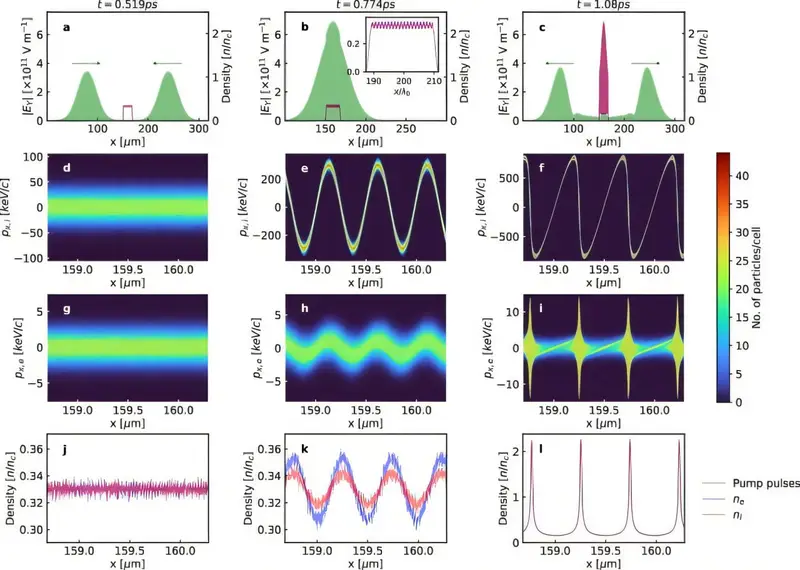
The results have not just been faster—they’ve been surprising. In one striking discovery, the plasma mirror did more than simply reflect a laser pulse. It compressed the pulse, shortening its duration in a way the researchers hadn’t anticipated. Professor Dino Jaroszynski recalls the moment of realization: the mirror’s plasma layers were acting like a concertina, folding and stretching to introduce new frequencies and subtly delaying parts of the pulse. This time-bound deformation created a natural compression effect, a phenomenon that could open doors to entirely new ways of controlling light.
The implications are staggering. By adjusting the design parameters, scientists can now imagine mirrors tailored to objectives that once seemed impossible. The plasma doesn’t just reflect; it shapes, manipulates, and even amplifies the behavior of light in ways we are only beginning to understand. The laboratory at Strathclyde has become more than a workshop for mirrors—it is a laboratory of discovery, where the act of building also reveals entirely new physics.
Shrinking Giants
Imagine reducing a mirror from ten meters to mere millimeters without sacrificing performance. This is no small feat. The potential impact stretches across industries and scientific fields. Smaller, lighter optics could revolutionize the design of high-power lasers, making them far more practical, portable, and affordable. Medical devices could become more precise, fusion research could accelerate, and manufacturing processes could leap forward in ways previously constrained by size and cost.
Yet, it is the combination of speed and creativity that truly excites the team. The machine learning framework does not merely optimize; it explores. By specifying objectives limited only by imagination, researchers can stumble upon mechanisms that would be nearly impossible to predict manually. The plasma mirror that compresses a pulse was one such serendipitous discovery—a reminder that in science, innovation often emerges at the intersection of careful planning and unexpected curiosity.
Why This Matters
At its core, this research is about breaking barriers. It shows that artificial intelligence can accelerate discovery not just by doing old things faster, but by enabling scientists to see phenomena they could not have foreseen. The plasma mirrors are not merely components of a machine—they are gateways to new physics, new technologies, and potentially, entirely new industries.
For the everyday observer, it may seem like an abstract feat: ionized gas reflecting light, lasers, and algorithms interacting in a lab. But in reality, this work is paving a path to a future where some of humanity’s most ambitious scientific dreams—fusion energy, precision medicine, and industrial innovation—are no longer constrained by the brute limitations of size and cost. The mirrors at Strathclyde are small, but the ideas they reflect are enormous.
The story of these plasma mirrors is a reminder that science thrives at the intersection of curiosity, imagination, and technology. By letting machines explore, we discover more than efficiency; we discover new worlds of possibility hidden in the physics we thought we already knew. And in the heart of this research, a simple truth shines: sometimes, the most profound discoveries come not from what we expect, but from what we dare to imagine.
Study Details
Ivanov, S. et al. Design of transient plasma photonic structure mirrors for high-power lasers using deep kernel Bayesian optimisation, Communications Physics (2026). DOI: 10.1038/s42005-026-02505-x. www.nature.com/articles/s42005-026-02505-x