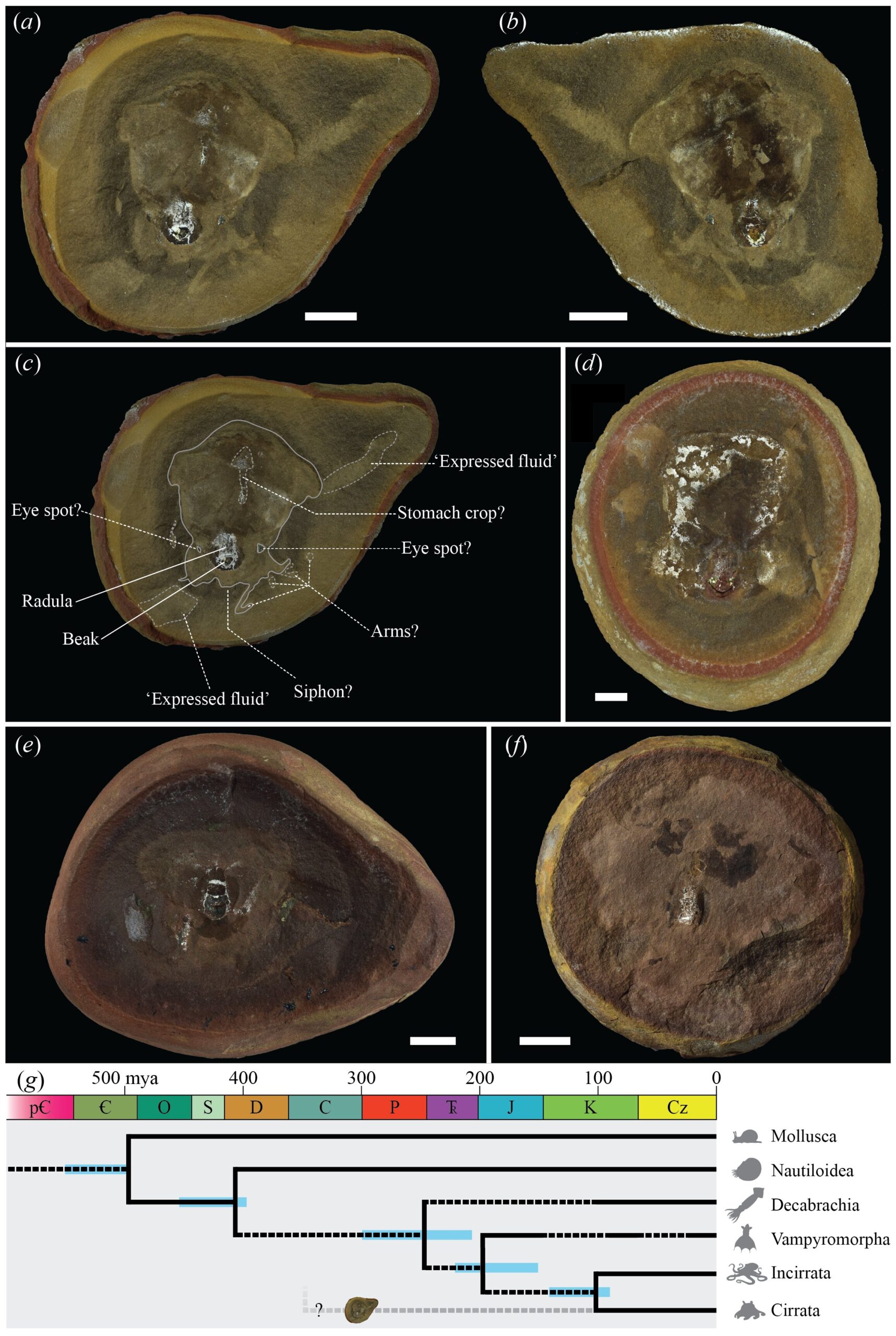
Imagine a creature frozen in a moment of time three centuries of millennia ago, its soft, boneless body pressed into the mud of what is now Illinois. For decades, this specimen, known to science as Pohlsepia mazonensis, held a prestigious title that most humans only dream of: it was a world record holder. Featured in the Guinness Book of Records as the world’s oldest octopus, this 300-million-year-old fossil was considered a foundational pillar in our understanding of marine evolution. It appeared to possess eight distinct arms and fins, suggesting that the clever, multi-armed cephalopods we know today had been patrolling the oceans for much longer than anyone had dared to guess. But as it turns out, this “octopus” was an impostor, a master of a deep-time masquerade that began with a slow, messy process of decay long before the first dinosaur ever walked the Earth.
The story of this fossil is a classic scientific “cold case.” While it was officially identified as an octopus twenty-five years ago, the classification always felt a bit like a puzzle piece forced into the wrong slot. The fossil pushed the history of octopuses back by an incredible 150 million years, creating a massive gap in the evolutionary timeline that scientists struggled to explain. For years, whispers of doubt circulated through the halls of paleontology, yet without the proper tools to peer inside the solid rock, the secret of Pohlsepia remained locked away. It took a team of modern forensic detectives and a light source brighter than the sun to finally crack the case and reveal that the world’s most famous octopus was actually something else entirely.
The Masquerade of a Rotting Stranger
The deception was not intentional, but rather the result of what happens to a body in the weeks after death. Before it was encased in stone, the animal had been decomposing for several weeks. During this period of rot, the creature’s anatomy began to shift and melt. Tissues that once held a specific shape softened and spread, eventually settling into a silhouette that looked convincingly like an eight-armed predator. When it was finally buried and fossilized at the Mazon Creek site, the distorted remains became a permanent biological lie. It looked so much like an octopus that the first researchers to describe it in the year 2000 were certain they had found the holy grail of cephalopod history.
To solve this 300-million-year-old mystery, researchers led by Dr. Thomas Clements from the University of Reading turned to synchrotron imaging. This cutting-edge technology uses high-energy beams of light to scan through the surface of the rock, revealing structures that are completely invisible to the naked eye. It was essentially a high-tech autopsy on a suspect that had been dead for geological eras. The team wasn’t looking for the obvious arms or the shape of the head; they were looking for the tiny, hard parts of the body that might have survived the decay process better than the soft skin.
Tiny Teeth and the Smoking Gun
Deep within the fossilized rock, the synchrotron light hit something significant. Hidden away from the human eye were tiny, fossilized teeth belonging to a radula—a ribbon-like feeding structure unique to mollusks. In the world of marine biology, the radula is as good as a fingerprint. By counting the number of teeth in each row, the scientists could finally identify the creature’s true lineage. They discovered that the specimen had at least 11 tooth-like elements per row. This single piece of data was the smoking gun that destroyed the “oldest octopus” theory.
A modern octopus typically has only seven or nine teeth per row. However, a group of animals known as nautiloids—ancestors and relatives of the modern Nautilus—possess 13 teeth. The tooth count in the fossil was a much closer match to the nautiloid family than to any octopus. Specifically, the teeth were an identical match for a fossil nautiloid called Paleocadmus pohli, a species already known to inhabit the same ancient Illinois waters. The “octopus” was actually a nautilus relative, a creature that would have possessed a hard external shell and many more tentacles than the eight attributed to it by previous researchers.
Rewriting the History of the Deep
This discovery does more than just correct a mistake in a record book; it fundamentally reshapes the timeline of life in the sea. By stripping Pohlsepia of its octopus title, the oldest evidence for octopuses has been pushed forward significantly. The data now suggests that octopuses actually appeared much later, likely during the Jurassic period. This aligns with the theory that the evolutionary split between octopuses and their ten-armed cousins, such as squids, occurred during the Mesozoic era. The 150-million-year ghost timeline that had confused scientists for decades has effectively vanished, replaced by a much clearer and more logical picture of how these intelligent creatures came to be.
Ironically, while the fossil lost its status as the world’s oldest octopus, it gained a new, equally impressive title. It now stands as the oldest evidence of nautiloid soft tissue preservation in the entire fossil record. By beating the previous record by roughly 220 million years, it provides a rare and precious look at the “fleshy” parts of an ancient nautilus relative, which are almost never preserved. We are seeing the remains of an animal that is often called a “living fossil” because its basic design has remained so successful for hundreds of millions of years.
Why This Ancient Identity Crisis Matters
This research serves as a powerful reminder that science is a self-correcting journey. The fact that a world-famous fossil could be misidentified for a quarter of a century isn’t a failure, but rather a testament to the importance of re-examining old “facts” with new technology. A few rows of hidden teeth, no larger than grains of sand, were enough to overturn decades of established wisdom. It proves that the fossil record is not a static book, but a dynamic archive that continues to reveal new secrets as our ability to “see” improves.
Understanding the true origin of octopuses is vital for mapping the history of intelligence and complexity in the oceans. When we know exactly when a group of animals branched off into their own lineage, we can better understand the environmental pressures that shaped them. This study clarifies that the rise of the octopus was a more recent event in Earth’s history, occurring alongside the age of the dinosaurs rather than in the deep, distant past of the Paleozoic. By correcting the record, scientists can now focus on the true ancestors of the octopus, ensuring that the story of life on Earth is told with the accuracy and clarity it deserves.
Study Details
Thomas Clements et al, Synchrotron data reveal nautiloid characters inPohlsepia mazonensis, refuting a Palaeozoic origin for octobrachians, Proceedings of the Royal Society B Biological Sciences (2026). DOI: 10.1098/rspb.2025.2369 , royalsocietypublishing.org/rsp … tiloid-characters-in