The ground in southern Bolivia carries a quiet kind of magic. At first glance it looks like ordinary sediment, cracked and sunburned under the Torotoro sky. But in a new study published in PLOS One, researchers reveal that this landscape is far more than an empty stretch of earth. It is a fossil archive so densely packed with dinosaur life that, as one scientist put it, “everywhere you look, the ground is covered in dinosaur tracks.”
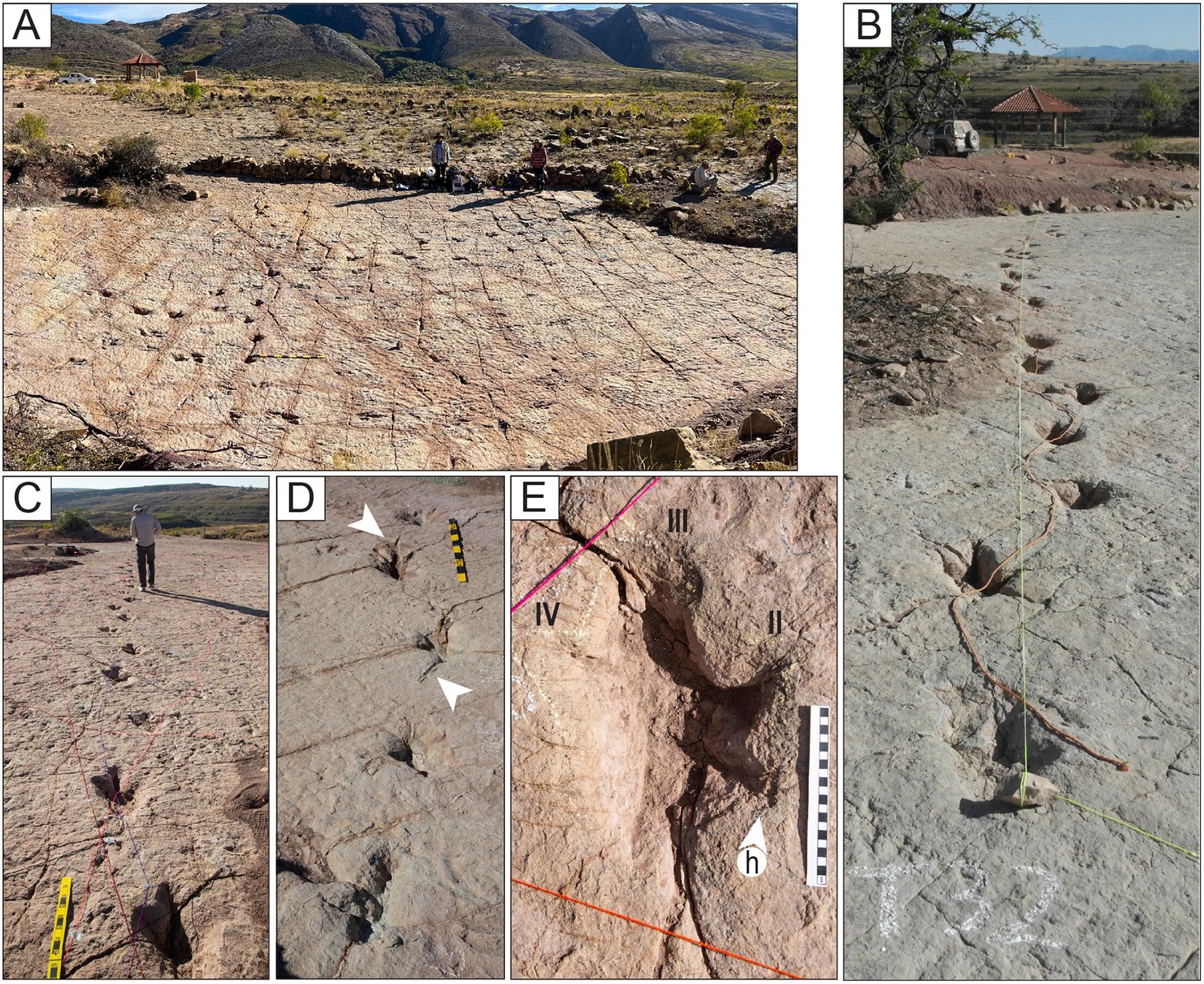
Led by Raúl Esperante of the Geoscience Research Institute in California, the team explored the Carreras Pampas tracksite, a place where ancient creatures left not just footprints but memories of how they lived, moved, and interacted with the world around them. The site had been known for its abundance of fossils, but much of it remained undescribed. Until now.
A Chorus of Footsteps Frozen in Time
Imagine a coastline at the end of the Cretaceous Period, the air heavy with humidity, the sand rippled by waves. Dinosaurs of all sizes walked, ran, and swam along this shifting boundary between land and water. Their feet pressed into soft sediment that hardened over millions of years, preserving their journeys with astonishing detail.
Across nine study sites within Carreras Pampas, Esperante and colleagues documented more than 16,000 tracks left by three-toed theropods. Some prints measure less than ten centimeters, hinting at the passage of small-footed individuals, while others exceed thirty centimeters, the mark of much larger predators. Together, they form a sprawling record of behaviors that once unfolded moment by moment.
These dinosaurs were not simply strolling in lazy circles. The tracks reveal running strides with long stretches between steps, sharp turns where bodies pivoted abruptly, and even delicate impressions suggesting that some animals swam while keeping only their toes in contact with the ground. One of the most surprising finds is tail dragging, a behavior rarely captured in fossil trackways. Each trace adds another layer to a picture that is both intimate and immense.
Where Footprints Become a Story of Many Lives
The orientation of the tracks tells its own tale. Many footprints run roughly northwest to southeast, pointing toward movement along the ancient shoreline. Ripple marks in the sediment confirm the presence of shallow coastal waters at the time, a place where dinosaurs likely gathered for food, safety, or migration.
The sheer density of tracks is unmatched. According to the researchers, the Carreras Pampas site now holds world records for the number of individual dinosaur footprints, continuous trackways, tail traces, and swimming traces documented in a single location. In scientific terms, this is an extraordinary concentration. In human terms, it is as if the ground remembers every step and refuses to forget.
The parallel orientation of some trackways even hints that groups of dinosaurs may have traveled together. While the study does not extend beyond the evidence preserved in stone, the alignment of steps invites the possibility of coordinated movement, the kind that transforms a collection of individuals into something more like a caravan.
The Researchers’ Awe at a Land of Stories
Even for scientists accustomed to working with fossils, Carreras Pampas is overwhelming in scale and significance. One of the authors reflects this sense of wonder in simple, vivid words that capture the experience of walking among the traces of vanished animals.
“This site is a stunning window into this area’s past—not just how many dinosaurs were moving through this area, but also what they were doing as they moved through.”
Those behaviors are etched into the ground with relentless clarity, creating a rare opportunity to study ancient motion directly rather than infer it from bones alone. And for researchers on the ground, the emotional impact of that realization is unmistakable.
“It’s amazing working at this site, because everywhere you look, the ground is covered in dinosaur tracks.”
This sense of immersion in deep time is not just poetic. It is scientifically valuable, giving researchers the ability to analyze entire networks of movement rather than isolated prints. Where most fossil sites offer a few scattered clues, Carreras Pampas offers a symphony.
Why These Ancient Steps Matter Today
The extraordinary richness of the Carreras Pampas fossil site does more than rewrite records. It expands the way scientists understand dinosaur behavior in the final chapter of the Cretaceous. Trackways hold clues about speed, gait, group movement, and the environments dinosaurs relied upon. They can reveal how animals interacted with shifting coastlines, how they navigated soft or wet ground, and how behaviors like swimming or tail dragging fit into their daily survival.
Most importantly, this study highlights how much remains hidden in Bolivia’s fossil-rich landscapes. Many sites remain unpublished or unstudied, meaning that discoveries on the scale of Carreras Pampas may still lie waiting beneath the soil. Each new track uncovered offers another glimpse into ecosystems long vanished but not forgotten.
By documenting more than sixteen thousand tracks and identifying behaviors with exceptional clarity, Esperante and colleagues have transformed a patch of ancient shoreline into one of the most vivid behavioral archives of dinosaur life anywhere in the world. Their work reminds us that science is not just about extracting data. It is about learning to listen to the ground beneath our feet, where entire histories still whisper through the stone.
More information: Morphotypes, preservation, and taphonomy of dinosaur footprints, tail traces, and swim tracks in the largest tracksite in the world: Carreras Pampa (Upper Cretaceous), Torotoro National Park, Bolivia, PLOS One (2025). DOI: 10.1371/journal.pone.0335973