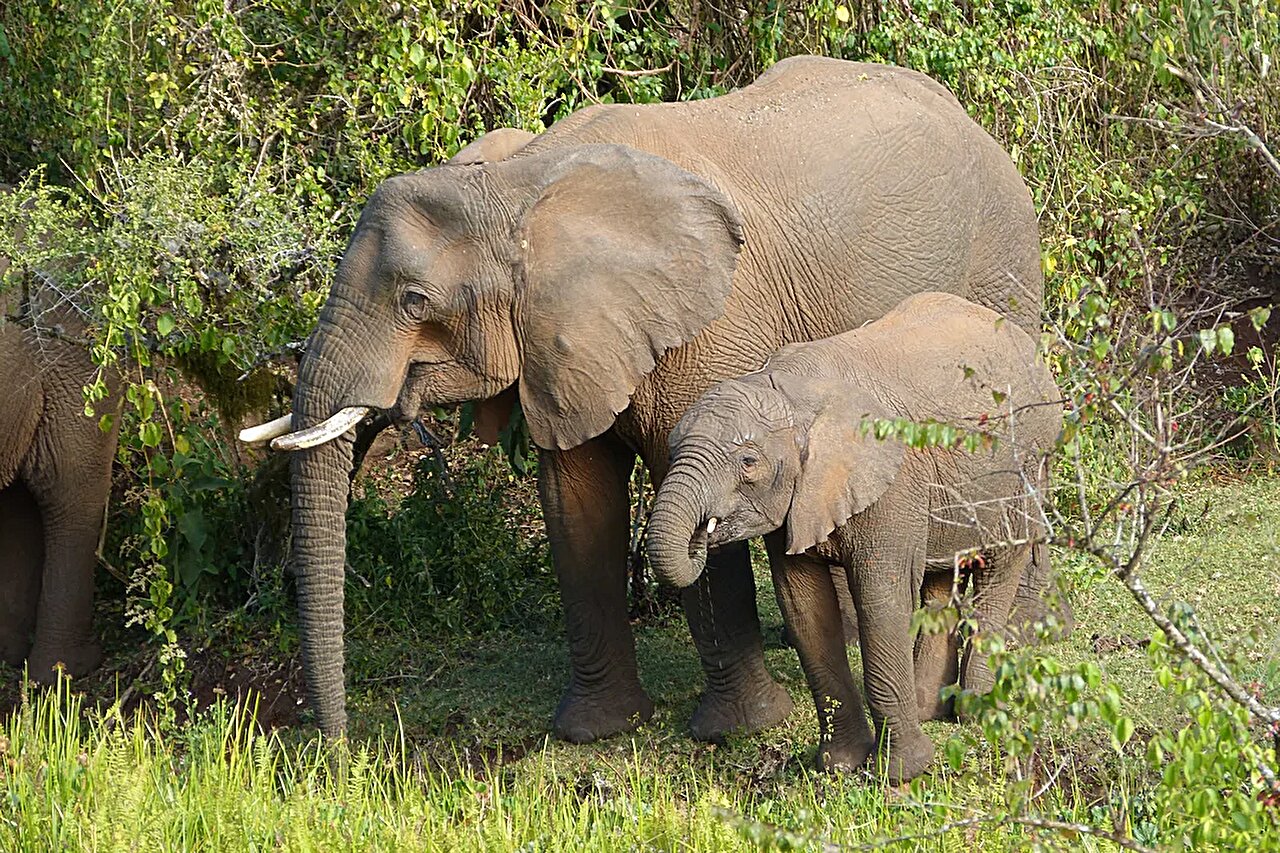
On the slopes of Mount Elgon in Kenya, elephants have been seen doing more than simply browsing for food. Local guides, wildlife scouts and elders describe animals selectively taking particular plants when they appear sick, while mothers have been reported mixing some plants with their milk and giving them to calves. A new study documents these accounts as evidence that African elephants may deliberately seek out plants for medicinal purposes, although the researchers stress that the observations do not yet establish that the plants actually treat disease.
The evidence comes from eight members of the Sabaot Indigenous community who have spent decades around the elephants of Mount Elgon. The group included two guides, two local elders, including a retired agricultural officer and a former Kenya Wildlife Service ranger, and four wildlife community scouts. All had more than 20 years of experience observing elephants in the region. The interviews were conducted between October 2023 and September 2024 across seven locations covering an estimated 344.9 square kilometers.
The researchers used semi-structured interviews to ask about plants elephants eat, whether any appeared to be used medicinally, what made the observers think that, whether elephants targeted particular plants when sick, and whether the animals might learn such behavior. The interviews also covered the clay and mineral deposits that elephants consume in Mount Elgon’s extensive cave systems.
The study was prompted by earlier anecdotal reports of elephants using plants as possible remedies and mining mineral-rich clay from caves. Rather than treating every unusual feeding event as evidence of medication, the researchers developed criteria for separating different levels of evidence.
That distinction is important because simply eating a plant that humans consider medicinal does not demonstrate that an elephant is using it as medicine. An elephant might consume the plant normally as part of its diet, or it might obtain some health benefit without deliberately seeking it for that reason.
The researchers therefore classified the reported behaviors into different modes of animal medication. Mode 3 described plants regarded by informants as medicinal for elephants when no particular illness or health state was identified. Mode 4 required an account in which an elephant was reported to target a resource for the perceived treatment of a specific health condition, or to administer it to another elephant for healthcare. A separate Mode 4(!) category was used when elephants were said to use a medicinal plant while sick but the specific illness was not identified.
Thirty-five plant species entered the picture
Across the interviews, the observers identified 35 plant species belonging to 23 families, along with four types of soil, mineral or clay resources. The researchers collected plant material with guidance from local informants, prepared herbarium specimens and had the plants identified by experienced taxonomists.
The 39 resources did not all receive the same interpretation. Informants described 25, or 64.1 percent, as having a medicinal function for elephants. All 25 were plants and all had local ethnomedicinal uses. Another 10 plants were classified as Mode 3, seven as Mode 4(!), and eight as Mode 4. Twelve resources could not be classified because there was not enough information, while two substrates were specifically identified by informants as non-medicinal for elephants.
The researchers also recorded the frequency with which each resource was mentioned. Because only eight expert informants took part, the resulting relative frequency of citation values were used descriptively rather than as measures of broader cultural importance.
The plants came from a wide range of families. Asteraceae, Malvaceae and Solanaceae each contributed four species, while Oleaceae, Rutaceae and Urticaceae each contributed two. Leaves and bark were the most commonly cited plant parts, with each mentioned for 15 species, followed by roots, which were mentioned for 11.
But the most striking evidence was not simply the number of plants. It was the unusual ways some elephants were reported to use them.
Mothers were reported giving plants to their calves
Eight species met the study’s criteria for Mode 4. They were Aloe arborescens, Bersama abyssinica, Coleus barbatus, Dombeya burgessiae, Dombeya rotundifolia, Dombeya torrida subsp. torrida, Ficus natalensis and Kuloa usambarensis.
Several of the accounts involved mothers and calves.
Female elephants were reportedly observed giving Aloe arborescens to calves to increase their appetite. In other accounts, mothers mixed Coleus barbatus, Ficus natalensis and Bersama abyssinica with their milk before feeding the mixture to their calves. The participants described this behavior as a kind of “immunization” for the young elephants.
The researchers classified five of the reported resources as involving allocare, meaning that one elephant was providing a resource to another for its perceived healthcare benefit. Four of these resources were among the Mode 4 cases, and the reported allocare involved mothers and calves.
These reports are particularly different from a simple case of an elephant choosing something unusual to eat. In the accounts described by the informants, the plant was reportedly incorporated into a particular behavior involving another animal and, in some cases, a specific preparation method.
The researchers nevertheless describe these as putative medicinal behaviors. The study did not experimentally determine that the plants function as medicines, nor did it establish that elephants understand their pharmacological effects.
Some plants were linked to specific signs of illness
Three Dombeya species, D. burgessiae, D. rotundifolia and D. torrida subsp. torrida, were reportedly used to aid digestion and soften droppings. The plant material involved the cambium, the slippery tissue between the bark and stem.
Another plant, Kuloa usambarensis, was associated with elephants displaying visible signs of sickness, including lethargy and a lack of movement. The informants did not provide a more specific medical diagnosis.
Other plants fell into the less certain Mode 4(!) category. These included Afrocarpus falcatus, Bambusa vulgaris, Croton macrostachyus, Olea welwitschii, Podocarpus latifolius, Solanum campylacanthum and Warburgia ugandensis. Informants identified these as medicines used by sick elephants, but did not provide enough information to connect them to a specific illness or symptom.
The study also recorded 10 Mode 3 plants. Informants considered these medicinal for elephants, but did not describe the elephants’ health state. That leaves open two possibilities: the animals could be deliberately using the plants as preventive medicine, or they could simply be eating them normally and receiving an incidental health benefit.
That uncertainty is one reason the researchers did not treat all 35 plants as evidence of the same behavior.
Selective feeding was part of the evidence
The informants described several features that led them to interpret some elephant feeding as medicinal rather than nutritional.
They pointed to unusual ways of consuming a plant, links between a resource and a particular illness, infrequent or seasonal targeting, and cases in which elephants appeared to travel considerable distances toward a resource without stopping to feed on other plants along the way. One of the reported patterns involved elephants taking only small quantities of certain plants.
Photographs collected during guided plant walks also documented signs of elephant activity on some plants. The paper includes images of Dombeya rotundifolia showing suspected elephant tusking and fresh tusking marks on a fallen tree, as well as damage to the bark of a Podocarpus latifolius tree. These photographs provide supporting evidence that elephants interacted with the plants, although the images alone cannot establish why the animals used them.
For some resources, the observers described particularly selective behavior. Croton macrostachyus, for example, had a relative frequency of citation of 62.5 percent and was reportedly consumed by visibly ill elephants. Ficus natalensis also had an RFC of 62.5 percent and was among the plants reported in the preparation given to calves.
The highest-frequency plants should not, however, be interpreted as necessarily being the most important medicines. With only eight expert informants, the researchers explicitly limited the use of these numbers to descriptive purposes.
People may have learned some medicinal knowledge from elephants
The interviews also revealed a possible two-way relationship between elephant behavior and local knowledge.
Several informants suggested that people in the Mount Elgon region had acquired medicinal or nutritional knowledge by observing elephants, including observations involving Olea welwitschii and Ipomoea batatas. Many participants described a local belief that plants eaten by elephants can also be useful to people.
But that belief was not treated as universally reliable. Two interviewees specifically noted that some plants eaten by elephants are poisonous to humans. One participant also described an apparently reversed transfer of knowledge, saying that after an elephant observed his own medicinal use of Rhamnus prinoides, he found the elephant had consumed the plant the following day.
The observations raise a question the study cannot answer: how would elephants acquire knowledge about which plants to use when they are sick?
The researchers note that medicinal behavior could potentially be learned from more experienced herd members, acquired through other forms of social transmission, arise through innate or physiological mechanisms, or result from some combination of these processes. The study provides observations that can inform that question but does not determine the mechanism.
Many of the plants already have human medicinal uses
The researchers compared the more frequently cited elephant resources with existing ethnomedicinal and pharmacological literature. They examined 10 plant species mentioned by more than 25 percent of the participants.
Nine of those 10 species had previously documented ethnomedicinal uses, and the same nine had previously identified pharmacological properties in the literature reviewed by the researchers.
The overlaps were sometimes specific. Croton macrostachyus, for example, was documented in the literature for a wide range of traditional uses involving digestive disorders, infections, wounds and inflammation, among others. Studies cited by the researchers also reported pharmacological properties including antiplasmodial, antibacterial, anti-inflammatory, antifungal, antidiarrheal and anthelmintic activity.
Ficus natalensis was associated in the literature with traditional treatment of digestive disorders, wounds, infectious diseases and reproductive health, while cited studies reported antimicrobial, antioxidant and anti-inflammatory effects. The Dombeya species also had documented traditional uses and reported biological activities in the literature reviewed by the authors.
These overlaps give the reported elephant behaviors a context, but they do not demonstrate that elephants are responding to the same pharmacological properties documented in humans or laboratory studies. The authors describe the plants as potentially providing chemical defenses or therapeutic mechanisms, not as proven elephant medicines.
The elephants’ clay-eating had a different explanation
Mount Elgon is also known for caves where elephants consume clay and other mineral-rich substrates. Given the study’s focus on animal medication, the researchers specifically asked the informants about this behavior.
The answer was notably different from the plant accounts.
The informants did not identify the clay, soil or mineral resources as medicines. Instead, they generally attributed the behavior to mineral acquisition, particularly salt and iron, and to the apparent enjoyment elephants get from eating the material. One participant suggested that red soil might have some connection to female elephants’ reproductive cycles, but provided no further information.
That distinction is important because the existence of other hypotheses about geophagy did not determine how this study classified the behavior. The researchers used the local observers’ accounts for their classification and did not convert the clay consumption into evidence of medicinal behavior.
The evidence has important limits
The central evidence in the study is observational testimony rather than a long-term experimental study of identified elephants.
The eight participants were deliberately selected as expert informants because of their extensive experience with Mount Elgon’s elephant populations and local medicinal practices. They were not a representative sample of the broader population, and the authors explicitly caution that the limited number of interviewees means the citation frequencies cannot be used as measures of wider cultural importance.
There is another complication. The informants themselves knew about traditional human medicine, and some also referred to modern biomedical concepts when explaining elephant behavior. That knowledge may have helped them recognize unusual feeding patterns, but the researchers acknowledge that it could also have shaped how the observers interpreted what they saw.
In other words, an observer who knows that a plant is traditionally used to treat a particular human condition may be more likely to interpret an elephant’s unusual consumption of the same plant as medicinal. The researchers say this interpretive process can help identify possible self-medication while also influencing the explanations given for the behavior.
The study therefore does not establish that the elephants diagnosed their own illnesses, understood the therapeutic properties of particular plants, or actually recovered because of them.
Instead, it documents a collection of observations in which experienced local observers saw patterns they interpreted as deliberate medicinal behavior and provides a framework for separating stronger and weaker cases.
Direct testing could reveal what the plants actually do
The researchers say the next step is pharmacological testing of plants repeatedly consumed by elephants in specific health-related contexts. Such work could investigate their active ingredients, mechanisms of action and physiological effects.
They also call for long-term behavioral studies that follow individual elephants over time. Such studies could determine whether the same animals repeatedly seek particular plants when particular symptoms appear, and whether the behaviors recur during illness or injury.
Another unresolved question is how the knowledge spreads. Researchers would need to examine whether young elephants learn medicinal behaviors from their mothers or other experienced herd members, whether the behavior emerges independently, or whether both processes contribute.
For now, the Mount Elgon accounts provide a detailed record of plants that local observers associate with elephant health. Among the 39 natural resources described in the interviews, eight plants met the study’s criteria for Mode 4 behavior, including cases in which sick or vulnerable elephants were reported to target plants and cases in which mothers were reported to administer plants to their calves. The authors characterize these observations as the first indications of Mode 4 self-medication and allo-medication in African elephants, while emphasizing the need for further evidence to establish the underlying medicinal effects and mechanisms.
The study was published in Scientific Reports.