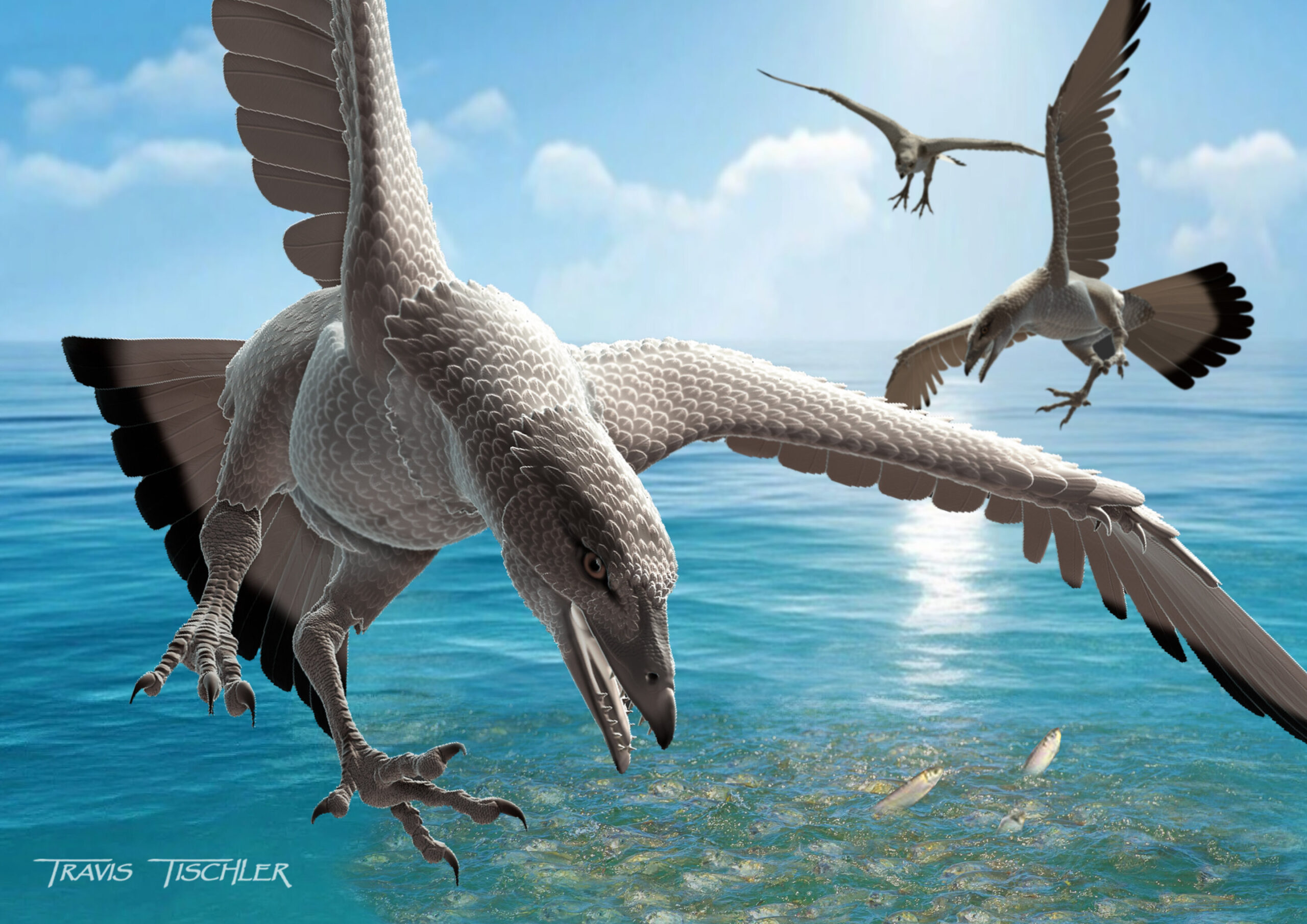
A slender bird lived in what is now central Queensland about 105 million years ago, when much of Australia was covered by shallow seas. Its remains consist mainly of a well-preserved lower-leg bone, but that single specimen carries a combination of features that distinguishes it from the only other formally named Cretaceous bird from Australia. The new species, named Tenuicruris piscanexum, is the second Cretaceous bird to be formally named from Australia.
Cretaceous bird fossils from Australia are unusually sparse. Most are isolated or fragmentary bones rather than articulated skeletons. The oldest recorded Australian bird fossil is a partial furcula from Victoria dating to about 128–120 million years ago. Other evidence includes feathers from the Koonwarra area of Victoria and 27 Early Cretaceous bird footprints from the Wonthaggi Formation.
By the time represented by the Toolebuc Formation, around 105 million years ago, bird remains were still limited. The only Cretaceous Australian bird that had previously received a formal name was Nanantius eos, known from a nearly complete left tibiotarsus found in the marine deposits of the Toolebuc Formation.
The new specimen came from a public fossil-collecting area near Richmond in central Queensland. The fossil, catalogued as KK F1451, is a left tibiotarsus, the fused lower-leg element formed from the tibia and ankle bones. It measures 64.5 millimeters from end to end and is preserved with much of the bone intact, although part of the lateral side remains embedded in the surrounding rock.
The researchers named the animal Tenuicruris piscanexum. The genus name combines Latin words meaning “slender” and “leg,” while the species name refers to the “fish mash layer,” a thin marker layer in the Richmond fossil-collecting areas where the specimen was found.
A leg with an unusual combination of features
The new bird’s identity rests on the detailed shape of its tibiotarsus. The bone has a long, relatively gracile shaft and several features that the authors regard as distinctive among enantiornithines.
One of the most conspicuous is a well-developed cnemial crest on the front-inner side of the upper part of the bone. It occupies roughly the upper quarter of the shaft. A second crest, the fibular crest, extends farther down the shaft in a crescent-shaped form, occupying about one-third of its length.
At the lower end of the bone, the medial and lateral condyles flare slightly outward rather than tapering toward the middle. Both condyles are somewhat concave, and the medial condyle is wider from side to side and taller from front to back than the lateral one. A shallow groove separates the two.
The bone also contains a deep lateral depression immediately above the lateral condyle. Together, the deep lateral fossa, flared distal condyles, concave condyles and combination of cranial and lateral cnemial crests form the diagnostic combination used to distinguish Tenuicruris from other known enantiornithines.
The authors identify two features as potential autapomorphies, or characteristics unique to the new taxon: the deep lateral fossa near the distal condyle and the flared distal condyles when viewed from behind.
The shape is not simply a variation of Nanantius. When the two specimens were scaled to the same size, the previously known N. eos tibiotarsus appeared more robust, while KK F1451 had the more slender form.
The differences extend along the entire bone. Tenuicruris has straighter margins near the proximal end, a different configuration of the cnemial and fibular crests, concave rather than convex distal condyles, a narrower cylindrical shaft toward the upper part of the bone and an accessory lateral depression that is absent in Nanantius. Its distal shaft remains columnar, whereas the distal region of Nanantius becomes markedly broader.
The comparison was tested in three dimensions
The distinction between the two birds was not based only on visual inspection.
The researchers created three-dimensional surface meshes of the fossils and used a pairwise morphological analysis to quantify their shape differences. The method uses an interactive closest-point algorithm to align three-dimensional models and calculates differences between their surfaces using Hausdorff distances. The resulting differences can be displayed as heat maps, with closely matching regions distinguished from areas that diverge more strongly.
The analysis compared the entire tibiotarsus and also examined its proximal and distal ends separately. The resulting heat maps showed morphological differences in both regions, supporting the anatomical comparison between KK F1451 and N. eos.
The authors also compared the new specimen with another Nanantius-like bone recovered from the preserved gut contents of a Cretaceous ichthyosaur.
That history is unusual. A partial bird tibia had previously been reported from the ichthyosaur’s gut contents and described as a good match for Nanantius, but the specimen itself was subsequently lost. The remaining material from the gut contents, however, was still held at the Queensland Museum. Among those remains was a previously unreported distal end of a tibiotarsus, catalogued as QM F16811.
Its shape closely matches the distal end of the known N. eos specimen, QM F12992. A three-dimensional comparison found only subtle differences between the two. The authors interpret those differences as probably resulting from preservation and consider the two specimens likely to belong to the same taxon.
Neutron imaging exposed another bird bone
The study also describes a second fossil, KK F1452, a complete right tarsometatarsus from the Toolebuc Formation near Richmond. It measures 32.7 millimeters along metatarsal III, 30.2 millimeters along metatarsal II and 30.5 millimeters along metatarsal IV. Its overall width is 5.2 millimeters.
Unlike the tibiotarsus, this specimen could not confidently be assigned to either Tenuicruris or Nanantius, so the researchers did not formally name it.
Thermal-neutron imaging provided a detailed view of its internal structure. The scan showed that the three metatarsals were fused in places at both their proximal and distal ends, while remaining individually distinguishable through much of their length. Some cross-sections showed complete fusion, whereas others clearly separated the individual bones.
The imaging also exposed faint internal sutures within the welded bone near the proximal end, allowing the researchers to identify the boundaries of the individual metatarsals. Metatarsal III extends farther distally than II and IV, while the distal ends of II and IV are nearly level. Metatarsal II also has a prominent enlarged flange on its plantar surface and ends in a strong medial curve.
The scanning itself was extensive. The tarsometatarsus was imaged with the DINGO thermal-neutron instrument at the Australian Nuclear Science and Technology Organisation. Researchers collected 720 radiographs at 0.25-degree intervals during a 180-degree rotation, with four 40-second exposures at each angle. The total scan took 33 hours.
The tibiotarsus underwent a separate 720-radiograph scan, with three 35-second exposures at each angle, taking 22 hours. The resulting data were reconstructed into virtual slices and segmented to produce three-dimensional models.
The researchers compared the articular surface of KK F1452 with the distal ends of the Tenuicruris and Nanantius tibiotarsi. That comparison was inconclusive because the fossils do not preserve the cartilage that would have occupied the joint surfaces. As a result, the authors left the tarsometatarsus formally unnamed, although they still included it as a separate taxon in their phylogenetic analysis.
The evolutionary analysis places all three fossils among enantiornithines
To test the evolutionary relationships of the fossils, the researchers added the new specimens to an existing Mesozoic bird dataset.
The analysis contained 281 anatomical characters and 83 operational taxonomic units, with dromaeosaurids used as the outgroup. The researchers used parsimony with extended implied weighting and conducted both a New Technology search and a traditional tree search. They also calculated support using symmetric resampling and Bremer support.
The analysis initially recovered 86 trees with the best tree score of 60.71976. A subsequent traditional search recovered 271 trees with the same best score. The resulting consistency index was 0.253 and the retention index was 0.617.
Those values also illustrate an important limitation of the evolutionary result. The low consistency index indicates substantial homoplasy, meaning similar anatomical features occur independently in different branches of the evolutionary tree. The consensus tree therefore contains a large unresolved polytomy among enantiornithines.
In that tree, Tenuicruris, Nanantius and KK F1452 all fall within Enantiornithes, but their precise relationships to one another and to many other members of the group are poorly resolved. The researchers attribute the large polytomy in part to the fragmentary nature of the Australian specimens, which act as “wildcards” in the analysis.
When the Australian taxa were removed and the analysis was rerun using the same settings, the resulting tree was much better resolved and lacked the large polytomies. The authors therefore regard the higher-level relationships of the Australian specimens as indeterminate within the non-pengornithid enantiornithines rather than assigning them to a more precise position.
The unusual crest links the new bird to other early enantiornithines
The prominent cnemial crest is particularly notable because such crests are generally low and poorly developed in enantiornithines.
The feature has been documented in some early members of the group, including Monoenantiornis, which also has a small cnemial crest along the craniolateral border of the tibiotarsus. Tenuicruris and Monoenantiornis additionally share similar fibular-crest proportions, with that crest occupying roughly 30% of the tibiotarsus length.
The new bone also resembles the tibiotarsus of Qiliania graffini, including its long, slender shaft, relatively short fibular crest and well-developed cnemial crest. Several other details of the proximal and distal anatomy are shared between the two.
The authors suggest that the repeated presence of a well-developed cnemial crest in Tenuicruris, Qiliania and Monoenantiornis may indicate a closer evolutionary relationship among these birds. They present that relationship as a possibility rather than a result directly established by the phylogenetic analysis, whose Australian taxa remain poorly resolved.
The tarsometatarsus adds another unusual piece of anatomy to the Australian record. Its combination of proximal and distal fusion differs from some patterns described elsewhere in early birds, and the authors note that the sequence of tarsometatarsal fusion has varied across early avian evolution. They therefore caution that fusion patterns should not necessarily be treated as a simple distinction between enantiornithines and ornithuromorphs.
One more specimen may belong to the same ancient bird community
The two new fossils came from separate localities in the Toolebuc Formation around Richmond, within sediments deposited in a shallow-marine setting during the Albian.
The researchers interpret the evidence as documenting another enantiornithine in an Australian fossil record that remains dominated by isolated bones. Tenuicruris piscanexum is formally named from KK F1451, while KK F1452 remains an unnamed enantiornithine specimen because its identity cannot be established securely from the preserved joint surfaces.
The phylogenetic analysis nevertheless places Tenuicruris, the unnamed tarsometatarsus and Nanantius within Enantiornithes. The study therefore adds both a formally recognized species and another anatomically informative bird specimen to the Cretaceous record of Australia, while leaving the exact evolutionary relationships among these Australian birds unresolved.
The study was published in Journal of Vertebrate Paleontology.