Two fossil jaw fragments from South Africa preserve an unusual configuration of the mandibular anatomy in Paranthropus robustus, adding to the anatomical variation known from an early population of the species. The fossils are among 18 previously undescribed hominin remains from Drimolen Main Quarry, which also include a large mandible of uncertain age and a partial adult skull tentatively assigned to Homo erectus.
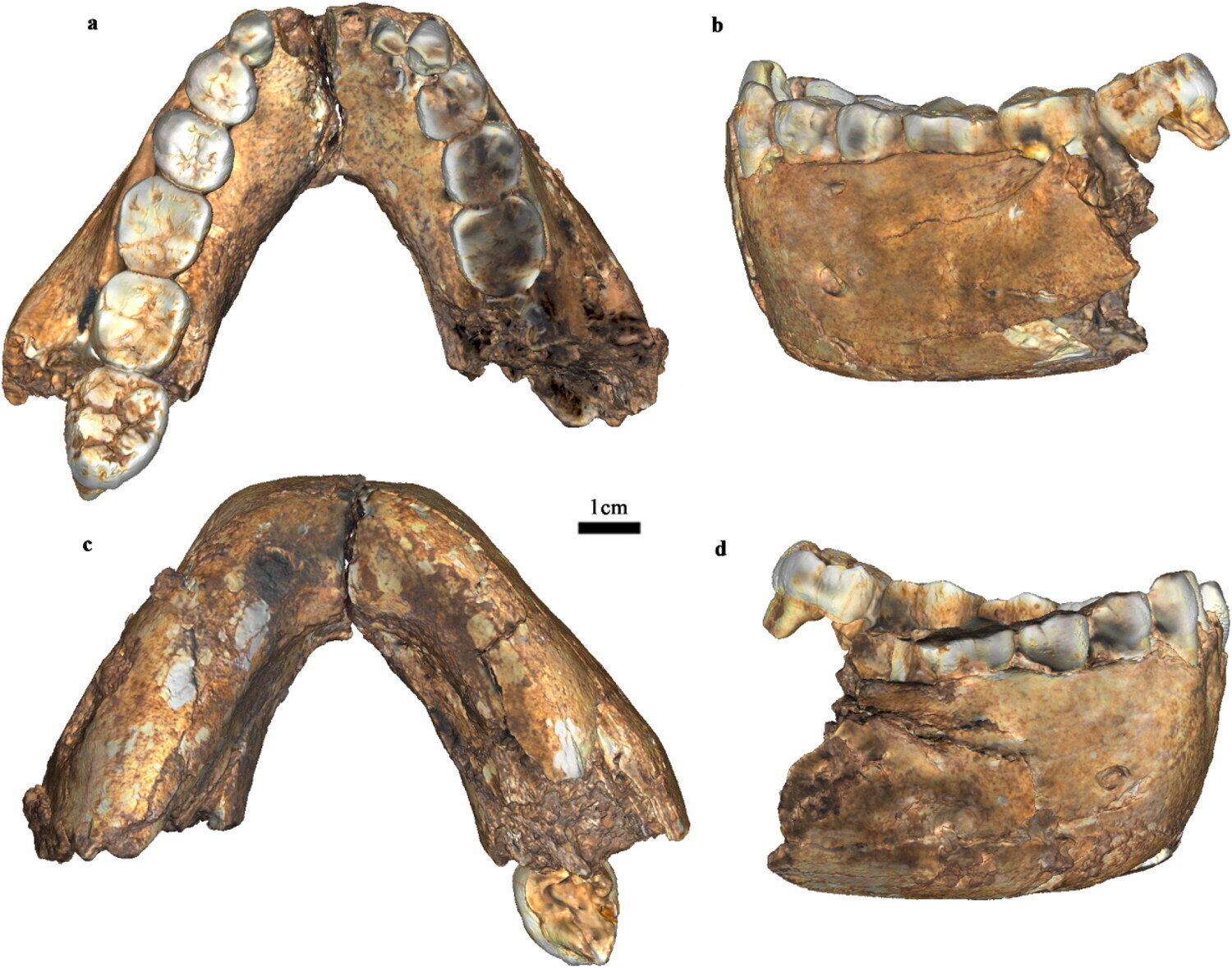
The most distinctive specimen is DNH 5, a set of right and left mandibular ramus fragments recovered from a breccia block on a talus slope at Drimolen Main Quarry.
Both sides preserve the coronoid process, the bony projection of the lower jaw where part of the temporalis muscle attaches. The specimen also preserves most of the mandibular notch, the curved space between the coronoid process and the condyle, which connects the jaw to the skull.
In DNH 5, the notch is wide and the coronoid process is relatively narrow. Most notably, the top of the condyle appears to sit higher than the top of the coronoid process.
That arrangement differs from the configuration conventionally associated with Paranthropus. The specimen superficially resembles the condition seen in the Australopithecus africanus specimen Sts 52b. The authors also note that Australopithecus sediba shows variation in the same region: its juvenile specimen MH 1 has a tall coronoid process and narrow notch, while MH 2 has a shorter process and wider notch.
The condyle of DNH 5 is 28.2 millimeters wide from side to side and up to 12.6 millimeters from front to back. Its breadth, together with the broad articular surface that it would have met in the skull, supports the authors’ assignment of the specimen to Paranthropus.
The unusual jaw configuration therefore adds another form of anatomical variation to the known range of P. robustus. More importantly, the authors suggest that it may eventually prove to be a discrete trait distinguishing the Drimolen population from younger P. robustus populations at Swartkrans and Kromdraai.
That possibility cannot yet be tested confidently. No other Drimolen P. robustus specimen preserves enough of the relevant anatomy to establish how common the configuration was in that population.
The authors also caution against treating the shape as a demonstrated explanation for differences in chewing performance. Earlier comparisons have suggested that the Drimolen P. robustus population may have been less efficient at producing bite force than later populations. Simple lever mechanics provide one possible explanation for how the jaw shape could contribute to that difference. A taller coronoid process, like those seen in younger Swartkrans specimens, could increase the mechanical advantage of parts of the temporalis muscle with a horizontal force component. The shorter configuration seen in DNH 5 could therefore produce less torque.
But the study did not perform a formal biomechanical analysis, so that functional interpretation remains untested.
The fossils come from an early P. robustus population
Drimolen Main Quarry, about 40 kilometers northeast of central Johannesburg, preserves fossils dating broadly from about 2.04 million to 1.95 million years ago. Since its discovery in 1992, the site has produced 119 hominin specimens, including several important P. robustus crania and the juvenile cranium DNH 134, which was identified as Homo erectus sensu lato.
The new study focuses on 18 cranial and mandibular specimens that had not previously been described in detail. The fossils were excavated or collected mainly during André Keyser’s work at the site between 1994 and 1999, with some specimens discovered during the broader period from 1992 to 2008. Two additional specimens were recovered from older excavation material in 2015.
The researchers used descriptive anatomical comparisons, examining the fossils directly and comparing them with specimens from Drimolen, Swartkrans, Kromdraai, Sterkfontein, Malapa and other sites. They supplemented those comparisons with measurements of preserved anatomical features.
Fourteen of the 18 specimens were assigned to P. robustus. One was tentatively assigned to H. erectus sensu lato, while three could be identified only as hominins whose genus and species could not be determined.
The P. robustus material includes maxillae, mandibles, mandibular rami and cranial fragments. Several specimens had previously been identified from their teeth, but their associated bone had not been described. Others had not previously been analyzed at all.
This expanded sample matters because an earlier study of Drimolen fossils had identified a distinctive combination of anatomical features that separated the site’s P. robustus remains from younger material from Swartkrans Member 1 Hanging Remnant and Kromdraai B Member 4–6.
Those differences have been interpreted as possible evidence of microevolution, meaning small evolutionary changes within a lineage over time.
An alternative explanation has been sexual dimorphism. Under that hypothesis, the apparent differences between the sites could reflect different proportions of males and females rather than evolutionary change. The proposed scenario is that females were disproportionately represented at Drimolen, while males were disproportionately represented at the younger sites, potentially because of differences in social organization and predation.
The newly described fossils provide additional tests of those competing explanations.
A very large mandible comes with a major dating problem
One of the most conspicuous specimens is DNH 6, a heavily damaged right posterior mandible and ramus.
Its molar crowns are extremely distorted by the surrounding matrix, but their original size is still apparent. They are comparable to or larger than those of SK 12 from Swartkrans, which the authors identify as the largest well-preserved P. robustus mandible. The preserved portion of the DNH 6 mandible is also very tall below the third molar, and its ramus appears to have been tall.
The specimen is therefore substantially larger than other P. robustus mandibles recovered from Drimolen.
If DNH 6 came from the older deposits at Drimolen, that size could present a problem for the proposed microevolutionary pattern. The strongest evidence for differences between the Drimolen and younger P. robustus populations comes from specimens securely dated to older than about 1.95 million years. A very large Drimolen mandible from the same older deposits would resemble the younger population in a feature that the microevolutionary hypothesis might predict should have changed through time.
But the researchers cannot establish that DNH 6 is that old.
It was recovered as a loose breccia block from mining rubble. Historic limestone mining disturbed material at the site, and the original source of the block is unknown. Deposits younger than 1.95 million years also occur at Drimolen, although no definitively in-situ hominin fossil has yet been recovered from those younger levels.
The authors therefore cannot rule out the possibility that the breccia containing DNH 6 came from a different-aged deposit that was removed during mining.
DNH 6 is consequently potentially relevant to the evolutionary hypothesis, but its uncertain geological context prevents the specimen from providing a decisive test of it.
Other jaws broaden the range of variation
Several of the newly described mandibles reinforce the broader anatomical picture without resolving every taxonomic question.
DNH 8 is a relatively complete mandible preserving both sides of the corpus and the symphysis. Its associated teeth had previously been assigned to P. robustus. The bone is consistent with that identification. The symphysis is robust, measuring 44.1 millimeters high and 25.8 millimeters wide, while the mandibular corpus falls within the known adult P. robustus range.
DNH 19 is a fractured left mandibular corpus preserving the premolars through most of the second molar. Its wide extra-molar sulcus and development of the lateral prominence are consistent with P. robustus.
DNH 21 preserves part of another left mandible. Its extra-molar sulcus is at least 10.6 millimeters wide, and its corpus breadth and overall configuration are compatible with P. robustus.
DNH 46 and DNH 51 were recovered from in-situ breccia in the R and B Pinnacles, respectively, while DNH 34 came from decalcified deposits between the DNH 7 Pinnacle and the Jangi Buttress. These securely contextualized fossils fall within the site’s 2.04-to-1.95-million-year-old interval.
The study also reexamines several fragments that cannot be confidently assigned to P. robustus.
DNH 12 is a fragmentary right mandible that had previously been attributed to P. robustus on the basis of its tooth. Its preserved bone, however, includes a relatively narrow and pinched corpus base beneath the second and third molars, which the authors consider incompatible with that assignment. They therefore provisionally classify it only as Hominini gen. et sp. indet., meaning an unidentified member of the human lineage.
DNH 142, another mandibular ramus, preserves most of the mandibular notch and coronoid process. Its wide notch and low coronoid process are compatible with the unusual arrangement seen in DNH 5. The specimen’s anatomy excludes several large non-hominin mammals, but it could belong to Homo, Paranthropus or Australopithecus. It is therefore also left unidentified below the hominin level.
That specimen is particularly important for interpreting DNH 5. Its similar anatomy means the unusual jaw configuration may not be unique to P. robustus. At the same time, DNH 142 cannot itself establish which hominin taxon possessed the feature.
A less projecting face adds another variation
The new material also changes the known range of facial variation within the Drimolen P. robustus sample.
DNH 41 is a left maxilla that had already been assigned to P. robustus on the basis of its teeth. Its preserved facial anatomy shows less subnasal prognathism than any other Drimolen specimen in which that feature can be assessed.
Subnasal prognathism refers here to the degree to which the region below the nose projects forward. Earlier Drimolen specimens, including DNH 7 and DNH 155, preserve a more pronounced form of this architecture.
Those earlier specimens are particularly relevant to the sexual-dimorphism hypothesis because DNH 152 and DNH 155 had been interpreted as presumptively male individuals, while other Drimolen fossils were thought to include females. The presence of pronounced subnasal prognathism in both putatively male and female members of the Drimolen sample had already indicated that the trait was variable.
DNH 41 extends that variation in the opposite direction.
The authors conclude that the additional specimen means the range of subnasal prognathism at Drimolen is broader than previously recognized and that the variation cannot simply be attributed to sexual dimorphism. They also note that both the Drimolen and Swartkrans P. robustus populations show variation in the degree of this feature.
A second kind of Homo skull
The other major discovery in the study is DNH 127, a partial right side of a skull recovered from a partly decalcified breccia block beside the DNH 7 Pinnacle.
Unlike the P. robustus fossils, DNH 127 is tentatively assigned to Homo erectus sensu lato.
The specimen preserves portions of the temporal, parietal and occipital regions of the skull. Several features are important to the assignment.
The posterior surface of the petrous portion of the temporal bone is vertically oriented, a configuration associated with both Homo and Paranthropus. A small post-glenoid process fused to the tympanic is also characteristic of those two genera.
Other features point away from Paranthropus. The mastoid process is relatively uninflated, and the overlap between the parietal and temporal bones at the squamosal suture is limited. The mastoid and supramastoid crests also rise to approximately the same level, a condition found in several Homo crania.
The squamosal suture itself is straight. The authors note that this is characteristic of H. erectus. Taken together, the mosaic of features most closely resembles the Dmanisi specimen D2700, leading to the tentative H. erectus sensu lato assignment.
The assignment is deliberately cautious. DNH 127 is not described as a definitive species-level identification.
Its geological setting strengthens the interpretation. The breccia block appears to have broken away from the larger DNH 7 Pinnacle in the central excavation area. The authors therefore consider DNH 127 likely to be approximately contemporary with DNH 7 and other hominins from that pinnacle.
Drimolen already produced DNH 134, a relatively complete juvenile cranial vault attributed to H. erectus sensu lato and dated to about 2.04 million years ago. DNH 127 adds an adult specimen to that sample and provides additional evidence for H. erectus at the site around the interval of roughly 2.04 to 1.95 million years ago.
The Homo identification remains part of a larger uncertainty
The new skull does not settle the broader question of how many Homo species may have been living in southern Africa around 2 million years ago.
The study notes that there is still no well-preserved, relatively complete adult H. erectus cranium in the combined southern African sample. Other fragmentary fossils, including SK 847 from Swartkrans and StW 53 from Sterkfontein, have been assigned different interpretations by different researchers, and there is no agreement about which Homo species they represent or even whether they belong to Homo.
Drimolen itself has yielded dental remains previously assigned to Homo, but those specimens were not assigned to a particular species.
The authors therefore leave open the possibility that more than one Homo species could have occupied the southern African landscape around 2 million years ago. But they emphasize that the available evidence does not yet unequivocally demonstrate more than one Homo species within the Drimolen assemblage itself.
DNH 144 illustrates the other end of the identification problem.
This small neurocranial fragment was originally classified as non-hominin material. Its cranial bone is about 5.1 millimeters thick at a preserved suture, with a relatively gentle curvature. Those features are incompatible with an attribution to Papio, and the fragment most closely resembles the condition seen in the South African australopith specimen Sts 5. But the resemblance is not strong enough for a confident taxonomic assignment, so DNH 144 remains an unidentified hominin.
The new fossils add to a population-level evolutionary pattern
Taken together, the 18 specimens expand the anatomical sample at Drimolen without producing a simple answer to every question.
The strongest pattern concerns P. robustus. The DNH 5 jaw adds a previously unrecognized configuration of the mandibular ramus to the species, and the authors suggest that it could become another feature distinguishing the older Drimolen population from younger P. robustus populations at Swartkrans and Kromdraai. But there are too few comparable Drimolen fossils to establish that this is a population-level difference.
DNH 41 expands the known range of facial variation, while DNH 6 presents a potentially important size difference whose significance cannot be evaluated without knowing its original geological context.
These observations are compatible with the authors’ earlier hypothesis that the Drimolen P. robustus population was morphologically distinct from the younger Swartkrans and Kromdraai populations and that the differences resulted from microevolutionary change within the lineage.
They do not, however, provide a formal statistical test of that hypothesis. The study relies on anatomical description, direct comparison and measurements rather than inferential statistics.
The researchers ultimately assign 14 of the 18 newly described specimens to P. robustus, one to H. erectus sensu lato, and three to Hominini gen. et sp. indet. The new fossils add both recognizable anatomy and unresolved fragments to a site whose hominin assemblage has continued to grow since excavations began more than three decades ago.
The study was published in Annals of Human Biology.