Deep in the Early Cretaceous rocks of northeastern China, a remarkably complete 57-centimeter-long dinosaur preserves new clues to how flight-related anatomy evolved among bird-like dinosaurs. Named Norellraptor barsboldi, the animal belonged to the microraptorines, a group whose members carried several features associated with aerial adaptations. Its anatomy, bone growth patterns and evolutionary relationships indicate that microraptorines and avialans acquired many similar flight-related features through different evolutionary sequences rather than through a shared developmental pattern inherited from their common ancestor.
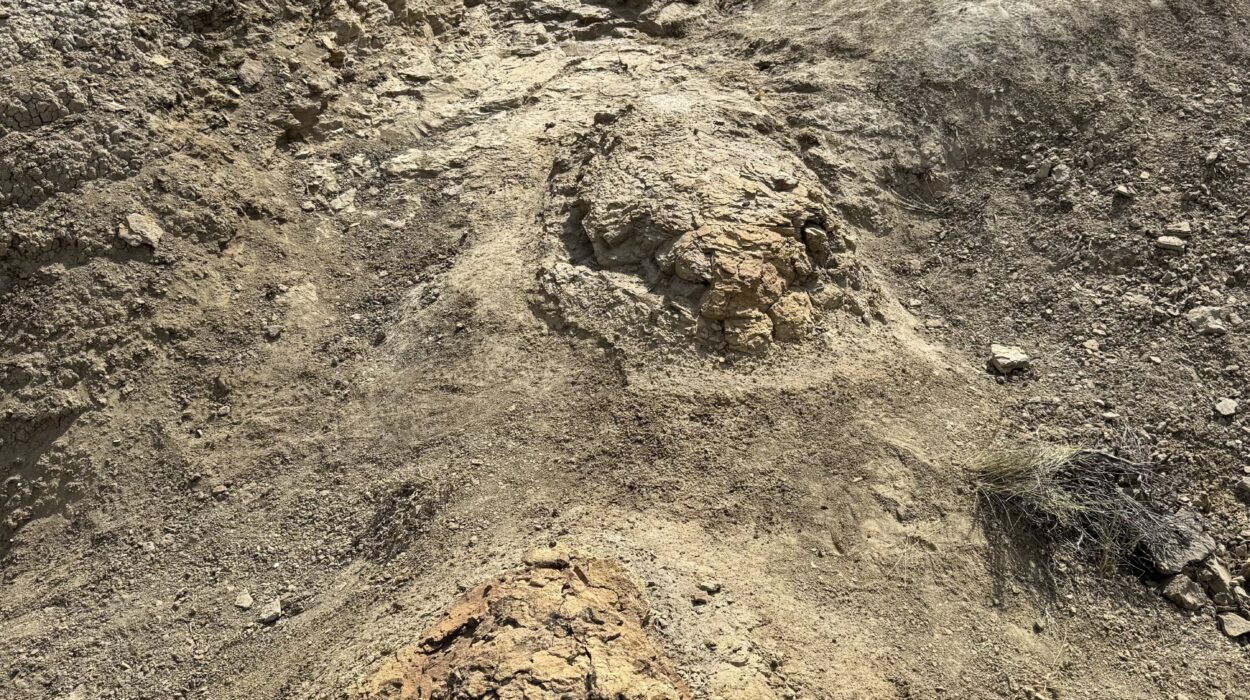
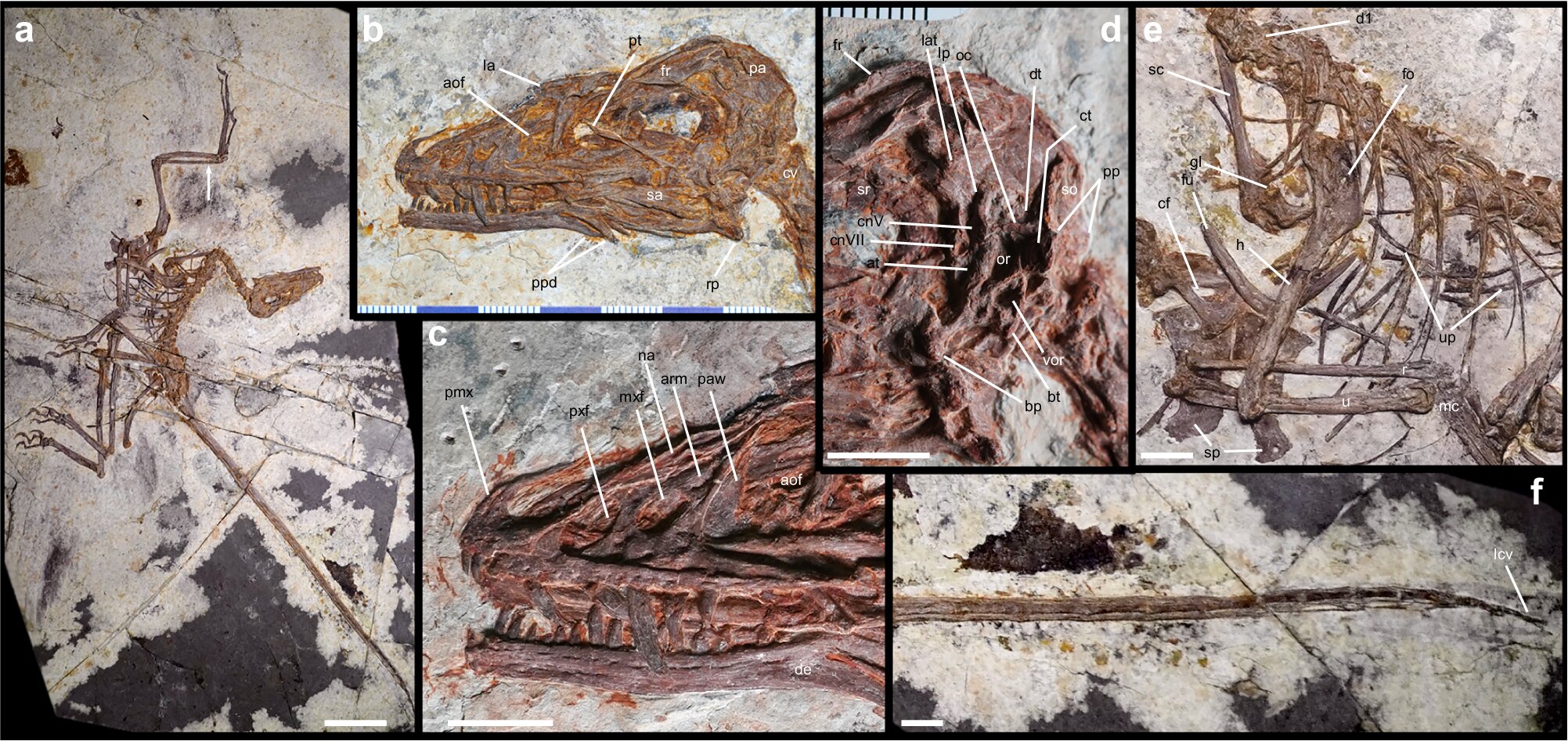
The fossil comes from the Jiufotang Formation of western Liaoning, China, and was found near Lamadong Town in Jianchang County. The specimen was donated to the Museum of Hebei GEO University in 2023. Its skeleton is almost completely preserved, with only moderate disarticulation around the limb girdles, and portions of its plumage remain visible around the body.
The animal has been named Norellraptor barsboldi. The genus honors American paleontologist Mark Allen Norell, while the species name honors Mongolian paleontologist Rinchen Barsbold. The researchers place the new dinosaur within Dromaeosauridae, specifically Microraptorinae and the more restricted Microraptorini.
At 57 centimeters long, Norellraptor was small. Its combination of skeletal features distinguishes it from other known microraptorines. Among the characteristics used to diagnose it are an unusually large opening in the front part of the antorbital fossa, distinctive proportions of the openings in the skull, and a gently curved pubis ending in a relatively small foot.
The skull is subtriangular in side view, with a vaulted frontoparietal region and moderately elongated snout. The antorbital fenestra is D-shaped, while the antorbital fossa contains an unusually extensive system of openings. The promaxillary fenestra occupies the entire rostral third of the antorbital fossa, and the maxillary fenestra is also enlarged.
The braincase is unusually well preserved. Its bones are fused, and the lateral surface is extensively pneumatized. Several recesses and other structures provide additional anatomical information that helped distinguish the animal from other dromaeosaurids.
The teeth show considerable variation in size. At least 16 teeth are preserved in the left dentary, with possibly two additional empty tooth positions. The largest preserved maxillary crown is more than twice as wide mesiodistally as the smallest erupted dentary crowns. Well-preserved teeth have serrated edges with hooked denticles along the distal margin.
The anatomy includes several features associated with aerial adaptation
The forelimbs provide some of the most important anatomical information. The humerus is shorter and less robust than the femur. Its deltopectoral crest contains an elliptical opening, a feature also seen in other microraptorines. The radius is about 80% as long as the humerus. Both hands are preserved and articulated with the forearms, forming an angle of about 100 degrees.
The hand has several features characteristic of microraptorines. The first digit is proportionally short, while the second finger is the most robust. The third finger has a shortened second phalanx and a relatively short, gracile penultimate phalanx.
The sternum is elongate, measuring about 40% of the femur’s length. The scapula is shorter and more slender than the humerus and is firmly fused to the coracoid. The coracoid contains a large drop-shaped opening, and its sternal end carries a distinct lateral process.
The hindlimbs are more lightly built. The distal tibiotarsus and proximal tarsometatarsus are fully fused. The third metatarsal is strongly constricted near its proximal end and is overlapped by neighboring metatarsals, producing an arctometatarsalian arrangement.
Some plumage is also preserved. Feathers occur near the right humerus, the synsacrum and proximal tail, the distal tail, and the right hindlimb. Preservation is not good enough to determine the complete length and detailed morphology of the plumage. The researchers say the forelimb probably carried asymmetrical pennaceous feathers, while feathers near the end of the tail had a rachis-dominated form. Other preserved feathers are straight and simple and appear tightly arranged.
These features place Norellraptor among the dinosaurs that possessed a combination of anatomical characteristics associated with aerial adaptations. But the central question is not simply whether this dinosaur had such features. It is how those features evolved and whether their similarities to bird anatomy came from the same underlying evolutionary process.
The fossil preserves a record of bone growth
To investigate that question, the researchers examined the microscopic structure of the dinosaur’s left radius. They cut successive transverse sections through the distal portion of the bone’s midshaft and examined them under transmitted, fluorescent and elliptically polarized light. The sampled radius was 49 millimeters long, and the resulting sections were 52 micrometers thick.
The radius was partly crushed after death, but its internal structure remained sufficiently preserved for detailed histological analysis. The compact bone was less than half a millimeter thick, ranging from 365 to 487 micrometers, and surrounded a large medullary cavity. The researchers found no trabecular structures inside that cavity, which they interpreted as evidence for extensive pneumatization of the bone.
The compact bone consisted of an inner endosteal layer and a much thicker periosteal component. The endosteal bone was 38 to 65 micrometers thick and represented 8% to 15% of the compact bone. The periosteal bone measured 316 to 448 micrometers and accounted for 85% to 92%.
Two lines of arrested growth, or LAGs, divided the periosteal bone into three zones. The first zone had undergone substantial resorption. The second zone was preserved in its entirety and contained changing patterns of vascular canals and bone organization. A third zone had only just begun to form and was no more than 15.7 micrometers thick at its thickest preserved point.
Those structures allowed the researchers to estimate the animal’s age. Two LAGs indicate that it lived for at least two years after hatching. Because substantial early bone had apparently been resorbed, the authors estimate that the animal was at least three years old when it died, near the beginning of what they interpret as its latest year of life.
The growth record was not straightforward. The researchers identified evidence of relatively rapid growth in part of the second zone, followed by a reduction in vascularity and other changes associated with slower growth. The latest bone deposited in the third zone was not yet circumferentially complete. The authors therefore conclude that the animal died early after the latest cessation of growth during its late juvenile period.
They also note that the unusual mixture of rapid- and slow-growth characteristics might reflect the approach to adulthood, but could perhaps have been related to unknown physiological problems. That possibility remains unresolved by the fossil.
The forelimb and hindlimb did not grow in the same way
The microscopic evidence becomes especially important when the new radius is compared with other microraptorine bones.
The radial growth pattern of Norellraptor differs distinctly from the femoral growth pattern of a late juvenile Microraptor. In that Microraptor specimen, the femur shows uninterrupted growth and a gradual reduction in the number of randomly distributed neurovascular canals. The Norellraptor radius instead shows interrupted growth and changing organization of the vascular and cellular structures across its growth zones.
The radius also resembles the juvenile radial growth pattern of Sinornithosaurus, although the late portion of one growth zone is missing in that specimen. In juvenile Sinornithosaurus and Wulong, forelimb and hindlimb sections had more similar histological patterns. The authors also note that the Norellraptor radius resembles the radial growth pattern of the basal paravian Aurornis, apart from differences associated with later maturity.
The comparison matters because the researchers were testing whether microraptorines and birds might have inherited a common developmental pattern that repeatedly pushed their bodies toward similar flight-related anatomy.
If such a developmental constraint existed, the evolutionary changes leading toward aerial adaptations would be expected to appear in broadly similar sequences in microraptorines and avialans, the lineage containing birds.
Instead, the anatomical changes reconstructed in the two groups occurred in different sequences.
The evolutionary tree places Norellraptor among late microraptorines
The researchers incorporated Norellraptor into an updated phylogenetic dataset focused on maniraptoran coelurosaurs. They analyzed the matrix using equally weighted parsimony in TNT 1.650. The analysis produced 50,000 shortest trees, each with a score of 8,735. The consistency index was 0.31 and the retention index was 0.54.
The topology of Microraptorinae was consistent across the shortest trees except for alternative placements of Graciliraptor and Sinornithosaurus. A second analysis using implied weighting produced a broadly similar topology. The strict consensus of those shortest trees was used for reconstructing ancestral character states.
Within this framework, Norellraptor is placed among late-diverging microraptorines and is reconstructed as the sister taxon of Zhongjianosaurus. Several shared features support that relationship, including a bulbous distal process of the ulna, extensive fusion of the proximal metatarsal shafts and the arctometatarsalian arrangement of the metatarsals.
The broader tree also produced a result relevant to the long-running question of how microraptorines relate to birds. Halszkaraptorines and unenlagiines were placed closer to birds than dromaeosaurids and troodontids. The authors note that this arrangement agrees with some previous work emphasizing the bird-like characteristics of those groups, although it differs from other proposed paravian relationships.
Under the authors’ preferred topology, microraptorines remain outside Avialae. Even when the analysis was forced to place microraptorines within Avialae, the shortest trees supporting that constraint were 23 steps longer than the shortest unconstrained trees, and microraptorines still fell stem-ward of Archaeopteryx and anchiornithines.
Similar features appeared, but not in the same order
The researchers identified 194 evolutionary changes, or apomorphies, along the microraptorine internodes and terminal branches in their reconstruction. Fifty-seven of those, about 30%, were also acquired independently along avialan branches.
The shared features include changes in the skull, vertebral column, ribs, sternum, shoulder region, forelimbs, hands, pelvis, feet and plumage. Among them are changes involving the maxilla and lacrimal, increases in uncinate processes, changes to the sternum and sternal ribs, a lateral coracoid process, relative forelimb robustness, an opening in the deltopectoral crest, changes in the proportions of the radius and ulna, modifications to the wrist and fingers, changes to the pubis and metatarsals, and alular feathers.
But sharing individual features does not by itself establish that the two lineages inherited a common developmental program for building a flight apparatus.
The sequence of changes is different.
In microraptorines, one early set of changes involved shortening the manual phalanges. These included shortening in the first phalanx of the thumb and in the penultimate phalanges of the second and third fingers. The authors suggest these changes might have been related to reducing the hand’s primitive grasping function. These modifications occurred at the root of Microraptorinae.
A later set of changes included fusion of carpometacarpal elements, development of a fenestra in the deltopectoral crest and relative elongation of the sternum. Those changes were reconstructed as features of the more restricted Microraptorini and therefore appeared later in microraptorine evolution.
In avialans, however, those latter transformations occurred before the changes that shortened the manual phalanges. The researchers reconstruct the former changes near the roots of Pygostilia and Ornithothoraces and the manual changes later, at the root of Ornithothoraces.
That difference in sequence is central to the study.
If the same hidden developmental program had been guiding the evolution of aerial adaptations in both lineages, the researchers reasoned that similar traits should tend to appear in a similar evolutionary order. Their reconstruction instead indicates that the two lineages assembled many of their shared features through different sequences.
The statistical test found no matching evolutionary sequence
The researchers tested that pattern directly by comparing the sequences of character-state changes along microraptorine and avialan branches.
Across all of the shared features, the Spearman rank correlation coefficient was −0.08, with a p value of 0.50. When the analysis was restricted to forelimb and pectoral features, the coefficient was 0.15, with a p value of 0.47. Neither relationship was statistically significant.
On the basis of this analysis, the authors reject the hypothesis that the evolution of bird-like traits in Microraptorinae reflects a developmental homology shared with birds. In other words, the fact that the two groups independently acquired many similar anatomical features does not come with evidence that they followed the same developmental sequence in doing so.
The distinction is important. The study does not argue that microraptorines and birds lack evolutionary similarities. The analysis instead addresses whether those similarities can be explained by a shared developmental regime inherited from their common paravian ancestry.
The reconstructed sequences provide evidence against that explanation.
Bone growth adds another piece to the same question
The histological evidence provides a separate line of evidence, although the authors describe it as preliminary.
Living birds can show differences in growth patterns between forelimbs and hindlimbs associated with their developmental and functional regimes. The authors compare this with histological evidence from microraptorines, where the sampled bones do not consistently reproduce an avian-like pattern.
In some of the most immature microraptorines examined previously, there was no clear differential growth regime between fore- and hindlimb bones. In more mature individuals, differences between the limbs might indicate an inverse pattern.
The Norellraptor radius adds another unusual pattern. Its growth was interrupted, and its osteons and osteocyte lacunae became more circumferentially organized. By comparison, the tibiotarsus of Microraptor showed uninterrupted growth with randomly organized osteons and osteocyte lacunae and a decline in osteon abundance toward the bone’s outer region.
The authors propose that, if the relationship between bone growth and function in microraptorines followed the same relationship observed in living birds, this inverse forelimb-hindlimb pattern could indicate a distinctive precocially developing forelimb in these four-winged paravians. They emphasize that this would differ from growth models observed among modern flying birds.
That interpretation remains conditional. It depends on assuming that the relationship between growth and function seen in living birds can be applied to the extinct microraptorines.
The evidence points to separate assembly rather than one inherited flight blueprint
Taken together, the new fossil, the phylogenetic reconstruction, the sequence of anatomical changes and the histological observations lead the authors to a specific evolutionary interpretation.
Microraptorines and avialans independently acquired a substantial set of similar features, but the features appeared in different evolutionary sequences. The phylogenetic analysis also places microraptorines outside Avialae rather than as part of the bird lineage. The statistical comparison found no significant correlation between the order of character-state changes in the two groups.
The authors therefore argue that the flight-related apparatus of microraptorines and birds was assembled independently rather than representing the expression of a single shared developmental program inherited from their common ancestor. They describe this as evidence for multiple and independent selective regimes associated with the origins of winged paravians.
The histological evidence adds a possible developmental difference, but the authors treat that part of the argument more cautiously. The growth patterns observed in Norellraptor and other microraptorines do not simply reproduce the developmental pattern expected if their flight-related anatomy had followed the same growth model as modern birds. Yet the authors note that the available histological evidence remains preliminary and that similarities in forearm growth among other paravians still need to be tested.
The new dinosaur therefore does more than add another name to the microraptorine fossil record. Its anatomy helps fill a position within the evolutionary history of the group, while its preserved radius provides a rare record of how the bones of a feathered, aerially adapted dinosaur grew. Those records, combined with the reconstructed order of anatomical changes, form the basis for the authors’ conclusion that similar flight-related structures arose through different evolutionary histories in microraptorines and birds.
The study was published in Nature Communications.