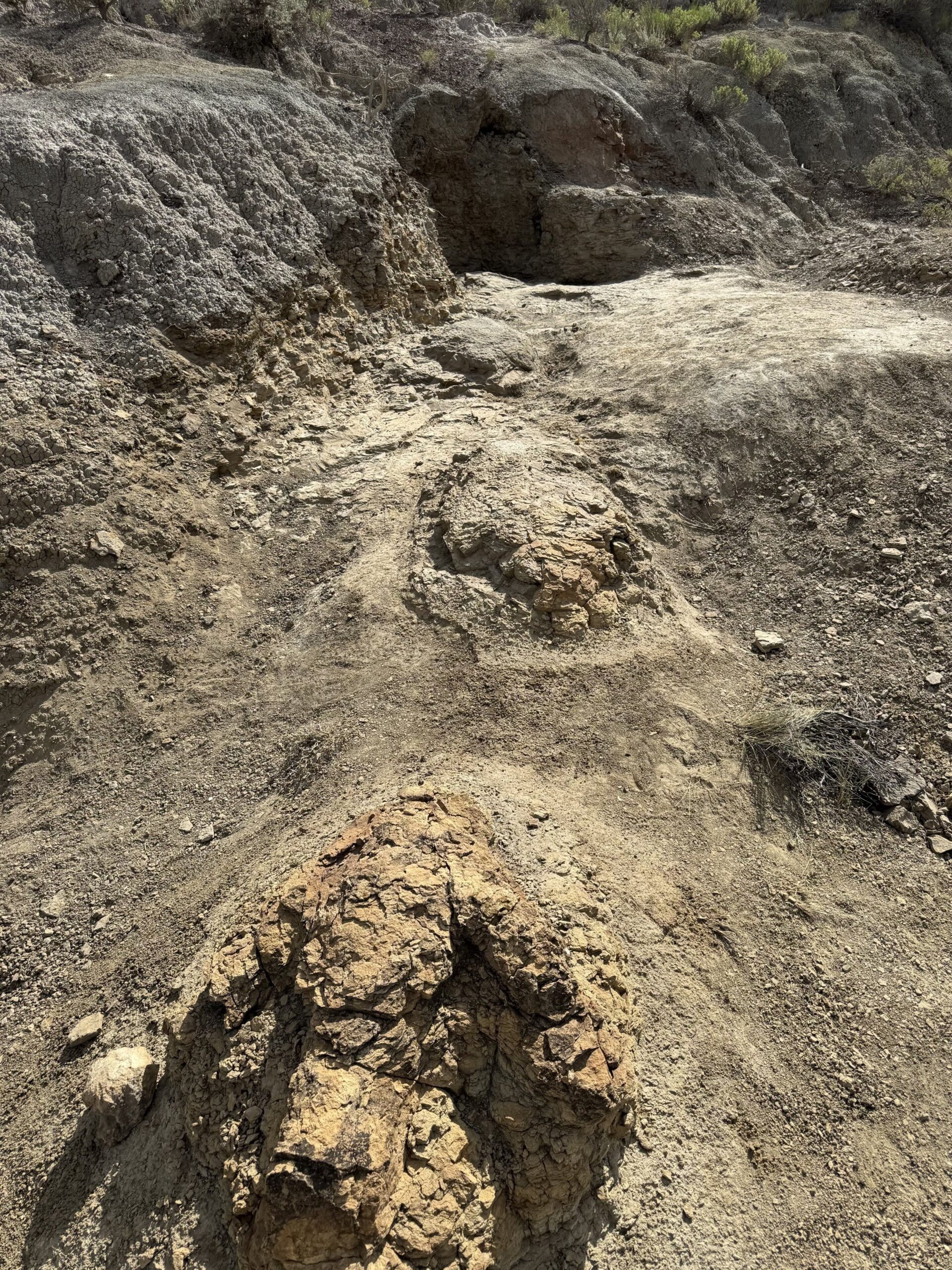
Four enormous three-toed footprints preserved in the Hell Creek Formation of North Dakota may be the first trackway attributable to an adult Tyrannosaurus rex. The tracks are about 1 meter long, form a roughly 7-meter trail, and date to about 66.5 million years ago, giving researchers a rare record of how a large adult T. rex moved across the ancient landscape.
The trackway was discovered in 2025 near Marmarth, North Dakota, in rocks belonging to the Upper Cretaceous Hell Creek Formation. It consists of four footprints, two from the left foot and two from the right, arranged along a trail about 7 meters long.
Each footprint is roughly 0.9 to 1 meter long and about 60 to 80 centimeters wide. The clearest footprint, identified as R2, measures 0.96 meters long and 0.8 meters wide.
The tracks are clearly three-toed, although erosion has damaged much of their anatomical detail. In R2, the impressions of digits II, III and IV measure about 34, 47 and 30 centimeters long, respectively. Each is about 13 centimeters wide.
A structure at the rear of R2 may represent a metatarsal pad or a hallux impression, although the researchers emphasize that its identity is uncertain.
That uncertainty matters because fossil footprints do not necessarily preserve an exact copy of an animal’s foot. Movement of the foot and changes in the sediment can alter the resulting impression, while weathering and preservation can further obscure its original form.
Even so, the combination of the footprints’ size, shape, age and location points strongly toward an adult T. rex.
Why the tracks are attributed to T. rex
Identifying the animal that made a dinosaur footprint can be difficult, particularly when several kinds of dinosaurs could have produced similar three-toed tracks.
Here, the researchers used several lines of evidence. The trackway occurs in the Hell Creek Formation of North Dakota and is estimated to be about 66.5 million years old. Its tracks are exceptionally large, measuring around 1 meter in length, and their relatively narrow digit impressions and narrow pace angulation are consistent with theropod tracks.
Hadrosaurs from the Hell Creek Formation could also make large three-toed tracks. But their digital impressions are broader, and their tracks tend to be wider than they are long. The researchers therefore consider a hadrosaur an unlikely explanation for this trackway.
The local fossil record provides another piece of evidence. Isolated T. rex skeletal elements are abundant in the area, and several partial T. rex skeletons have also been collected locally.
The size is particularly important. Previously reported tyrannosaurid trackways are considerably smaller. The tracks in the Wapiti Formation of British Columbia, attributed to non-Tyrannosaurus tyrannosaurids, are more than 50 centimeters long. The Glenrock Trackway in Wyoming, attributed to a subadult T. rex or Nanotyrannus lancensis, has tracks about 40 centimeters long. A Hell Creek trackway in South Dakota assigned to Wakinyantanka styxi has tracks measuring about 55 to 60 centimeters.
The new North Dakota tracks are nearly twice the length of some of these trackway footprints.
That combination of evidence leads the researchers to identify an adult T. rex as the most likely trackmaker.
The trail dates to about 66.5 million years ago
The trackway lies about 33 meters below the contact between the Hell Creek and Fort Union formations. That contact locally lies within about 1 meter of the Cretaceous-Paleogene boundary.
Nearby paleomagnetic work places the relevant 30n/29r magnetochron boundary about 26 meters below the Hell Creek/Fort Union contact. The trackway is about 7 meters below that magnetic boundary.
Using an estimated sedimentation rate, the researchers calculate that the footprints were made about 66.5 million years ago.
This places the trackway near the end of the Cretaceous, within the interval represented by the upper Hell Creek Formation.
Mineral-rich groundwater helped preserve the footprints
The footprints survived because of an unusual form of preservation.
Rather than remaining as simple depressions in soft sediment, the tracks became surrounded by hard sandstone concretions. The concretions formed when calcium carbonate cement accumulated around the footprint depressions, effectively creating durable casts.
The surrounding Hell Creek rocks are generally unconsolidated soft sediment. Over time, the softer material eroded away while the hardened concretions remained.
The most heavily eroded concretion, R2, exposes the fossilized footprint cast inside it.
This preservation also created a problem for the researchers. The surfaces of the casts are heavily fractured and weathered, leaving little anatomical information beyond the overall size and number of digits. The condition of the tracks also makes some measurements difficult to determine accurately and consistently.
The animal was probably walking
The four footprints are separated by strides of about 4 meters. The trackway is about 0.8 to 1 meter wide, and the footprints overlap the trackway’s midline by roughly 40% to 50%.
Using the stride and track measurements, the researchers estimate a walking speed in the region of 1.5 to 2 meters per second.
A calculation based on the approximately 1-meter track length gives a speed of about 1.6 meters per second. If the animal’s actual feet were closer to 80 centimeters long, rather than the full length of the preserved tracks, the estimate rises to about 2 meters per second.
The researchers caution that these numbers should be treated only as rough estimates because of the poor preservation and uncertainty about how faithfully the tracks represent the animal’s actual feet. They also conclude that the trackmaker was likely moving more slowly than these estimates suggest.
The estimated range nevertheless falls within the range of walking speeds reported for smaller tyrannosaurs.
The trackway is short, but it adds something missing from isolated footprints
Earlier tracks attributed to adult T. rex include large isolated footprints, but those individual tracks do not preserve information such as stride length.
The North Dakota trackway contains four sequential footprints, making it possible to examine the animal’s movement across the surface rather than just the size and shape of a single impression.
There is still little that can be inferred about locomotion from this particular trackway. Its short length and poor preservation limit the available information.
The trackway is also exposed along the edge of a steep butte, while any earlier footprints may remain buried beneath substantial overburden. Further excavation could potentially expose more of the trail and additional features, although the researchers note that the amount of overburden may make such excavation unlikely.
For now, the four large footprints provide the first trackway considered attributable to an adult Tyrannosaurus rex.
The study was published in Journal of Vertebrate Paleontology.