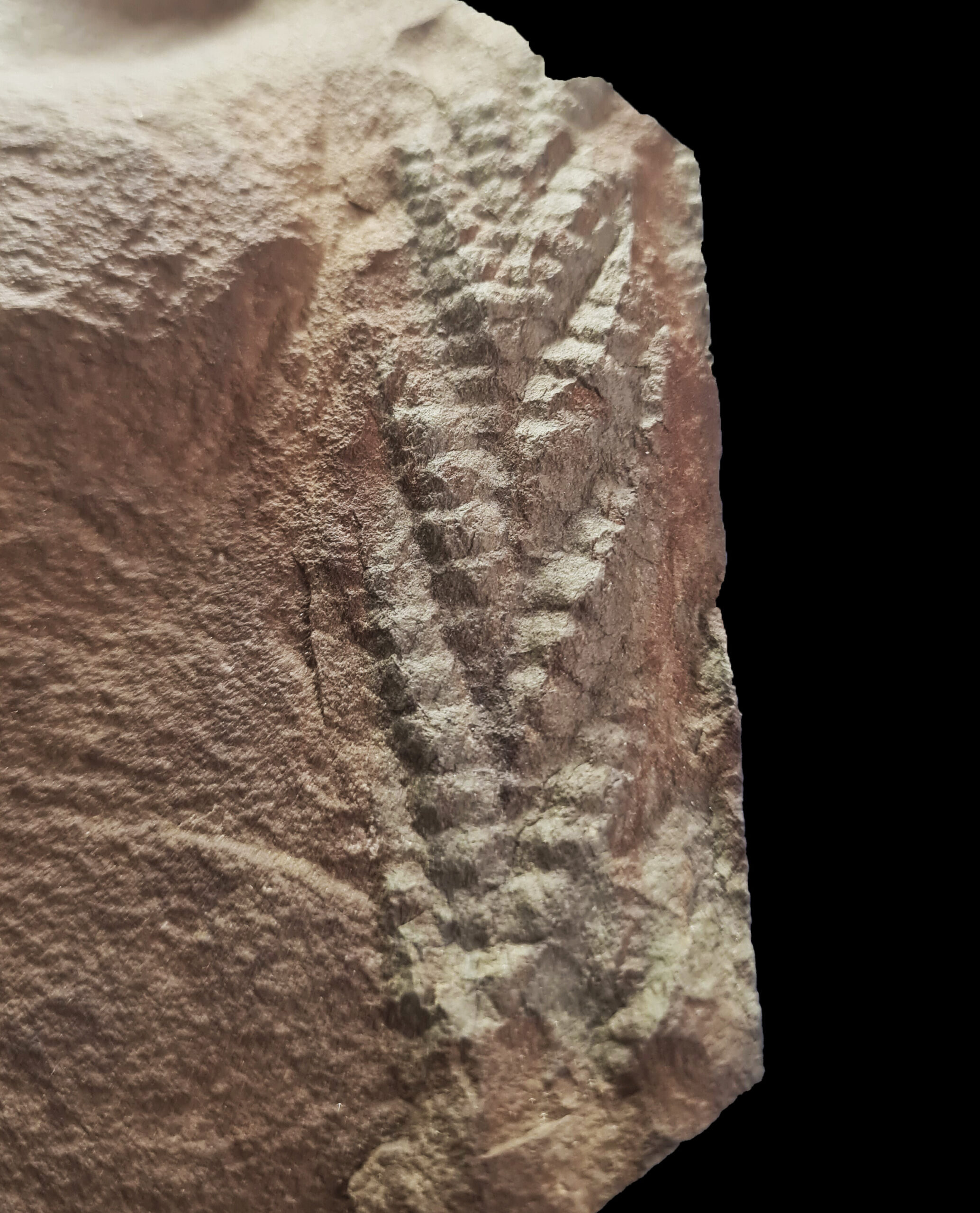
Embedded inside a slab of ancient rock in Arctic Norway, a small Charnia fossil preserves an unusually detailed three-dimensional view of a frond-shaped organism that lived more than half a billion years ago. Unlike the flattened impressions that commonly preserve Ediacaran soft-bodied fossils, this specimen retains about 5 millimeters of relief and shows an unusual set of angular ridges along its branches. Its preservation suggests that a sediment gravity flow may have transported and rapidly buried the organism, while other fossils in the same rocks point to several different processes that shaped which parts of the ancient community survived in the fossil record.
The fossils come from the Indreelva Member of the Stahpogieddi Formation, part of the Vestertana Group in Finnmark, Arctic Norway. The rocks record a late Neoproterozoic to early Cambrian interval, and the Indreelva Member is interpreted as a late Ediacaran succession. The age is not directly constrained by a precise date, but its position below the regional Ediacaran-Cambrian boundary, its fossil assemblage and the known age ranges of some Palaeopascichnus species are consistent with a late Ediacaran age. Earlier work placed a maximum age of 565 million years for the base of the member.
Most previous fossil discoveries from the Indreelva Member came from the Digermulen Peninsula. The new material was collected farther east on the Varanger Peninsula, an area that has received less intensive paleontological study. The fossils were found in loose blocks that could confidently be traced to the Indreelva Member at two localities, Blåberget and Kommagnes. At Blåberget, the exact fossil-bearing horizon could not be established. At Kommagnes, a Charnia-bearing block was found at the foot of the section, allowing its original stratigraphic position to be approximated.
The discovery is important first of all because Charnia had not previously been confirmed from Scandinavia. The authors regard these specimens as the first reported Scandinavian occurrence and the second confirmed occurrence of Charnia on the ancient continent of Baltica, after finds from the White Sea region.
That geographic distribution matters because Ediacaran fossil discoveries are unevenly distributed. Much of the known record comes from a relatively small number of intensively studied outcrop belts. The authors therefore emphasize the value of finding fossils in less-studied regions when assessing how representative the existing fossil record is of life during the Ediacaran.
Two Charnia fossils, with one preserved in unusual relief
The researchers identified two Charnia specimens, one from each locality. Both are incomplete fronds and neither preserves an associated stem or holdfast.
The larger Blåberget specimen is about 12 centimeters long where exposed and reaches a maximum width of 5 centimeters. It is preserved as a very low-relief impression, with relief much less than 1 millimeter.
The smaller Kommagnes specimen is about 7 centimeters long and 2 centimeters wide. It is preserved in much higher relief, about 5 millimeters, and retains three orders of branching. Both specimens show the characteristic zigzag suture between two rows of alternating first-order branches, with the branches rotated and furled through the observable branching levels.
Neither fossil can confidently be assigned to one of the currently recognized Charnia species. The Kommagnes specimen has first-order branches that diverge from the midline at about 20 degrees, a feature that could suggest Charnia gracilis. But its branches have a moderately high degree of sigmoidality, falling within the morphometric range of Charnia masoni. The Blåberget specimen shows the reverse combination, with divergence angles of about 20–30 degrees that are more characteristic of C. masoni but lower branch sigmoidality more characteristic of C. gracilis.
The Kommagnes fossil has another feature that makes it unusual. Seven of its 10 observable first-order branches have an angularity of about 120 degrees around their circumference. This produces a central ridge and gives the branches a distinctly “keeled” cross-sectional appearance rather than the more rounded or bulbous form usually seen in Charnia.
The remaining three branches do not show the same angularity, but those branches are also less well preserved, with lower relief and poorly visible third-order branches. The authors therefore suggest that the keeled appearance may have relatively low preservation potential. If so, the unusually angular specimen could represent a feature that was more common in Charnia than the fossil record normally indicates. That remains an interpretation rather than a demonstrated feature of the species.
The rock records two very different ways of preserving the fronds
The contrast between the two Charnia fossils is not simply a matter of size. They were preserved in fundamentally different settings within the sediment.
The Blåberget Charnia lies on a bedding surface in low relief. The surrounding mudstone contains very thin, discontinuous siltstone layers whose cross-laminae downlap onto irregular bed bases. The authors interpret these features as evidence of background sedimentation interrupted by distal turbidity currents. The position of the fossil indicates that the organism initially molded the sediment above it during burial, after which the overlying sediment could be exposed as a cast.
The Kommagnes Charnia is different. Its high-relief fossil surface cuts across the internal sedimentary fabric of the host siltstone rather than lying along a bedding plane. The researchers interpret this as an internal fracture that followed a weakness created by the fossil itself. That means the Charnia was preserved within the sediment as a transported piece of biological material, rather than simply leaving an impression on the seafloor.
Its long axis is aligned with the direction of ancient water flow inferred from the cross-lamination. The authors interpret this alignment as consistent with the fossil having been incorporated into the ripple-cross-laminated part of a sediment gravity flow.
The sediment above the fossil provides additional clues. It grades normally from sand-rich siltstone into claystone and contains sigmoidal cross-laminae before passing into structureless claystone. The combination of mixed grain sizes and these sedimentary structures is consistent with what the authors call a transitional flow, meaning a clay-rich sediment gravity flow with both turbulent and cohesive behavior.
The authors propose several factors that may have helped the Kommagnes Charnia survive this transport. The clay-rich flow may have been relatively cohesive and less turbulent than a more purely turbulent current. The fossil may also have come from a nearby growth site, because Aspidella-type holdfasts occur in the same unit. A short transport distance would have reduced the opportunity for the fragile organism to be damaged.
The authors also note that Charnia has been interpreted as having a bag-like hydrostatic exoskeleton, which would have made the organism relatively light and potentially easy to transport as a large biological fragment. They propose that continued flow after deposition may then have allowed the specimen to be rapidly filled and buried. These are proposed taphonomic explanations for the exceptional preservation, not measurements of the transport distance or direct observations of the burial process.
A thin coating of gray clay on the fossil may also have helped make it visible today. But the origin of that coating is uncertain. It could reflect early clay adsorption or mineral formation, low-grade metamorphism, or the fossil’s earlier burial in a clay-rich soft substrate. The authors therefore regard its original role in preservation as unresolved and potentially less important than the short transport path, the cohesive flow and rapid burial.
Other fossils fill out the ancient assemblage
Charnia is not the only fossil newly documented from these rocks. The researchers also describe possible scratch circles, Aspidella-type holdfasts, two species of Palaeopascichnus and two additional macroscopic body fossils that could not be formally identified.
One of the unidentified specimens is a possible frond from Kommagnes. It tapers toward its distal end and has curved first-order branches extending from a central stem. The authors consider an arboreomorph affinity possible because the branches appear downward-curved and undivided, but they do not formally identify the fossil.
The second unidentified specimen has a dumbbell-like outline, with one end circular and the other goblet-shaped. The researchers interpret it as a holdfast connected by a stem to a frond or calyx. Irregularity around the upper margin could indicate several upward-extending branches. Sediment around the holdfast also records scour and accumulation patterns consistent with a sessile organism acting as an obstacle to flow. The changing relief of the stem suggests that its lower portion may have stood partly upright while the upper part bent downward toward the substrate.
A large partial structure from Blåberget is interpreted as a possible scratch circle. It has a minimum radius of about 15 centimeters, with concentric to nearly concentric scratches that end relatively abruptly. The asymmetry of the individual scratches is consistent with an agent disturbing the sediment at an angle from a central position. The authors retain the identification as provisional because distinguishing scratch circles from discoidal fossils such as Aspidella can be difficult.
Aspidella-type concentric discoidal impressions are much more common in the Indreelva Member than the body fossils. Their preservation varies, but the different forms are consistent with a shallow, concentric structure surrounding a deeper vertical boss. That deeper structure appears to have had greater preservation potential.
Some sandstone-filled structures common at Kommagnes resemble the central structures of these Aspidella-type fossils. The association supports the hypothesis that at least some of the sandstone-filled structures are parts of Aspidella, although the authors stress that those structures can have several possible origins. If that interpretation is correct, holdfasts were even more abundant relative to body fossils than the visible fossil assemblage suggests.
Palaeopascichnus preserves repeated activity on the seafloor
The Palaeopascichnus fossils provide another unusually detailed view of how organisms and sediment interacted.
Several slabs from Blåberget contain dense assemblages of two species, Palaeopascichnus linearis and Palaeopascichnus gracilis. The fossils occur as strings of chambers, and some strings cross over themselves. The authors compare this self-overprinting pattern with younger palimpsest trace-fossil assemblages and interpret it as evidence that different generations of activity accumulated on the same surface over time.
One slab, specimen TSGF 18956, is particularly informative because the same Palaeopascichnus strings contain more than one style of preservation. Most chambers appear as raised rings surrounding a central hollow. Others form completely positive, rounded bulbs.
The first form may represent simple impressions made by the organism on the sediment surface that were later cast by overlying sediment. The second may have formed when the roof of a chamber was molded by the overlying sediment and then later cast from below, provided that the sediment mold remained intact. The researchers attribute the coexistence of both forms on the same surface, and even along individual strings, to small-scale differences in the strength of the overlying sediment and the physical behavior of the underlying substrate.
The fossils also contain morphological irregularities. Although Palaeopascichnus chambers generally have predictable shapes and spacing, some chambers are unusually small, while other strings contain several successive chambers with irregular widths, lengths or spacing. One chamber appears to bridge the usual elliptical and more meniscate shapes.
The authors interpret the appearance and transmission of these irregularities between successive chambers as consistent with a deterministic growth pattern previously proposed for Palaeopascichnus. Again, the wording is important: the fossils are consistent with that interpretation rather than independently proving the organism’s developmental mechanism.
Some Blåberget specimens have chambers whose width-to-length ratio approaches 10, with little change in dimensions along a string. Those specimens are attributed to Palaeopascichnus gracilis, a species known from the late Ediacaran of Baltica.
Why holdfasts survived when fronds often did not
Taken together, the fossils create a recognizable pattern. The Indreelva Member contains many more penetrating holdfast structures than preserved body fossils, much like other Ediacaran turbidite successions. This pattern has traditionally been described as “Fermeuse-style” preservation. The conventional explanation emphasizes turbidity currents removing frond-like organisms while leaving holdfasts attached to the sediment, sometimes in association with the absence of microbial mats that might otherwise aid preservation of surface impressions.
The new observations complicate that explanation.
The researchers found surface fossil structures in the Indreelva Member that are not associated with microbial textures. This indicates that microbial mediation was not necessarily required for surface impressions to survive. In their interpretation, turbidity currents could explain the removal of organisms attached to holdfasts, but they cannot by themselves account for the overall scarcity of surface impressions.
The sedimentary environment offers another possible explanation. The authors suggest that long intervals between sedimentation events could have allowed sessile organisms enough time to establish holdfasts in the seafloor. At the same time, repeated fine-grained sedimentation could have produced semi-fluid layers, or “mudcaps,” at the sediment surface.
Surface impressions within this active layer would have been vulnerable to being reworked or erased by winnowing and erosion. More deeply penetrating holdfasts, by contrast, could extend below that vulnerable layer and remain anchored in more stable sediment.
The exceptional Kommagnes Charnia represents a different route to preservation. Instead of remaining attached to the seafloor, it appears to have been transported into a sediment gravity flow and buried within the resulting deposit. Its preservation therefore bypassed some of the processes that normally remove exposed, surface-level remains in a turbidity-current environment.
The rocks themselves shaped what can still be seen
The authors also caution that the fossil assemblage reflects not only what lived there and what happened to the organisms after death, but also what happened to the rocks long after fossilization.
The Indreelva Member is thin-bedded and contains abundant bedding surfaces and variations in sediment texture. Those characteristics create opportunities for fossil surfaces to become exposed. But the rocks also underwent low-grade metamorphism, and modern exposure has been influenced by late Quaternary glaciation and freeze-thaw weathering.
As a result, loose blocks often break along fractures and cleavage planes instead of along the original bedding surfaces. Surface impressions can therefore be preferentially lost from the material available for observation, while deeper holdfasts that intersect fractures and cleavage planes may remain visible.
That sequence of processes is central to the authors’ interpretation. They argue that the holdfast-dominated assemblage should not be attributed to a single preservation mechanism. Instead, it is a polygenetic pattern produced by a chain of ecological, sedimentary, taphonomic, structural and modern outcrop processes.
In this view, the apparent absence of many frond-like body fossils does not necessarily record their absence from the ancient community. Some may have been removed during sediment transport, some surface impressions may have been destroyed while the seafloor remained soft, some fossils may have been affected during burial and later geological alteration, and others may simply be missing from the surfaces now exposed.
The two Charnia specimens illustrate that variability particularly clearly. One was preserved as a shallow impression on a bedding surface. The other was transported and embedded within a clay-rich sediment gravity flow, retaining substantial three-dimensional relief and an unusual keeled form. The same rock unit therefore records markedly different pathways by which a soft-bodied organism could enter the fossil record.
The newly described material also adds two species of Palaeopascichnus, possible scratch circles, Aspidella-type holdfasts and two unidentified macroscopic fossils to the assemblage. The Palaeopascichnus specimens preserve both multiple taphonomic styles and self-overprinting patterns consistent with time averaging on individual surfaces.
The authors conclude that the new Charnia specimens reinforce the broad geographic distribution of the genus during the late Ediacaran, while the wider assemblage demonstrates that fossil discoveries can still emerge from successions that have previously yielded relatively few and poorly diverse macrofossils.
The study was published in Palaeontology.