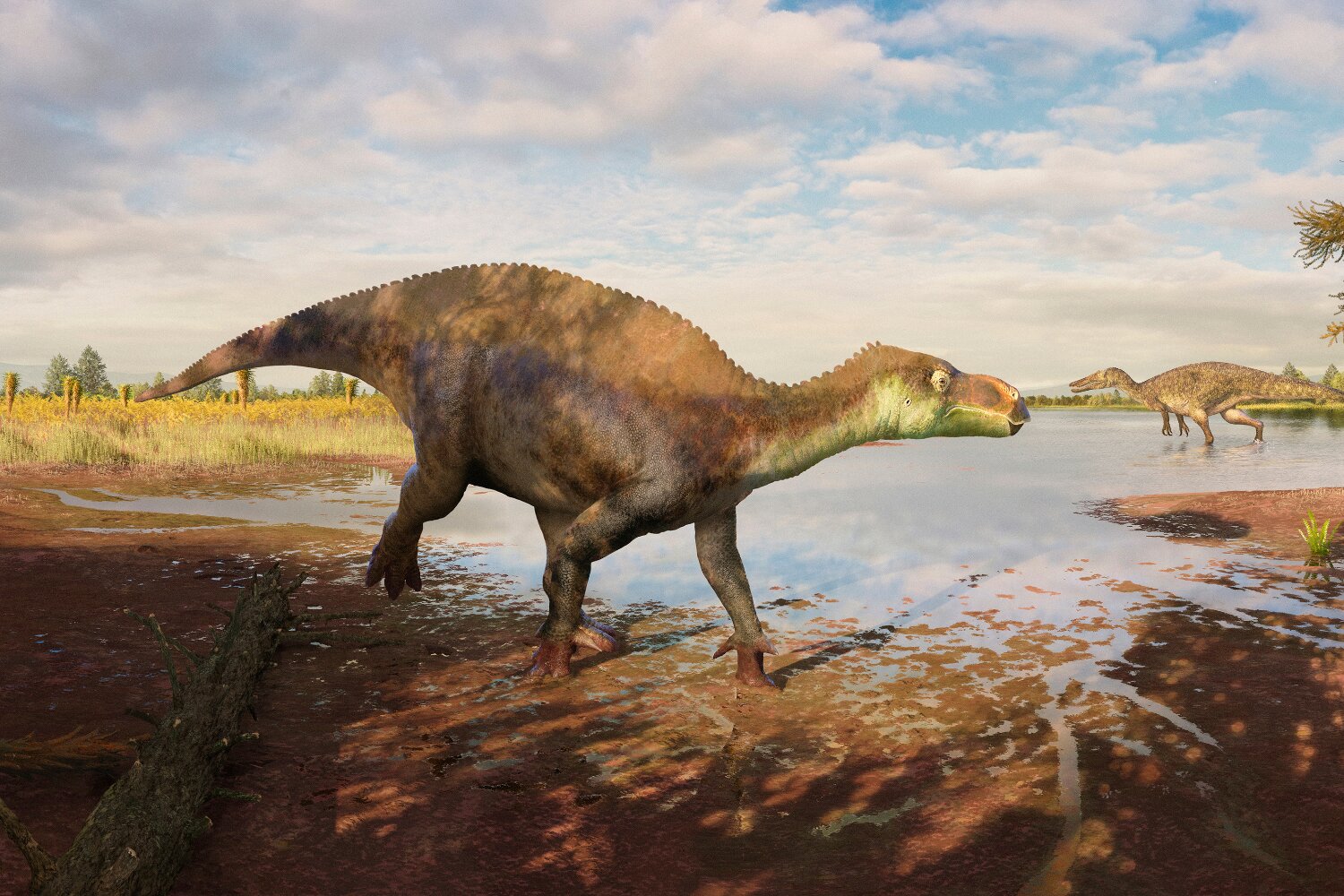
A dinosaur fossil discovered in a southern England quarry in 2001 has finally been recognized as belonging to an entirely new genus and species. Named Paludohadros proudlovii, the plant-eating dinosaur lived about 125 million years ago and may have grown to twice the size of the individual found. Its identification also raises the possibility that more previously unrecognized dinosaur species are waiting in museum collections.
The fossil was uncovered at Ewhurst Works, a brick and roof tile quarry in Surrey, in 2001. It was later donated to the Natural History Museum in London, where it remained part of the museum’s collections.
The dinosaur belonged to a group called iguanodontians, plant-eating dinosaurs known for the distinctive spikes on their thumbs.
For many years, iguanodontian fossils found in southern England were generally classified as either Iguanodon or Mantellisaurus, a smaller relative. But a detailed reassessment of Mantellisaurus by Natural History Museum scientists in 2023 helped paleontologists identify differences between these dinosaurs and other fossils.
That work has contributed to the recognition of several previously unnamed iguanodontians in recent years, including Brighstoneus, Comptonatus and Istiorachis. Paludohadros is the latest addition.
The name reflects the environment in which the dinosaur lived. About 125 million years ago, during the Early Cretaceous, southern England was covered in muddy wetlands. The word “palus” means swamp in Latin.
The dinosaur was named in memory of a quarry manager
The species name, proudlovii, honors Will Proudlove, a former employee of Ewhurst Works who eventually became its manager.
Proudlove died at 35, shortly before the dinosaur was excavated. He had been interested in dinosaur fossils and often wondered what might be uncovered as workers removed layers of clay from the quarry.
His wife, Rachael Proudlove, said the family was invited to watch the fossil being excavated in 2001. Although the discovery came a year after her husband’s death, the dinosaur’s story became part of their family life.
She said the family was delighted to learn that the fossil represented not just a new species but an entirely new genus, and that her husband’s name would remain associated with it.
A young herbivore that lived alongside Baryonyx
When it died, Paludohadros proudlovii was about 5 meters (16 feet) long and weighed roughly 1.5 to 2 tonnes (1.7 to 2.2 tons), making it similar in size to a rhinoceros.
However, its bones do not appear to have been fully developed. Researchers therefore believe the animal was probably still young and may have grown to twice its recovered size if it had reached adulthood.
The dinosaur lived alongside several other species, including Baryonyx walkeri, a large, two-legged meat-eating dinosaur whose fossils were also discovered at Ewhurst Works, in 1983.
The two dinosaurs may have had a direct connection. Paludohadros was found about 100 meters (328 feet) from the Baryonyx fossils now held by the Natural History Museum.
Although Baryonyx is best known for eating fish, evidence from one specimen indicates that its last meal also included a young iguanodontian.
Professor Susannah Maidment, a senior author of the research at the Natural History Museum and the University of Birmingham, said it is not possible to determine which iguanodontian species that young animal belonged to.
She said Baryonyx may have scavenged the remains of a young Paludohadros, although it is also possible that it hunted the dinosaur when the opportunity arose.
Museum collections could contain more unnamed dinosaurs
The identification of Paludohadros has also prompted scientists to take another look at iguanodontian fossils already held by the Natural History Museum.
Researchers have identified several additional Paludohadros specimens among fossils originally collected in the 1950s. Their recognition suggests that some museum specimens may have been assigned to broader dinosaur groups without their distinct identities being recognized.
Ricardo Sacamoto, a Ph.D. student at the Natural History Museum and the University of São Paulo who led the research, said he plans to examine the museum’s iguanodontian collections as part of his doctoral work.
The review could identify additional dinosaur species that have not yet been formally recognized.
The study was published in the Journal of Systematic Palaeontology.