Astronomers have confirmed two actively accreting supermassive black holes inside the same compact, intensely star-forming galaxy system, providing the first confirmed example of a dual active galactic nucleus in a Green Pea galaxy. The two black holes are separated by about 8.4 kiloparsecs in projection and are both producing powerful X-rays and characteristic emission from active galactic nuclei.
Two active nuclei in one compact system
The galaxy system, SDSS J162209.41+352107.5, is known as J1622+3521. It belongs to a class called Green Pea galaxies, compact systems known for intense star formation, relatively low metallicity and unusually strong ionization.
Green Pea galaxies are nearby examples of compact galaxies that are thought to resemble some of the conditions associated with rapidly assembling galaxies in the early Universe. Their small sizes and intense star formation make them useful for studying how stars and supermassive black holes grow in dense, rapidly evolving environments.
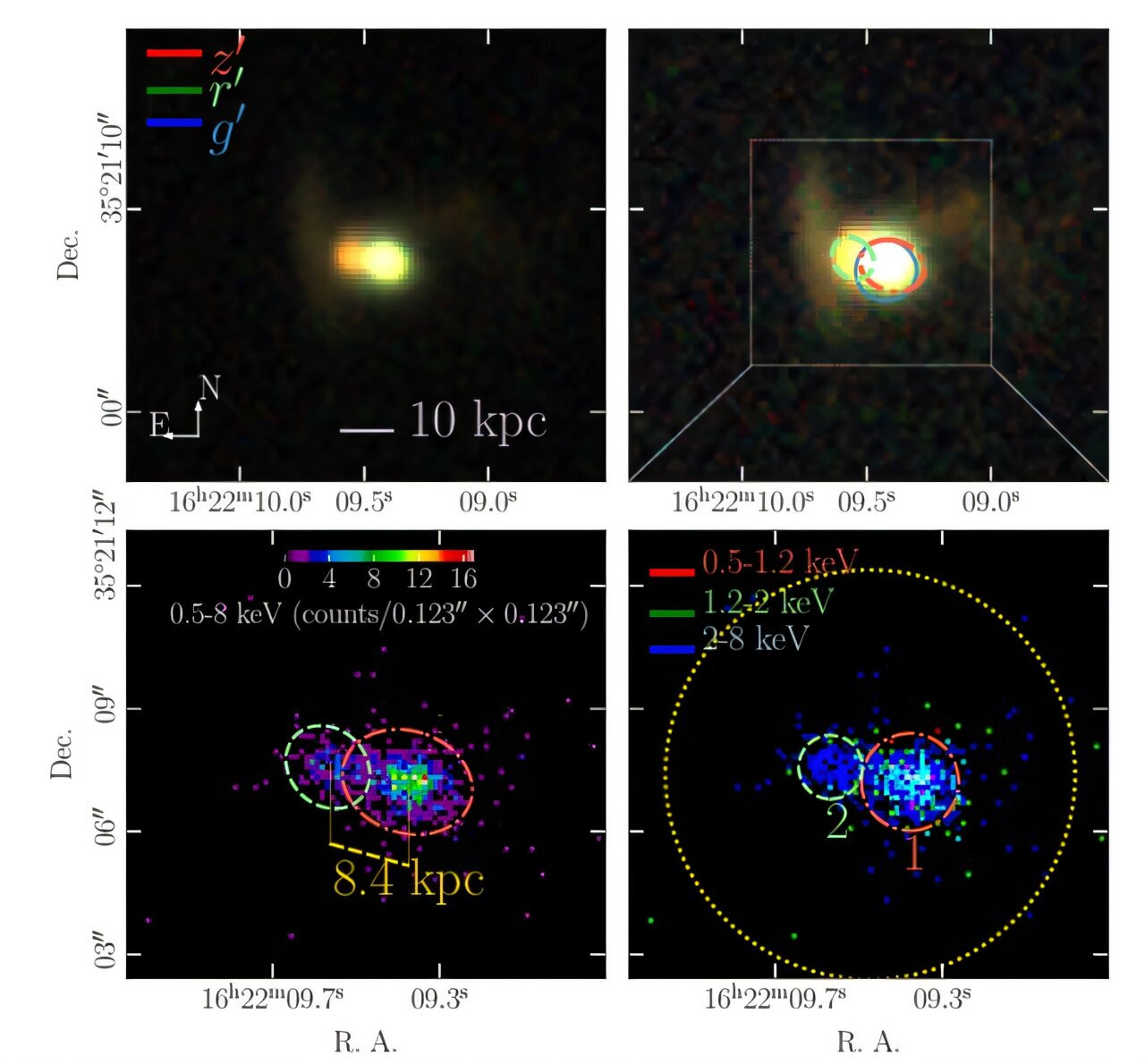
J1622+3521 stood out because its optical appearance was irregular and showed signs of an interaction. Deep optical imaging reveals two distinct nuclei surrounded by diffuse stellar emission. Faint asymmetric structures extend mainly from east to west and are consistent with tidal debris produced during an ongoing interaction.
The two nuclei are separated by about 1.9 arcseconds on the sky. At the system’s distance, that corresponds to a projected separation of about 8.4 kiloparsecs.
But the optical appearance alone could not establish that both nuclei contained actively feeding black holes. The researchers therefore combined X-ray observations with detailed optical spectroscopy.
Chandra resolves two X-ray sources
The strongest evidence came from observations with NASA’s Chandra X-ray Observatory.
The researchers analyzed 42.7 kiloseconds of newly obtained Chandra observations. The X-ray images revealed two spatially separated sources at the positions of the two optical nuclei.
Both sources emit substantial amounts of hard X-rays. The intrinsic 2–10 keV luminosity is about 10⁴³.⁹³ erg per second for Source 1 and about 10⁴³.⁵⁵ erg per second for Source 2.
Their X-ray spectra also show that both sources are significantly obscured by gas. The estimated line-of-sight hydrogen column densities are about 10²².⁸ cm⁻² for Source 1 and 10²³.⁶ cm⁻² for Source 2.
Despite that obscuration, the hard X-ray emission is strong enough to establish the active nature of both sources. The spectral analysis gives intrinsic coronal photon indices of about 1.76 for Source 1 and 1.79 for Source 2.
The two X-ray sources are therefore not simply two unresolved pieces of diffuse emission. They are spatially distinct sources that coincide with the two optical nuclei.
The two nuclei are physically associated
The researchers then used the Keck II telescope’s DEIMOS spectrograph to examine both optical components simultaneously.
The spectra show two spatially separated emission-line systems. Both contain strong emission lines from hydrogen and highly ionized elements.
The two nuclei have essentially the same measured redshift. The best-fit values are 0.2667 ± 0.0001 for Source 1 and 0.2667 ± 0.0002 for Source 2.
The inferred velocity difference between them is only about 7 kilometers per second, with an uncertainty of about 74 kilometers per second. Within the uncertainties, the two nuclei therefore share a common systemic velocity.
That result supports the interpretation that the two objects belong to the same interacting system rather than being unrelated galaxies that happen to appear close together on the sky.
The optical data also provide an independent indication that both nuclei contain active black holes.
Both nuclei show broad emission from active black holes
One of the clearest signs comes from broad Hα emission.
For Source 1, the broad Hα component has a full width at half maximum of about 1,892 kilometers per second. For Source 2, the corresponding width is about 1,690 kilometers per second.
Broad Hβ emission is also detected in both sources, although it is fainter and therefore less precisely measured. The fitted broad Hβ widths are about 1,200 kilometers per second for Source 1 and 1,000 kilometers per second for Source 2.
The broad Hα components are not simply minor features added to the spectra. Including them produces a major improvement in the spectral fits for both nuclei. The resulting broad-line emission is consistent with emission from broad-line regions around actively accreting black holes.
The spectra also contain high-ionization lines such as He II λ4686, [Ne V] λλ3346, 3426 and [Fe VII] λ6087.
The [Ne V] and [Fe VII] lines require photons with energies of roughly 97 and 99 electron volts, respectively. Such high-energy ionization is widely associated with active galactic nuclei.
Together with the X-ray detections and the broad Balmer lines, these features provide several independent indicators of active accretion in both nuclei.
Both nuclei fall in the AGN region of the BPT diagram
The researchers also examined the narrow emission lines using a Baldwin–Phillips–Terlevich, or BPT, diagram.
This method compares specific emission-line ratios to distinguish gas primarily ionized by active galactic nuclei from gas whose emission is dominated by star formation.
Both nuclei fall securely within the AGN region of the diagram. They have similar excitation, with log([O III]/Hβ) of about 0.9.
This provides another independent line of evidence that the emission from each nucleus is dominated by radiation from an accreting supermassive black hole rather than by star formation alone.
The optical and X-ray evidence therefore converge on the same result. J1622+3521 contains two active galactic nuclei.
Each black hole has a mass of about 20 million Suns
The broad Hα measurements also allow the researchers to estimate the masses of the two black holes.
Using single-epoch virial relations calibrated for low-mass broad-line active galaxies, they estimate a black hole mass of about 10⁷.³¹ solar masses for Source 1 and 10⁷.²⁹ solar masses for Source 2.
These correspond to roughly 20 million times the mass of the Sun for each black hole.
The quoted statistical uncertainties are about 0.13 dex for Source 1 and 0.16 dex for Source 2. The researchers note that these estimates do not include the larger systematic uncertainty associated with single-epoch virial black hole mass measurements, which they estimate at about 0.4–0.5 dex.
The study does not use black hole masses derived from the local black hole–stellar velocity-dispersion relation because the stellar motions in this interacting system may be affected by rotation, tidal motions and other non-equilibrium effects.
Both black holes are growing efficiently
The X-ray luminosities and black hole mass estimates can be combined to estimate how rapidly the two black holes are accreting relative to their Eddington limits.
Using a bolometric correction of 20, the researchers derive bolometric luminosities of about 10⁴⁵.²³ erg per second for Source 1 and 10⁴⁴.⁸⁵ erg per second for Source 2.
The resulting Eddington ratios are about 0.66 and 0.29.
In other words, Source 1 is radiating at roughly two-thirds of its Eddington luminosity, while Source 2 is at roughly three-tenths of that limit under the adopted assumptions.
The researchers describe both nuclei as efficiently accreting, with Source 1 showing particularly rapid accretion characteristic of rapidly growing Seyfert 1 and narrow-line Seyfert 1-like systems.
Changing the adopted bolometric correction within the range commonly reported for such systems would alter the inferred Eddington ratios by about 0.2 dex but would not change the study’s main conclusions.
The system is still before the two nuclei merge
The projected separation of about 8.4 kiloparsecs indicates that the two nuclei have not yet coalesced.
The optical images show two distinct nuclei within diffuse stellar emission, along with faint asymmetric structures interpreted as tidal features. Their similar redshifts and small relative velocity are consistent with an interacting system in a pre-coalescence phase.
The researchers interpret the system as an ongoing merger in which both black holes are active at the same time.
This is important because confirmed dual AGN are rare and have generally been found in more massive, gas-rich merging galaxies. J1622+3521 instead places two actively accreting supermassive black holes inside a compact Green Pea system with intense star formation and relatively low stellar mass.
The black holes are obscured by nuclear gas and dust
The two nuclei also show evidence of substantial obscuration.
The broad-line Balmer decrements give color excesses of E(B−V) = 0.65 ± 0.26 for Source 1 and 0.92 ± 0.32 for Source 2.
Source 2 therefore shows stronger reddening of its broad-line region than Source 1.
The X-ray measurements independently indicate significant obscuration. The estimated column densities are about 10²².⁹ cm⁻² for Source 1 and 10²³.⁶ cm⁻² for Source 2.
The combination of optical reddening and X-ray absorption indicates that both active nuclei are surrounded by substantial obscuring material.
The researchers find that the ratios between X-ray absorbing gas and optical reddening are about 17 and 75 times larger than the canonical Galactic value for the two sources. They interpret these elevated gas-to-dust ratios as evidence that a significant fraction of the absorbing gas may lie in the circumnuclear environment of the active nuclei rather than in the wider interstellar medium of the host galaxy.
The absorbing columns remain below the Compton-thick levels measured in some nearby dual-AGN systems.
Infrared observations also support the AGN interpretation
The system was also examined using infrared observations from NASA’s Wide-field Infrared Survey Explorer.
Because WISE has a relatively large point-spread function, J1622+3521 appears unresolved in its infrared images. Even so, its infrared colors are strongly associated with active galactic nuclei.
The measured colors are W1 − W2 = 1.38 ± 0.03 magnitudes and W2 − W3 = 3.05 ± 0.03 magnitudes.
These colors place the source within established AGN selection regions. They are also consistent with the infrared colors of most infrared-detected Green Pea galaxies, although many of those galaxies had not previously been classified as AGN using their optical spectra.
The two nuclei follow the He II–X-ray relation seen in AGN
Another comparison comes from the He II λ4686 emission line and soft X-rays.
He II emission traces gas exposed to photons with energies above 54.4 electron volts. The observed narrow He II-to-Hβ ratios are about 0.19 for Source 1 and 0.25 for Source 2.
Both nuclei fall within the AGN-dominated regime of the relevant diagnostic diagrams. Their observed He II luminosities also lie close to an empirical relation between He II and soft X-ray luminosity established for AGN.
This agreement provides additional evidence that both nuclei contain actively accreting black holes and have highly ionized environments.
It also places J1622+3521 alongside a recently identified X-ray-detected Red Dot in the same general luminosity relation. The researchers note that this agreement is consistent with compact, rapidly accreting supermassive black holes following a common ionizing-continuum scaling relation across different luminosities and cosmic epochs.
A rare type of dual AGN
The central distinction of J1622+3521 is not simply that it is an interacting galaxy with two nuclei. Other dual AGN are known in interacting systems.
What makes this system unusual is the environment in which both active black holes are found.
Green Pea galaxies are compact, intensely star-forming, low-metallicity systems with extreme ionization conditions. Confirmed dual AGN have not previously been established in such a compact, low-mass, metal-poor galaxy environment.
J1622+3521 therefore extends the confirmed population of dual AGN into a host-galaxy regime that has been poorly represented in previous samples.
Both nuclei have Seyfert-like X-ray luminosities and relatively high Eddington ratios despite the system’s comparatively modest stellar mass.
The inferred black hole masses also place both nuclei broadly within the scatter of local black hole–stellar mass relations. The researchers note that the stellar masses come from spectroscopic apertures and may underestimate the total stellar masses of the interacting galaxies by a few tenths of a dex.
A nearby system with similarities to compact high-redshift AGN
The researchers also compare J1622+3521 with compact active galaxies observed at high redshift, including the recently identified populations known as Little Red Dots and Little Blue Dots.
Both nuclei in J1622+3521 have broad Balmer emission, compact morphology and substantial nuclear obscuration. Source 2, in particular, has strong broad-line reddening and a relatively large Balmer decrement.
These properties resemble some compact, obscured AGN identified with the James Webb Space Telescope.
At the same time, J1622+3521 differs from many compact high-redshift AGN candidates because both of its nuclei are detected in X-rays and have intrinsic X-ray luminosities consistent with active galactic nuclei.
The researchers find that both nuclei remain broadly consistent with the established relation between broad Hα and intrinsic X-ray luminosity for local broad-line AGN. They note that this makes J1622+3521 more similar to the recently identified X-ray Dot than to many currently known X-ray-weak compact AGN.
The study also notes that the current data cannot completely exclude more heavily obscured geometries in which some of the observed X-rays could be scattered or reflected. Future hard X-ray observations will be needed to investigate whether deeply buried components are present.
The first confirmed dual AGN in a Green Pea system
The evidence from several independent observations points to the same conclusion.
Chandra resolves two hard X-ray sources. Keck spectroscopy shows that the two optical nuclei share a common redshift and each displays broad Balmer emission and high-ionization lines. Both nuclei fall in the AGN region of the BPT diagram. Their X-ray luminosities, broad-line properties and infrared colors independently support active accretion.
The two black holes have estimated masses of about 10⁷.³ solar masses and are accreting at Eddington ratios of about 0.66 and 0.29. They are separated by about 8.4 kiloparsecs in projection within a compact Green Pea system showing signs of an ongoing interaction.
Together, these observations establish J1622+3521 as the first confirmed dual active galactic nucleus hosted within a Green Pea galaxy system.
The researchers interpret the ongoing interaction as a likely contributor to gas inflow toward the nuclear regions, fueling the activity and contributing to the observed obscuration. They identify the system as a nearby laboratory for studying the relationship between mergers, compact star-forming environments and supermassive black-hole growth.
The study was posted as a preprint on the arXiv preprint server