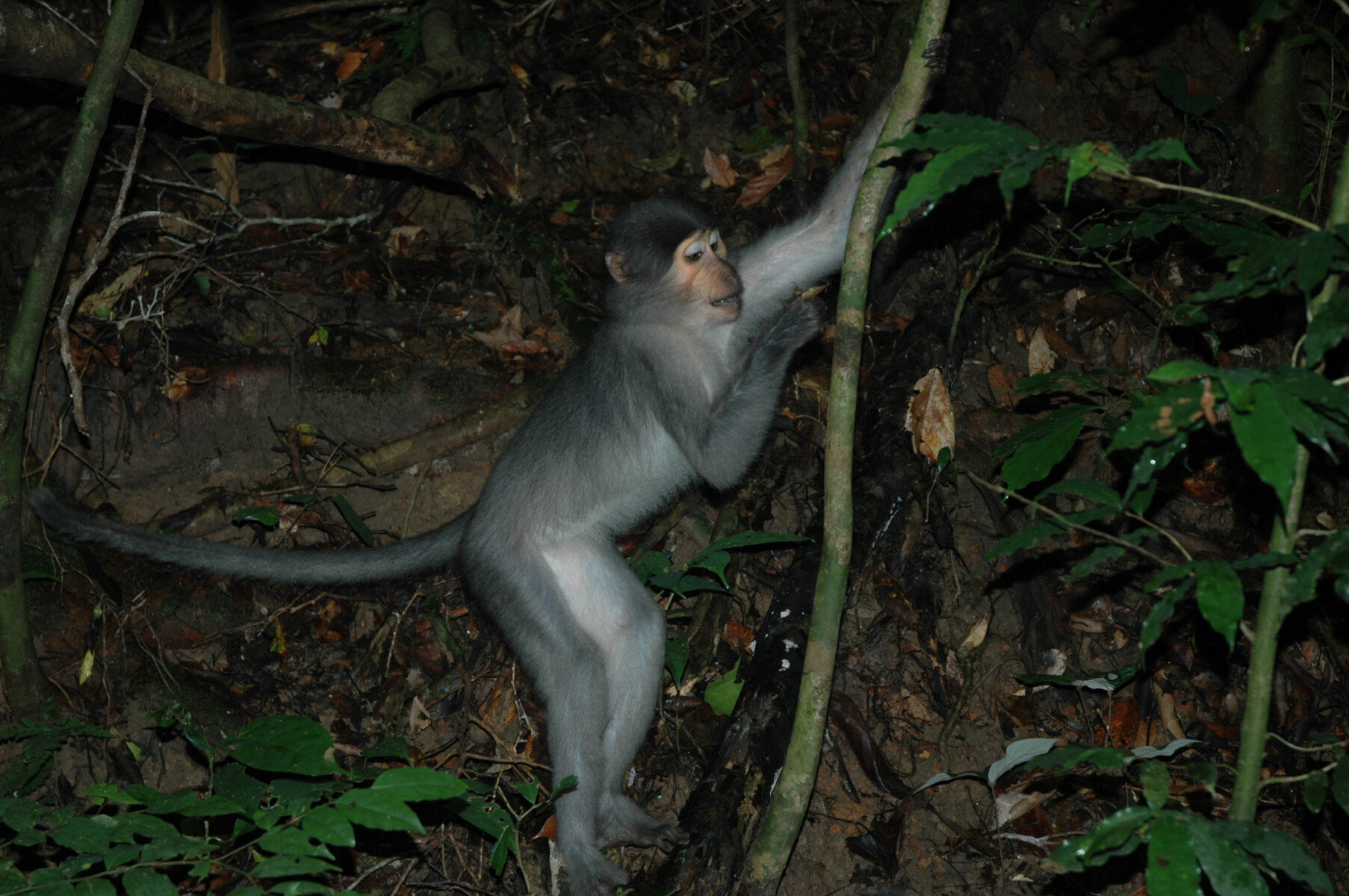
Wild sooty mangabeys can bend their midfoot by about 46 degrees while climbing vertical tree trunks, nearly matching the extreme ankle flexibility seen in chimpanzees. The finding suggests that primates with different foot structures can arrive at similar climbing mechanics, and it leaves open the possibility that the human-chimpanzee ancestor could have climbed vertically even if its feet were more monkey-like.
For years, researchers studying early human evolution have debated what the feet of the last common ancestor of humans and chimpanzees looked like and how that ancestor moved through trees.
One view holds that this ancestor had a distinctly African ape-like foot, with features that supported tree climbing and terrestrial movement. Another argues that its foot was more similar to that of generalized monkeys, with a shorter midfoot and a different set of functional capabilities.
The disagreement matters because the two models lead to different ideas about how important vertical climbing may have been in the ancestor’s locomotion.
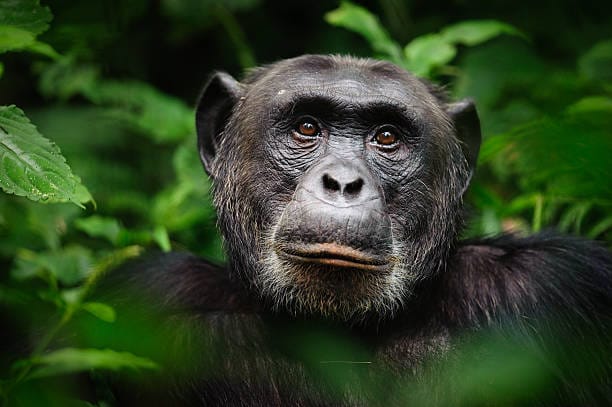
In African apes such as chimpanzees, vertical climbing involves very large movements at the ankle. During a climb, the ankle can bend upward by more than 45 degrees. This brings the body’s center of mass closer to the tree trunk and reduces the backward torque produced by gravity, helping make climbing safer.
Most modern humans and fossil hominins do not have the same widened ankle structure found in African apes. That has made it difficult to explain how a hominin with a more human-like or monkey-like foot could have achieved similar climbing mechanics.
The new observations of wild sooty mangabeys point to another solution.
Instead of producing most of this movement at the ankle, the monkeys can produce an unusually large amount of bending through the middle of the foot.
Sooty mangabeys bend their midfeet by about 46 degrees
Researchers observed wild sooty mangabeys (Cercocebus atys) in Taï National Park in Côte d’Ivoire. The species is a large African monkey that forages on the ground but also climbs vertical tree trunks.
Using video recordings, the researchers measured movement at both the ankle and midfoot during vertical climbing.
The difference between the two joints was striking.
The monkeys reached a maximum average midfoot dorsiflexion of 45.7 degrees, with a standard deviation of 7.0 degrees across 21 individuals. Dorsiflexion here means bending the foot upward.
Their maximum ankle dorsiflexion was much smaller, averaging 23.3 degrees with a standard deviation of 10.3 degrees.
That means the mangabeys produced roughly 65% more maximum dorsiflexion at the midfoot than at the ankle during their climbing bouts.
The midfoot movement was also unusually large compared with measurements from other forms of movement. It was greater than the maximum midfoot dorsiflexion previously recorded in chimpanzees during terrestrial quadrupedalism, which averaged 26.5 degrees, and in modern humans during walking, which averaged 11.1 degrees.
The midfoot movement matches chimpanzee ankle movement
The most important comparison came from looking at how the mangabey midfoot movement compares with the ankle movement of other vertical climbers.
Chimpanzees reached an average maximum ankle dorsiflexion of 45.5 degrees during vertical climbing. The mangabey midfoot value of 45.7 degrees was therefore nearly identical in magnitude.
The mangabey midfoot also exceeded the maximum ankle dorsiflexion measured in climbing Twa hunter-gatherers, which averaged 40.7 degrees.
Statistical comparisons showed that the mangabey’s midfoot dorsiflexion was not significantly different from the chimpanzee or Twa ankle values.
By contrast, the mangabey’s ankle dorsiflexion was significantly lower than the ankle dorsiflexion measured in both chimpanzees and Twa hunter-gatherers.
The researchers also found that chimpanzees and sooty mangabeys had comparable size-standardized horizontal distances between their centers of mass and the tree during maximum climbing dorsiflexion.
The measurements therefore point to two different ways of producing a similar mechanical position during vertical climbing. Chimpanzees achieve extreme movement mainly through the ankle, while sooty mangabeys achieve a comparable degree of foot flexion through the midfoot.
A flexible midfoot can provide an alternative
The relevant part of the mangabey foot is the midfoot, where substantial movement can occur between the cuboid and the fourth and fifth metatarsals. This movement is sometimes described as a “midfoot break.”
Earlier work had proposed that this flexibility could be functionally similar to the extreme ankle dorsiflexion used by African apes during vertical climbing.
The new field measurements provide direct kinematic evidence for that possibility.
The researchers interpret the result as evidence of a kinematic convergence in primate foot biomechanics. In other words, primates with different overall foot structures can use different joints to produce similar movement during the same type of behavior.
Their findings indicate that extreme dorsiflexion, whether produced at the ankle or the midfoot, can be an important feature of vertical climbing.
The researchers do not argue that the mangabey and chimpanzee feet are structurally the same. Instead, the key similarity is in how their feet move during climbing.
What this means for the human-chimpanzee ancestor
The observations bear directly on the debate over the last common ancestor of humans and chimpanzees.
If that ancestor had an African ape-like foot, extreme ankle dorsiflexion could have supported vertical climbing under the model already proposed for African apes.
But if the ancestor instead had a more monkey-like foot, the mangabey observations show that such morphology would not necessarily rule out vertical climbing.
The researchers therefore conclude that vertical climbing would still have been a plausible part of the locomotor repertoire of the last common ancestor even if it possessed a more monkey-like foot.
That does not establish which of the competing reconstructions of the ancestral foot is correct. The researchers explicitly state that their comparative data do not favor one reconstruction over the other.
Instead, the findings show that safe vertical climbing can be compatible with either an ape-like or monkey-like foot because different foot structures can produce similar climbing kinematics.
This adds a functional dimension to the debate. A particular fossil foot shape cannot necessarily be treated as evidence that vertical climbing was impossible simply because it lacks the specialized ankle features seen in African apes.
The findings also apply to early hominin feet
The observations may also help explain unusual features found in the feet of some early hominins.
Most Plio-Pleistocene australopiths lacked the mediolateral expansion of the front part of the ankle that characterizes African apes. That anatomy has been interpreted as evidence against frequent chimpanzee-like vertical climbing with a strongly flexed ankle, alongside a greater role for striding bipedalism.
But some Australopithecus species had distinctive structures in the fourth metatarsal, one of the long bones of the foot.
In Australopithecus deyiremeda, which lived about 3.5 million years ago, the base of the fourth metatarsal had a relatively short dorsoplantar height. In Australopithecus sediba, which lived about 2.0 million years ago, the base was strongly convex.
Previous researchers had suggested that these features could indicate greater midfoot flexibility than in modern humans and could have been useful for climbing.
The new kinematic observations support those functional interpretations. The researchers propose that a cercopithecoid-like degree of midfoot dorsiflexion, potentially similar in magnitude to that measured in the mangabeys, could have provided these hominins with another means of achieving safe vertical climbing.
That interpretation remains tied to the functional evidence rather than establishing exactly how these extinct hominins moved. The study’s direct measurements come from living sooty mangabeys, while the implications for fossil hominins depend on comparisons between their preserved foot anatomy and the observed mechanics.
The study is based on wild monkeys
The researchers collected their observations opportunistically from habituated wild sooty mangabeys in the primary study grid of the Taï Monkey Project in Taï National Park.
They recorded the animals at 30 frames per second with a tripod-mounted Canon EOS 7D video camera. The analysis of maximum ankle and midfoot dorsiflexion followed previously established analytical protocols.
The study included 21 sooty mangabeys in the kinematic measurements.
The resulting measurements provide direct field data on how a wild cercopithecoid monkey uses its foot while climbing vertical trunks. Those observations are what allow the researchers to compare the monkey’s midfoot movement with ankle movements measured in other vertical climbers.
The central result is that the sooty mangabey does not need extreme ankle flexibility to produce an extreme degree of foot dorsiflexion during vertical climbing. Its midfoot provides much of that movement instead.
The study was published in PNAS.