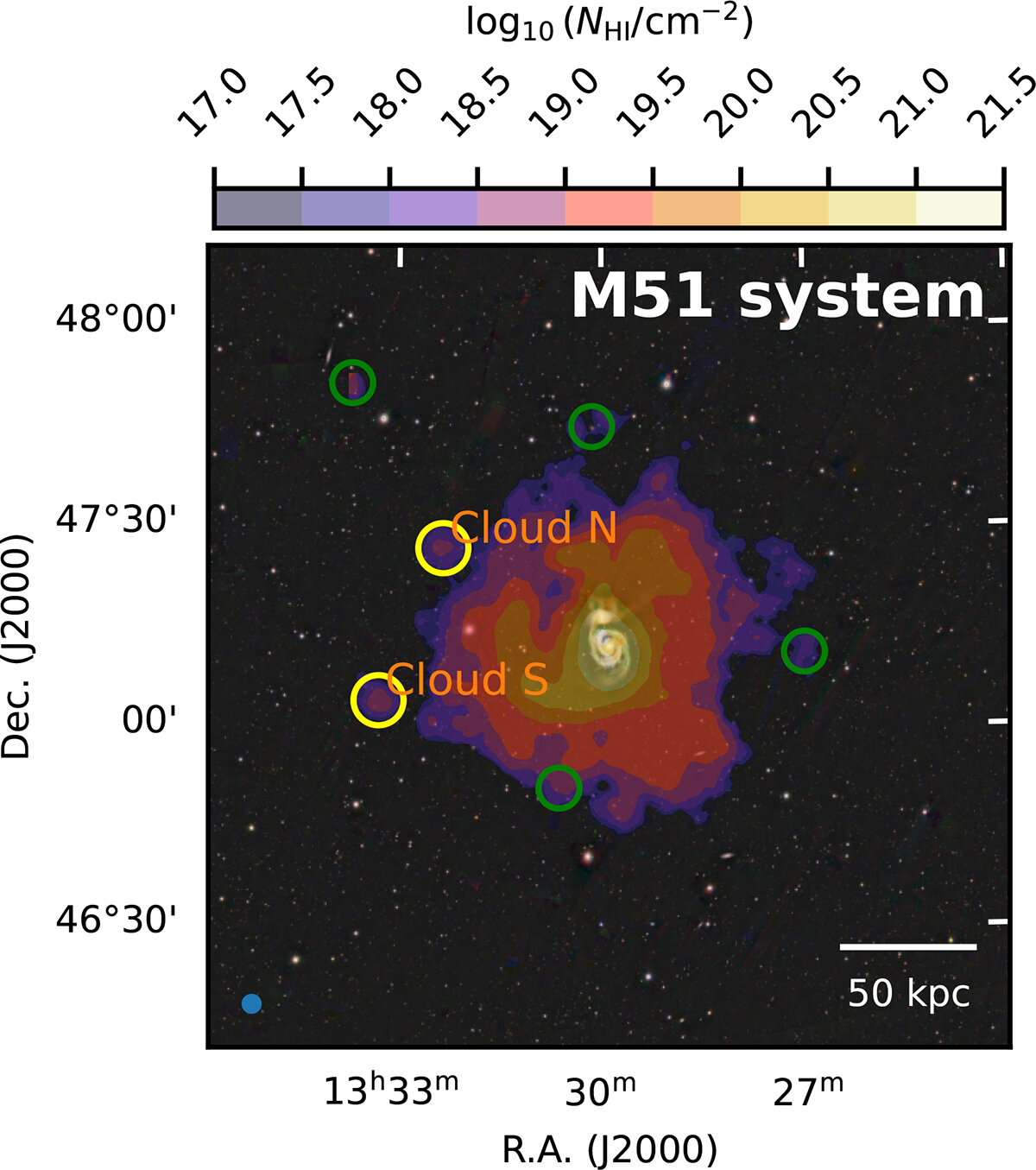
Two compact clouds of hydrogen gas found near the interacting galaxy M51 have no visible stars and show properties expected from a class of possible starless dark matter halos. The observations are consistent with the reionisation-limited H I cloud, or RELHIC, model, but the evidence is not yet strong enough to rule out a different explanation: gas left behind by the interactions around M51.
The two objects, called Cloud S and Cloud N, were detected with the Five-hundred-metre Aperture Spherical radio Telescope, or FAST. They lie in the outer regions of the M51 system, about 70 to 90 kiloparsecs from its center. The study adopts a distance of 8 million parsecs, or 8 megaparsecs, for M51 and the two clouds. Their velocities are also consistent with the M51 environment.
Both clouds contain about 3 million solar masses of neutral hydrogen. Their measured line widths correspond to velocity dispersions of roughly 20 kilometers per second. Cloud S has a barycentric velocity of 407.2 kilometers per second and a measured W50 line width of 21.63 kilometers per second. Cloud N has a barycentric velocity of 486.2 kilometers per second and a W50 of 29.33 kilometers per second.
What makes the pair unusual is what is missing. Neither cloud has a detected optical counterpart. Deep imaging from the DESI Legacy Imaging Surveys found no stellar object at the clouds’ distance and velocity. The study sets a conservative g-band surface-brightness limit of about 27.5 magnitudes per square arcsecond for the M51 field. Under an assumed effective radius of about 500 parsecs, this corresponds to a stellar luminosity limit of roughly 100,000 times the luminosity of the Sun.
The absence of visible stars is important because the objects were selected specifically as possible examples of very low-mass systems in which gas remains but star formation has not occurred.
Why starless hydrogen clouds can exist
In the standard Lambda cold dark matter model, small dark matter halos can contain little or no stellar material. Galaxy formation becomes difficult below halo masses of about 1 billion solar masses and is expected to be strongly suppressed at still lower masses. Simulations cited in the study also indicate that some halos below about 5 billion solar masses can remain completely starless.
The RELHIC model provides one way such an object could retain detectable neutral hydrogen without forming stars. In this model, gas remains gravitationally bound inside a low-mass dark matter halo after cosmic reionization. The gas does not cool enough to form stars. Instead, it reaches hydrostatic and thermal equilibrium with the ultraviolet background that fills intergalactic space. Only a centrally concentrated region of the gas remains neutral enough to be detected as H I.
The model predicts compact neutral hydrogen cores with line widths of about 20 kilometers per second. Those properties made the two M51 clouds useful candidates for comparison.
FAST found only two candidates in the survey
The researchers searched data from the FAST Extended-Atlas-of-Selected-Targets Survey, known as FEASTS. The survey is designed to detect extended and faint hydrogen structures around nearby, H I-rich galaxies. Its data have a spatial resolution of 3.24 arcminutes and a velocity resolution of 1.61 kilometers per second. For a 20-kilometer-per-second line width, the moment-0 maps reach a typical 3-sigma column-density sensitivity of 5 × 10^17 hydrogen atoms per square centimeter.
The researchers searched 55 galaxies in the FEASTS sample for clouds meeting three requirements. A candidate had to have no optical counterpart in the DESI Legacy Imaging Surveys catalog, a compact and approximately regular H I shape that was not obviously tidal debris, and a velocity dispersion of roughly 20 kilometers per second. Only Cloud N and Cloud S in the M51 field met all three requirements.
Several other H I regions were rejected. One had an obvious optical counterpart, while another was projected inside M51’s extended H I envelope. Of the remaining isolated clouds, two were substantially more elongated. Their measured beam-convolved axis ratios were 0.50 and 0.43, compared with 0.80 for Cloud S and 0.95 for Cloud N. Because FAST cannot resolve the intrinsic shapes of the two candidates, these measurements describe their appearance after being blurred by the telescope’s beam rather than their true physical shapes.
Their hydrogen profiles match the RELHIC models
The researchers next compared the observed hydrogen distributions with predictions from the RELHIC model.
They modeled each candidate as a spherical gas system in hydrostatic equilibrium inside a Navarro-Frenk-White dark matter halo. The model assumes that dark matter dominates the gravitational potential and that the gas’s self-gravity can be neglected. The gas temperature is tied to its density through thermal equilibrium with the cosmic ultraviolet background. The calculation also accounts for the ionization of hydrogen and for self-shielding at sufficiently high gas densities.
The model predicts that the observable H I mass changes rapidly over a relatively narrow range of halo masses. Below about 1 billion solar masses, the gas remains almost completely ionized and becomes difficult to detect in H I. Above about 5 billion solar masses, gas cooling is expected to become efficient enough that star formation is likely.
For the observed H I mass of about 10^6.5 solar masses, the model’s allowed range of halo concentration gives a characteristic halo mass of about 3.7 billion solar masses, with an uncertainty of about 0.4 billion solar masses.
Because FAST’s beam is much larger than the expected intrinsic size of a RELHIC, the researchers blurred the model profiles to match the telescope’s resolution. Both observed clouds have radial H I profiles consistent with these beam-convolved RELHIC predictions. The comparison gives a characteristic halo mass of about 3.7 × 10^9 solar masses for both clouds.
The modeling also predicts that the intrinsic H I column density should be two to three orders of magnitude higher than the roughly 10^19-square-centimeter values seen after the FAST beam has blurred the clouds. Higher-resolution observations could therefore reveal more detail in their internal gas structures.
A simulation test supports the mass estimates
The researchers tested their modeling method against the TNG50 cosmological simulation.
They selected 166 central halos that had between 10^4 and 10^7 solar masses of H I, no stars, and halo masses that could be defined as M200. The simulated systems covered halo masses from about 1 billion to 10 billion solar masses. When the researchers applied their RELHIC-based method to the simulated H I masses, the estimated halo masses generally agreed with the actual simulated values to within a factor of two.
The simulations were also used to examine whether internal gas motions could affect the interpretation of the observations.
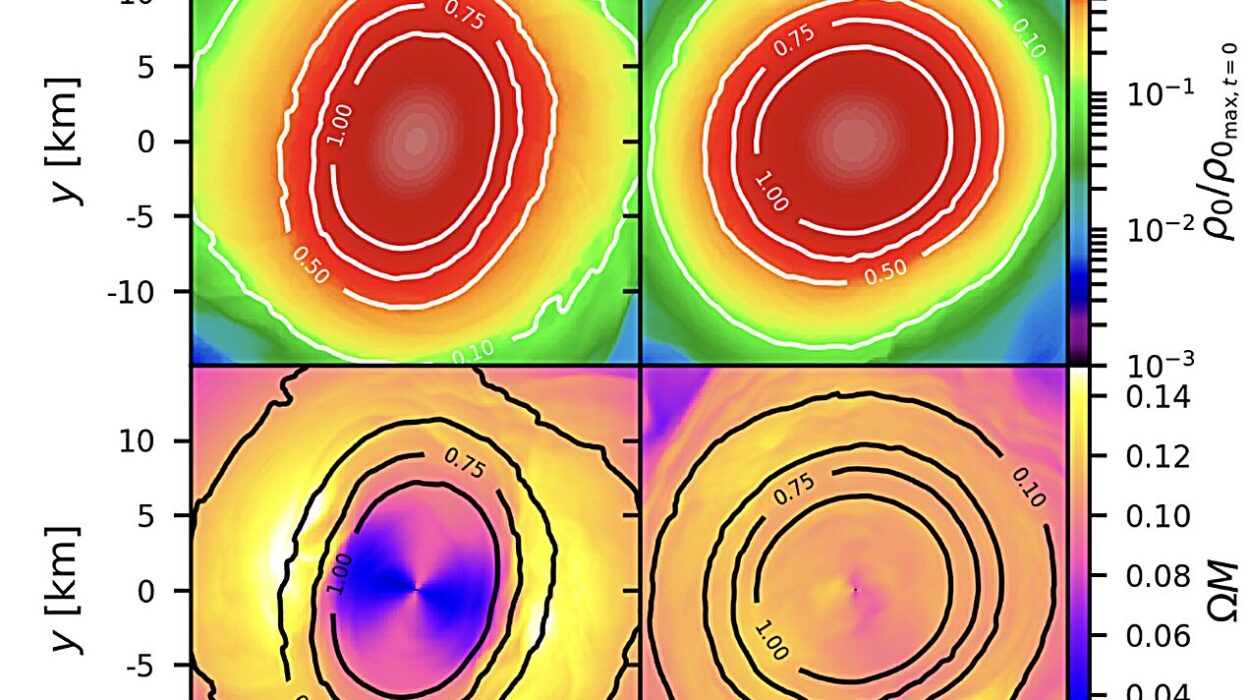
Cloud N appears to have a clearer velocity gradient, while Cloud S shows weaker ordered motion. At first glance, such a gradient could raise questions about whether the clouds fit the expected behavior of pressure-supported starless systems. But the simulated starless halos were not purely pressure-supported either. Although thermal pressure was the dominant source of support, many of the simulated halos showed measurable ordered gas motions after their H I distributions were blurred to match the FAST beam.
Both observed clouds fall within the range of apparent rotation velocities and velocity dispersions found in the simulated sample. Cloud N lies toward the higher-velocity end of that range, while Cloud S lies toward the lower end. The comparison therefore does not conflict with a cosmological population of starless H I-bearing dark matter halos.
The M51 environment leaves another explanation open
The main difficulty is that M51 is an interacting galaxy system. Gas associated with such interactions can be pulled away from galaxies and form structures outside their main bodies.
The researchers therefore considered whether Cloud N and Cloud S could instead be tidal debris. They do not claim that the current FAST observations can distinguish the tidal and RELHIC explanations unambiguously. Tidal debris is often found in large-scale structures, including the southeastern tidal tail previously reported around M51.
There is one factor that could allow a dark matter halo containing a cloud to survive in M51’s environment. Using a total M51 system mass of about 3 × 10^11 solar masses, the researchers estimate that a 3.7 × 10^9-solar-mass dark matter halo at a galactocentric distance of 100 kiloparsecs would have a tidal radius of about 19 kiloparsecs. An H I cloud inside such a halo could therefore remain gravitationally bound at that distance.
The narrow line widths and high H I-to-light ratios are consistent with the RELHIC interpretation, but they are not enough to eliminate a tidal origin. The clouds’ intrinsic structures remain unresolved by FAST, and Cloud N may contain an internal velocity gradient.
Higher-resolution observations are needed
The next step is to resolve the clouds more clearly.
Interferometric radio observations could measure their intrinsic shapes and sizes instead of seeing them primarily through FAST’s much larger beam. Such observations are needed to distinguish more effectively between a compact gas core embedded in a dark matter halo and gas associated with the tidal environment of M51.
Deeper optical observations could also test whether an extremely faint stellar population is present. The study notes that imaging with the Hubble Space Telescope could resolve individual bright stars at the adopted distance of 8 megaparsecs. Comparing the number and properties of point sources in the cloud regions with nearby control fields could reveal a localized stellar excess or place a tighter limit on any hidden stellar component.
For now, Cloud N and Cloud S remain promising but unconfirmed RELHIC candidates. Their H I masses, line widths, lack of detected optical counterparts, and radial H I profiles are all compatible with the model, while the interacting environment of M51 keeps a tidal explanation firmly in consideration.
The study was published in Astronomy & Astrophysics.