Supermassive black holes sit at the centers of galaxies with very different shapes, but one relationship keeps appearing: the more massive the galaxy, the more massive its central black hole tends to be. A new analysis of 2,435 disk galaxies hosting active black holes now finds that this relationship persists even in galaxies with no detectable stellar bulge, the dense central component traditionally associated with black-hole growth. The result points to a substantial role for processes that can operate without major galaxy mergers in linking black holes to their host galaxies.
The study began with galaxies observed by the Dark Energy Spectroscopic Instrument, or DESI, combined with optical imaging from the DESI Legacy Surveys. The researchers selected galaxies classified as disks and then looked for broad H-alpha emission, a signature that can be used to identify active galactic nuclei, or AGN, in which gas is rapidly orbiting and feeding a central supermassive black hole.
The final DESI disk sample contained 2,435 galaxies. Their redshifts ranged from 0.0172 to 0.2504. The researchers also constructed a comparison sample of 5,879 broad-line AGN in early-type, smooth galaxies and weighted 3,226 of them to match the disk sample in redshift and stellar mass.
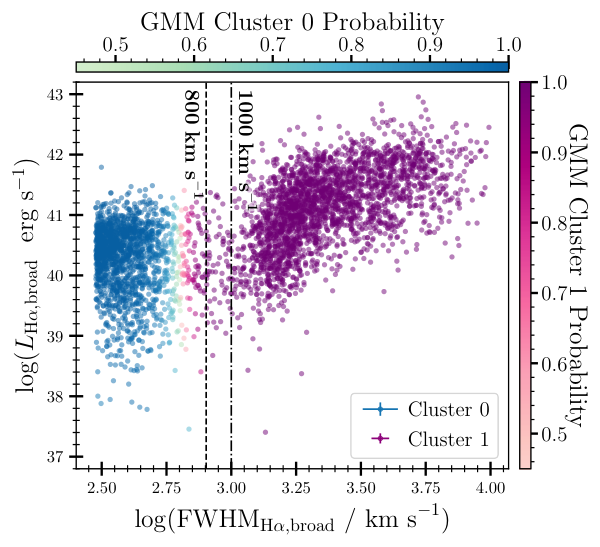
To identify the active black holes, the researchers used emission-line models from DESI’s EmFit catalog. They first selected sources with broad H-alpha emission and then separated two populations in the relationship between the line’s width and luminosity using a two-component Gaussian mixture model. Of the objects assigned to the higher-width group, 96% had broad H-alpha widths of at least 800 kilometers per second and 94% exceeded 1,000 kilometers per second. The researchers chose a broad-line AGN sample using these properties and additional quality requirements.
The approach deliberately emphasized completeness rather than maximum purity. Broad H-alpha emission can occasionally arise from stellar processes such as outflows and supernovae, so the authors acknowledge that some contamination is possible. They did not impose traditional emission-line-ratio AGN selections because those can exclude some broad-line AGN.
Finding the galaxies without bulges
The crucial part of the analysis was separating galaxies with and without substantial central bulges.
The researchers fitted the galaxies’ surface-brightness profiles using GALFITM, modeling their disks, central point sources and additional Sérsic components. They classified a component as a bulge or not a bulge using its shape and Sérsic index, with the selection designed to prioritize the purity of the bulgeless sample.
This produced 1,233 initially identified bulgeless galaxies and 278 galaxies with some bulge component. The researchers then subjected the decomposition method to injection tests, adding artificial bulges and point sources to images of known bulgeless galaxies and checking whether the fitting procedure recovered them.
Quality cuts reduced the usable decomposition sample substantially. After further inspection and reclassification of some objects, the final samples contained 546 galaxies classified as bulgeless and 240 with some bulge component. The bulgeless sample was therefore more than five times larger than the 101 broad-line AGN in disk-dominated galaxies studied in an earlier SDSS analysis cited by the authors.
The researchers used a deliberately conservative definition. A galaxy was considered bulgeless when its best-fitting model contained no identified bulge component, rather than simply requiring a bulge-to-total ratio below 0.1. That distinction matters because the ground-based imaging has limited spatial resolution, making very small bulges difficult to resolve.
The injection tests also showed why the researchers treated the classification cautiously. Faint injected bulges were more likely to be missed, and the authors say the measured completeness and purity from the tests should be regarded as lower limits for the science sample after the relevant selections.
The black holes still follow the galaxy
For each broad-line AGN, the researchers estimated black-hole mass from the broad H-alpha emission. The method assumes that the gas in the broad-line region is orbiting under the black hole’s gravity. Its velocity is estimated from the width of the H-alpha line, while the line luminosity provides information related to the size of the emitting region.
Using the Reines et al. relation, with a virial scale factor of 1, the researchers obtained virial black-hole masses. They included an assumed scatter of about 0.5 dex, reflecting the substantial uncertainty inherent in these estimates. The authors specifically note uncertainties associated with the geometry of the broad-line region and the empirical relations underlying the method.
Across the 2,435 disk galaxies, black-hole mass correlated with total stellar mass. The fitted relation was
log(MBH/M☉) = −3.7 ± 0.3 + (1.00 ± 0.03) log(M/M☉),*
with an intrinsic scatter between 0.21 and 0.25 dex. The correlation coefficient was 0.536, and the very large sample size made the probability of no correlation extremely small.
The striking result emerged when the researchers separated the disk galaxies according to whether a bulge was present.
The bulgeless galaxies continued to follow a black-hole-to-total-stellar-mass relationship. Their fitted slope was 1.08 ± 0.07. Galaxies with some bulge component had a slope of 1.31 ± 0.15. The difference between the slopes was about 1.4 standard deviations, and the authors concluded that the two relationships were statistically consistent within 3 standard deviations.
The same similarity does not appear when black-hole mass is compared specifically with bulge mass.
The bulge relationship changes dramatically
The researchers estimated bulge stellar masses from the fitted bulge light, assuming the same mass-to-light ratio as the whole galaxy. They acknowledge that this is a simplification because bulges and disks can have different stellar populations, but argue that adopting a common ratio avoids introducing additional assumptions.
For the 546 bulgeless galaxies, the absence of a fitted bulge meant that the researchers could only establish upper limits on bulge mass. Some of those limits were constrained by the brightness of the central point source associated with the AGN.
The distribution of bulge masses was substantially different between the two galaxy populations. The bulgeless galaxies had a median bulge mass of about 10^9 solar masses, compared with about 10^9.9 solar masses for the galaxies containing a bulge component. An Anderson-Darling test reached the imposed floor of p = 0.0001, corresponding to a difference at greater than 3 standard deviations. The bulgeless galaxies also peaked at a bulge-to-total ratio of about 0.008, well below the commonly used 0.1 threshold.
When the researchers fitted black-hole mass against bulge mass, the contrast became much stronger.
For the bulgeless population, treating the upper limits as measurements produced a slope of 0.12 ± 0.03. For galaxies with some bulge, the corresponding slope was 0.98 ± 0.12. The difference in slopes was 0.86, or about 7 standard deviations. The authors therefore regarded the two black-hole-to-bulge-mass relationships as statistically distinct.
Removing the 135 bulgeless galaxies whose bulge-mass limits were set by the central point source did not eliminate the difference. The bulgeless slope increased to 0.39 ± 0.04, but it remained statistically different from the relationship for galaxies with bulges, with a slope difference corresponding to about 4.7 standard deviations.
The contrast is also visible relative to an established black-hole-to-bulge-mass relation. About 87% of the DESI bulgeless galaxies lay above the Häring and Rix relation, compared with about 46% of the galaxies containing some bulge. Excluding the point-source-limited bulge estimates reduced the bulgeless fraction to about 82%.
In other words, the black holes in these bulgeless galaxies are often much more massive than their tiny or unresolved bulges would predict from relations derived largely from bulge-dominated galaxies.
What the comparison says about galaxy mergers
This difference between total stellar mass and bulge mass is central to the authors’ interpretation.
Bulgeless galaxies are used as an observational proxy for galaxies that have experienced relatively quiet merger histories. That does not directly establish an individual galaxy’s complete merger history, but the paper uses the absence of a significant stellar bulge as evidence consistent with relatively little major merger activity.
If black holes and galaxies were linked primarily through merger-driven growth, the authors argue, the black-hole-to-bulge relationship should be particularly similar between galaxies with and without bulges. Instead, the bulgeless and some-bulge populations have statistically consistent relationships when all of the galaxy’s stars are considered, while their relationships with bulge mass are strongly different.
The authors interpret this pattern as evidence that black holes can grow through processes that do not require galaxy mergers. They argue that the disk, which is predominantly shaped through secular processes, can remain connected to black-hole growth even when a substantial bulge is absent. Their interpretation is that secular processes make a significant contribution to galaxy-black-hole co-evolution, both in bulgeless galaxies and in the broader disk-galaxy population.
The conclusion is also consistent with the earlier SDSS work cited in the study, but the much larger DESI bulgeless sample gives the comparison substantially more objects to work with.
A group of unusually massive black holes
The overall black-hole-to-total-stellar-mass plot contains another feature the authors examine: a trail of galaxies with unusually massive black holes relative to their total stellar mass.
This population becomes apparent at stellar masses below roughly 10^10.5 solar masses. The researchers inspected the photometry and spectra of these objects and report that the measured black-hole and stellar masses appear reliable.
About one-third of the objects in this trail belong to the bulgeless sample.
The authors do not identify the cause. They speculate that the pattern could result from periods in which a black hole grows substantially through secular mechanisms without a comparable increase in the host galaxy’s stellar mass. They specifically discuss gas inflow driven by structures such as bars or spiral arms as possible ways to continue feeding the central black hole.
They also note that the stellar mass around 10^10.5 solar masses has been identified in previous work as a transition region in several galaxy properties. The authors therefore leave open several possible explanations, including changes in galaxy properties or AGN activity, rather than treating the trail as evidence for a single mechanism.
The black holes are not simply accreting faster in bulgeless galaxies
The researchers also compared current AGN activity between the different galaxy populations.
They used bolometric AGN luminosity from spectral-energy-distribution fitting and calculated the Eddington ratio, which compares the observed luminosity with the theoretical maximum luminosity associated with the estimated black-hole mass.
For the subset with reliable bolometric luminosities, the median Eddington ratio was 0.034 for the overall disk sample, 0.027 for bulgeless galaxies and 0.021 for galaxies with some bulge. The weighted control sample of early-type galaxies had a median value of 0.039.
The early-type control population showed a statistically significant tendency toward higher bolometric luminosity than the bulgeless population. The black-hole mass distributions, however, differed only moderately. The bulgeless and some-bulge populations had median black-hole masses of approximately 10^6.8 and 10^7.0 solar masses, respectively.
An Anderson-Darling test comparing their black-hole mass distributions gave p = 0.07, corresponding to about 1.8 standard deviations. The authors therefore could not reject the null hypothesis that the two populations were drawn from the same black-hole-mass distribution.
The study consequently does not find evidence that the early-type control galaxies have substantially larger black holes despite their higher observed AGN luminosities. The authors interpret this cautiously, suggesting that the greater prevalence of mergers in the histories of early-type galaxies may not necessarily translate into greater long-term black-hole growth.
Bars and spiral arms offer possible feeding routes
The paper then considers how secular growth might actually supply material to the central black hole.
Stellar bars are one possibility. Bars can redistribute angular momentum and help drive gas inward. Using Galaxy Zoo DESI classifications, the researchers find bars in about 65% of the bulgeless sample and 68% of the galaxies with some bulge.
The similar bar fractions provide a possible explanation for why the two populations have similar black-hole-to-total-stellar-mass relationships and similar current accretion properties. But the observations do not demonstrate that the bars are responsible for the black-hole growth.
Spiral arms provide another possible route. The Galaxy Zoo classifications indicate identifiable spiral-arm patterns in about 87% of the full disk sample, including 85% of the bulgeless galaxies and 76% of those with some bulge.
The authors compare these observations with previously reported gas-inflow rates from simulations and observations of spiral galaxies. They find that the reported inflow rates are sufficient to sustain the estimated accretion rates of the DESI AGN, and that even the lower simulated inflow rate would be sufficient for 83% of the DESI disk sample. Again, this is presented as a possible mechanism rather than a direct measurement of gas flowing into the black holes in these particular galaxies.
AGN feedback may also shape the relationship
The researchers consider the black holes themselves as another possible driver of galaxy evolution.
About 22% of the DESI disk AGN have Eddington ratios below 0.01. The authors note that AGN operating around this regime are generally associated with kinetic energy injection, while higher accretion rates are more commonly associated with radiative energy release. They emphasize that the 1% level is an approximate transition rather than a precise threshold.
The observed distribution therefore allows for both forms of AGN energy release within the sample.
The authors speculate that kinetic feedback could contribute to the trail of over-massive black holes at lower stellar masses. If feedback suppresses star formation while the black hole continues to grow, the black hole could become more massive relative to the galaxy. But the study does not directly measure such a causal sequence in the galaxies that make up the trail.
Observations of four bulgeless galaxies from an earlier sample have detected large-scale ionized-gas outflows, which the authors cite as evidence that AGN in bulgeless galaxies can produce strong feedback. The DESI sample is substantially larger and spans a broad range of AGN luminosities, giving the researchers a larger population from which candidates for future spatially resolved studies could be selected.
The observations do not match one major galaxy simulation
The researchers also compared their bulgeless galaxies with bulgeless galaxies from the Horizon-AGN cosmological simulation.
The comparison revealed a pronounced difference. The simulated bulgeless population contains far fewer low-mass black holes than the DESI observations. The discrepancy appears in both the black-hole-to-total-stellar-mass plane and the black-hole-to-bulge-mass plane.
The authors caution that the two populations are not directly equivalent. Horizon-AGN uses a single snapshot at redshift 0.0556, while the DESI bulgeless galaxies span redshifts from 0.0172 to 0.2504. The observational sample also has completeness limitations, including luminosity selection and possible biases against low-surface-brightness galaxies.
The definitions of “bulgeless” also differ. The simulation study selected galaxies with bulge-to-total ratios below 0.1, allowing a small bulge component, while the DESI analysis required no identified bulge component in the fitted model. The simulation’s bulge measurements are also limited by its spatial resolution of 1 kiloparsec.
Horizon-AGN seeds black holes at 10^5 solar masses, so it cannot produce black holes below that mass. The authors also point to the simulation’s 1-kiloparsec resolution as a potential source of differences in gas accretion and the stochastic behavior of black-hole feeding. At that scale, gas properties are smoothed, and the simulation cannot fully capture small-scale variations in the interstellar medium.
The authors note that the shortage of low- to intermediate-mass black holes is not unique to Horizon-AGN. They cite a comparison of several cosmological simulations in which simulated populations also struggle to produce black holes below about 10^7.5 solar masses in galaxies with stellar masses around 10^10.5 to 10^11.5 solar masses, while producing an excess of black holes above about 10^9 solar masses relative to local observations.
The authors suggest that calibration against black-hole scaling relations dominated by massive elliptical and bulge-dominated galaxies may contribute to this mismatch. They also identify black-hole seed mass, limited resolution and the difficulty of reproducing realistic disk-galaxy populations as possible contributors.
A relationship that does not require a prominent bulge
The central observational pattern remains the same across the different tests. In the DESI disk sample, black-hole mass correlates with total stellar mass. That relationship remains present in galaxies classified as bulgeless, while the relationship between black-hole mass and bulge mass changes sharply between bulgeless and some-bulge systems.
The authors interpret that combination as evidence that galaxy-black-hole co-evolution can occur without major mergers and that secular mechanisms can make a significant contribution to black-hole growth. The observations alone do not identify one particular secular mechanism as responsible. Bars, spiral arms and AGN feedback are discussed as possible contributors.
The study also highlights the observational difficulty of determining how much bulge mass these galaxies truly contain. The ground-based imaging can miss very small bulges, and the bulge masses themselves involve simplifying assumptions about stellar mass-to-light ratios. The authors point to higher-resolution space-based imaging as a way to resolve smaller central structures and extend similar studies to higher redshifts.
The study was published in Monthly Notices of the Royal Astronomical Society.