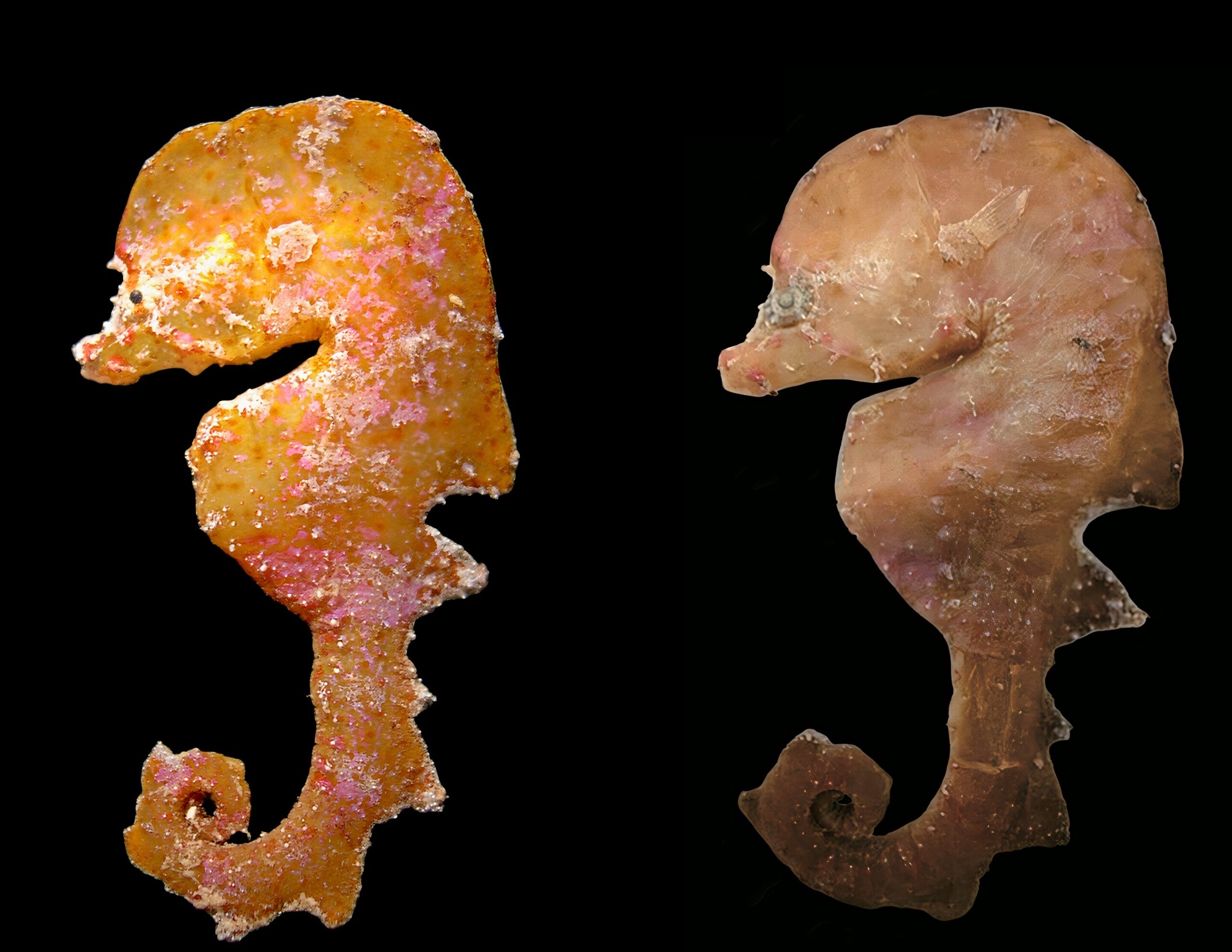
For decades, they looked like seahorses. They carried their young in enclosed brood pouches, curled their tails around objects, and held their heads at the familiar angle that has made seahorses instantly recognizable around the world. Yet almost every specimen came from deep, dim waters, and only a handful had ever been collected. Now, after combining high-resolution CT scans with genome-scale DNA evidence, scientists report that these elusive fishes are not seahorses at all, but members of an entirely separate evolutionary lineage that independently evolved a remarkably similar body plan.
The story begins with an extraordinary scarcity of evidence. Across nearly eight decades, researchers have documented only eight museum specimens belonging to this unusual group of fishes, all collected accidentally between 50 and 124 meters (164–407 feet) beneath the surface in the temperate mesophotic ecosystems of southern Australia. No verified underwater observations exist, and the newest specimen was recovered as trawl bycatch in 2006.
That long silence has earned the animals another distinction beyond their unusual anatomy. Under the study’s framework, all three species qualify as “lost” because they have gone at least 10 years without a confirmed record.
The new research, published in the Journal of Lost Species, argues that these mysterious fishes deserve not only renewed attention but an entirely new genus: Australyichthys. Alongside creating the new genus, the authors describe a previously unknown species, Australyichthys aegis, while transferring two previously described species that had long been classified as seahorses into their new evolutionary home.
The disguise that fooled scientists
The resemblance to seahorses was convincing enough that the first known species entered science in 1997 as Hippocampus minotaur. A second species, Hippocampus paradoxus, followed in 2010.
The similarities were obvious. All possessed a sharply angled head, a grasping tail, and a completely enclosed brood pouch in males—hallmark characteristics traditionally associated with the seahorse genus Hippocampus. Their bodies also lacked a caudal fin and displayed the upright posture typical of seahorses.
Yet even the original descriptions noted features that did not quite fit.
The animals had unusually fleshy bodies with softened external segmentation. They lacked the spines common in many seahorses, developed distinctive fleshy lobes along their backs, and possessed skeletal characteristics that earlier studies could not fully interpret. With only a few specimens available, and without modern genomic tools or comprehensive CT imaging, their true relationships remained unresolved.
The new study revisits those longstanding questions with technology unavailable to the original researchers.
Looking beneath the skin
Rather than relying solely on external appearance, the team examined every available specimen using high-resolution micro-computed tomography, or micro-CT, which creates detailed three-dimensional images of internal skeletal structures without damaging the specimens.
The scans exposed a body plan unlike that of any recognized seahorse.
One of the most important differences involved the underside of the trunk.
In typical seahorses, bones along the lower trunk meet at the body’s midline to form a rigid ventral ridge. In Australyichthys, those plates never fuse. Instead, the researchers identified a completely different support system composed of three specialized skeletal components: anterior ventral elements, posterior ventral elements, and a single median anal pterygiophore positioned between them.
Together these structures create an arrangement that, according to the authors, has not been observed elsewhere within the family Syngnathidae, which includes seahorses, pipefishes, seadragons, pipehorses, and pygmy pipehorses.
The head told a similar story.
Seahorses possess a characteristic bony crown known as a coronet, formed through the integration of particular skull bones. CT scans showed that Australyichthys lacks this integrated structure. Instead, one of the relevant bones remains greatly reduced and detached, preventing a true coronet from forming despite the outward resemblance.
These internal anatomical differences, rather than the animals’ outward appearance, became the strongest evidence that the fishes represented something fundamentally different.
DNA pointed to an unexpected family
Anatomy alone suggested that the fishes had been misplaced, but the researchers also wanted genetic evidence.
They extracted DNA from the newly discovered species, Australyichthys aegis, using preserved tissue from its holotype specimen. Sequencing produced more than 101 million paired-end whole-genome shotgun reads.
Rather than assembling an entirely new genome, the team incorporated these data into an existing ultraconserved element dataset representing 22 other syngnathid species across 15 genera. They analyzed 271 conserved genetic loci using both maximum-likelihood and coalescent-based phylogenomic methods.
Both approaches reached the same conclusion.
Instead of falling within the seahorse tribe, Australyichthys belonged to Haliichthyini, an Indo-Pacific group containing pipefishes and pygmy pipehorses that forms the sister lineage to true seahorses.
That placement carries an important evolutionary implication.
According to the authors, the seahorse-like body plan evolved independently in the two groups. In other words, Australyichthys resembles seahorses because similar evolutionary pressures produced similar external forms, not because the animals inherited those features from a recent common seahorse ancestor.
A new species helped solve the puzzle
Resolving the mystery required more than old museum specimens.
The study introduces Australyichthys aegis, represented by a specimen collected near the entrance to Spencer Gulf in South Australia.
Geographically, the new species occupies a crucial position between the earlier species found off New South Wales and Western Australia, bridging more than 2,500 kilometers (about 1,550 miles) of southern Australian coastline.
Its anatomy revealed that the unusual skeletal characteristics seen separately in the earlier species were actually shared across the lineage.
That common architecture allowed the researchers to recognize the fishes as members of a single new genus rather than isolated oddities within the seahorses.
Remarkably few animals are known
One striking aspect of the research is how little material exists.
The entire genus is represented by just eight known specimens.
Australyichthys minotaur accounts for five examined specimens from New South Wales, with an additional juvenile specimen previously reported but not examined in this study. Australyichthys paradoxus is represented by a single female holotype collected from Western Australia. Australyichthys aegis is known only from its male holotype from Spencer Gulf.
Every verified specimen comes from Australia’s temperate mesophotic zone, generally between 50 and 124 meters deep.
These habitats receive much less sunlight than shallow reefs and are dominated by structurally complex communities that include sponge gardens, bryozoans, and coral-like organisms. Compared with shallow marine ecosystems, these environments remain relatively poorly studied.
The authors note that all known specimens were collected from areas where such habitat-forming organisms occur.
Built for a hidden life
Although no one has observed living Australyichthys underwater, the preserved specimens offer clues about their biology.
The fishes possess soft, fleshy bodies whose external ring boundaries are largely obscured by tissue. Along the middle of the back, many specimens bear fleshy lobes unsupported by bone. The researchers suggest these structures may help provide camouflage among complex benthic habitats, although they emphasize that their function remains unknown.
One CT scan also revealed the remains of unidentified crustaceans inside the digestive tract of A. paradoxus, providing the first direct evidence that these fishes feed on small invertebrate prey.
The three species also differ in an unusual way.
Australyichthys minotaur retains a dorsal fin with seven rays supported by five robust skeletal elements. The other two species completely lack the dorsal fin and all associated supporting structures.
The authors propose that this loss may reflect reduced dependence on active swimming if those species spend much of their lives concealed within structurally complex habitats. However, they explicitly present this as a hypothesis because no observations of living animals exist.
Hidden differences between males and females
CT imaging also revealed details impossible to see externally.
Male A. minotaur possess brood pouches beneath specialized skeletal structures, and one scanned specimen contained approximately nine embryos still developing inside the pouch.
Females differ in the shape of several ventral skeletal elements and contain hydrated eggs within the abdominal cavity rather than embryos.
The skull also changes between sexes, with males displaying a more steeply angled supraoccipital bone than females.
Whether similar sexual differences occur in the other two species remains unknown because each is represented by only one sex.
Why the lineage matters
The study does more than rename unusual fishes.
According to the authors, Australyichthys represents the first syngnathid genus documented predominantly from the temperate mesophotic ecosystems of southern Australia. Its placement within Haliichthyini while independently evolving a seahorse-like body plan offers a new example of convergent evolution within this family.
At the same time, the researchers stress how little is known about these animals.
With only historical museum specimens, no confirmed observations in the wild, and no records since 2006, they conclude that available information is insufficient for a formal conservation assessment under International Union for Conservation of Nature criteria. Instead, they recommend treating the genus as Data Deficient while calling for targeted, non-extractive surveys of southern Australia’s mesophotic habitats.
For now, the “sea Muppets,” as the authors propose calling them because of their large domed heads and fleshy appearance, remain among the ocean’s most elusive fishes. After decades masquerading as seahorses, they have finally found their proper place on the evolutionary tree. Yet their lives beneath Australia’s dimly lit reefs remain almost entirely hidden, leaving scientists with a newly recognized lineage that is still, in many ways, as mysterious as when the first specimen surfaced nearly 80 years ago.