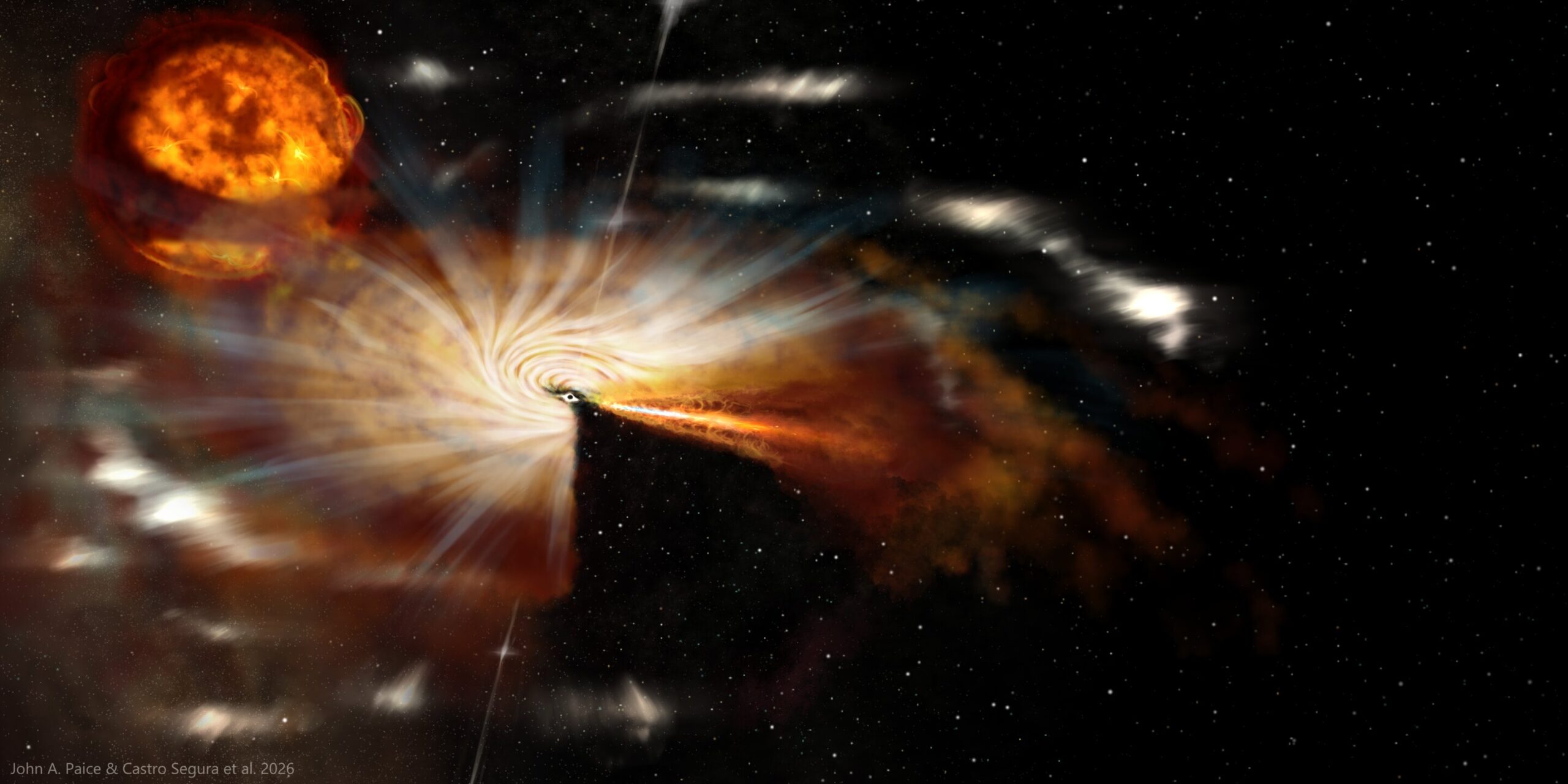
As a stellar-mass black hole settled down after one of the brightest outbursts astronomers have seen in years, its light changed in an unexpected way. Familiar glowing signatures from hot gas circling the black hole gave way to broad, sweeping absorption features, hinting that something substantial had appeared between the system and Earth. By carefully following that transformation over months, astronomers uncovered evidence that a powerful, cool wind may emerge as the outburst fades—one capable of removing material from the system at a rate comparable to the black hole’s own appetite.
Black holes are famous for pulling matter inward, but they can also drive matter away. Exactly when those outflows appear, how they evolve, and how much influence they have over a black hole’s growth remain open questions.
A new study published in Monthly Notices of the Royal Astronomical Society follows those questions through the 2023–2024 outburst of the transient black hole X-ray binary Swift J1727.8−1613, tracing the system from its bright rise through its decline using repeated optical spectroscopy. Rather than capturing only a snapshot, the researchers watched the changing behavior of the accretion disk—the swirling disk of gas feeding the black hole—as the eruption unfolded.
That long-term view revealed two striking episodes. During a powerful jet ejection, the outer parts of the disk briefly appeared to respond to an increase in irradiation. Much later, as the outburst faded into a low-luminosity hard state, the spectra changed dramatically, revealing what the authors interpret as evidence for a massive, cool accretion-disk wind.
Watching an outburst from beginning to end
Swift J1727.8−1613 was first detected in August 2023 and rapidly became one of the brightest X-ray sources in the sky. Its optical brightness climbed from roughly 20th magnitude in quiescence to about 12th magnitude, triggering an extensive observing campaign across many wavelengths.
For this study, the researchers obtained 13 spectra across 11 observing epochs using the X-Shooter spectrograph on the European Southern Observatory’s Very Large Telescope. The observations covered the system as it moved through the familiar sequence seen in many transient black hole binaries: an initial bright hard state, a softer state near the peak of the outburst, and finally a return to a much dimmer hard state.
Because the observations sampled different stages of the eruption, the team could track how specific emission lines evolved rather than simply comparing the beginning and end.
Those spectral lines act like fingerprints of the gas surrounding the black hole. Their shapes, widths, brightness, and shifts provide clues about where the gas is located and how it moves.
A radio flare seemed to change the outer disk
One of the most interesting moments came during the transition into the soft state, when the system produced a major radio flare associated with the launch of bipolar jet ejecta.
At nearly the same time, one prominent helium emission line behaved differently from neighboring observations.
Its brightness increased, while the separation between its two peaks and its overall width both decreased.
The researchers interpret that combination as evidence that the dominant helium-emitting region temporarily shifted farther outward in the accretion disk. If the emitting gas moved to larger orbital distances, its orbital speeds would naturally be lower, producing narrower spectral features.
The authors suggest this may reflect increased irradiation of the outer disk during the jet ejection. Additional heating could have expanded the region producing the helium emission without requiring major changes closer to the black hole itself.
Notably, the study found no comparable evidence that the innermost part of the disk changed during this episode.
The biggest surprise came after the fireworks were over
The most dramatic transformation did not occur during the bright phase of the eruption.
Instead, it appeared months later, after the system re-emerged from behind the Sun at an X-ray luminosity roughly 100 times lower than during the earlier observations.
By the final observing epoch, the optical spectrum looked fundamentally different.
Throughout most of the outburst, hydrogen lines had appeared primarily in emission. Now many higher-order hydrogen lines were instead dominated by broad absorption features. A strong Balmer absorption edge also appeared, indicating the presence of an optically thick absorbing medium.
At the same time, an important helium emission line remained visible but became strongly asymmetric.
Instead of showing the familiar double-peaked profile expected from gas orbiting in an accretion disk, one side of the profile appeared to be missing.
The researchers found that the velocity associated with the broad hydrogen absorption—about 750 kilometers per second toward Earth—aligned closely with the missing blue side of the helium emission profile.
That kinematic match suggested the two unusual features could share the same origin.
A cool wind may be blocking part of the view
The authors argue that the simplest explanation is a substantial outflow emerging from the accretion disk.
In this interpretation, the helium emission still comes from the rotating disk, but the approaching side of that emission is partially absorbed by cooler gas flowing outward along our line of sight.
Meanwhile, the broad hydrogen absorption would arise from that same outflow.
The study also considers another effect that may contribute.
As the X-ray spectrum hardened late in the outburst, energy may have penetrated deeper into the disk, allowing an underlying disk photosphere—the visible surface layers of the disk—to become more apparent. That process could naturally strengthen broad absorption features.
The researchers therefore suggest that both effects may play a role. However, they argue that the close agreement between the hydrogen absorption velocity and the altered helium profile is more naturally explained if a disk wind is shaping both sets of spectral lines.
Importantly, the paper presents this as an interpretation supported by the observations rather than a definitive proof.
Computer simulations reproduced the unusual line shapes
To test whether such a wind could realistically produce the observed spectra, the researchers performed exploratory radiative transfer simulations using a model of a rotating, accelerating accretion-disk wind.
The simulations generated helium line profiles resembling those observed during the final epoch, including cases where the blue emission peak became partially suppressed.
The authors emphasize that these calculations were exploratory rather than an attempt to uniquely reproduce the observations. They conclude only that this type of wind is capable of naturally producing the unusual spectral shapes seen in the data.
The wind could rival the black hole’s own feeding rate
The study also estimated how much material such an outflow might carry away.
Using the observed hydrogen absorption together with the Sobolev approximation—a standard method for estimating conditions in moving gases—the researchers derived a wind mass-loss rate of roughly 10⁻⁹ solar masses per year.
That estimate is comparable to the instantaneous rate at which matter was being accreted by the black hole during the observations.
It also represents a substantial fraction of the longer-term rate at which material is transferred from the companion star into the system.
If such winds remain active even when the system is much fainter, the authors suggest they could substantially influence the long-term evolution of black hole binary systems by removing material that might otherwise have reached the black hole.
The study does not claim that this has been demonstrated. Instead, it identifies it as a potentially important consequence if similar outflows persist at low luminosities.
Hidden winds may be more common than they appear
The researchers also caution that these kinds of winds may not always be easy to detect.
During the brighter stages of the outburst, the optical spectra did not display classic “P Cygni” profiles—the textbook signature often used to identify stellar or disk winds.
That absence does not necessarily mean no wind was present.
According to the authors, emission from the bright inner disk or the base of the jet could overwhelm subtler wind signatures, particularly in a system viewed at a moderate inclination. Another possibility is that the outflow becomes so highly ionized during the brightest phases that the optical signatures largely disappear.
If either explanation is correct, powerful disk winds could spend much of an outburst hidden from view, only becoming conspicuous as conditions change.
By following Swift J1727.8−1613 through nearly its entire eruption, the researchers captured evidence that the most important changes in a black hole’s surroundings may occur not during its brightest moments, but as the fireworks fade and a powerful, cool wind emerges from the disk itself.