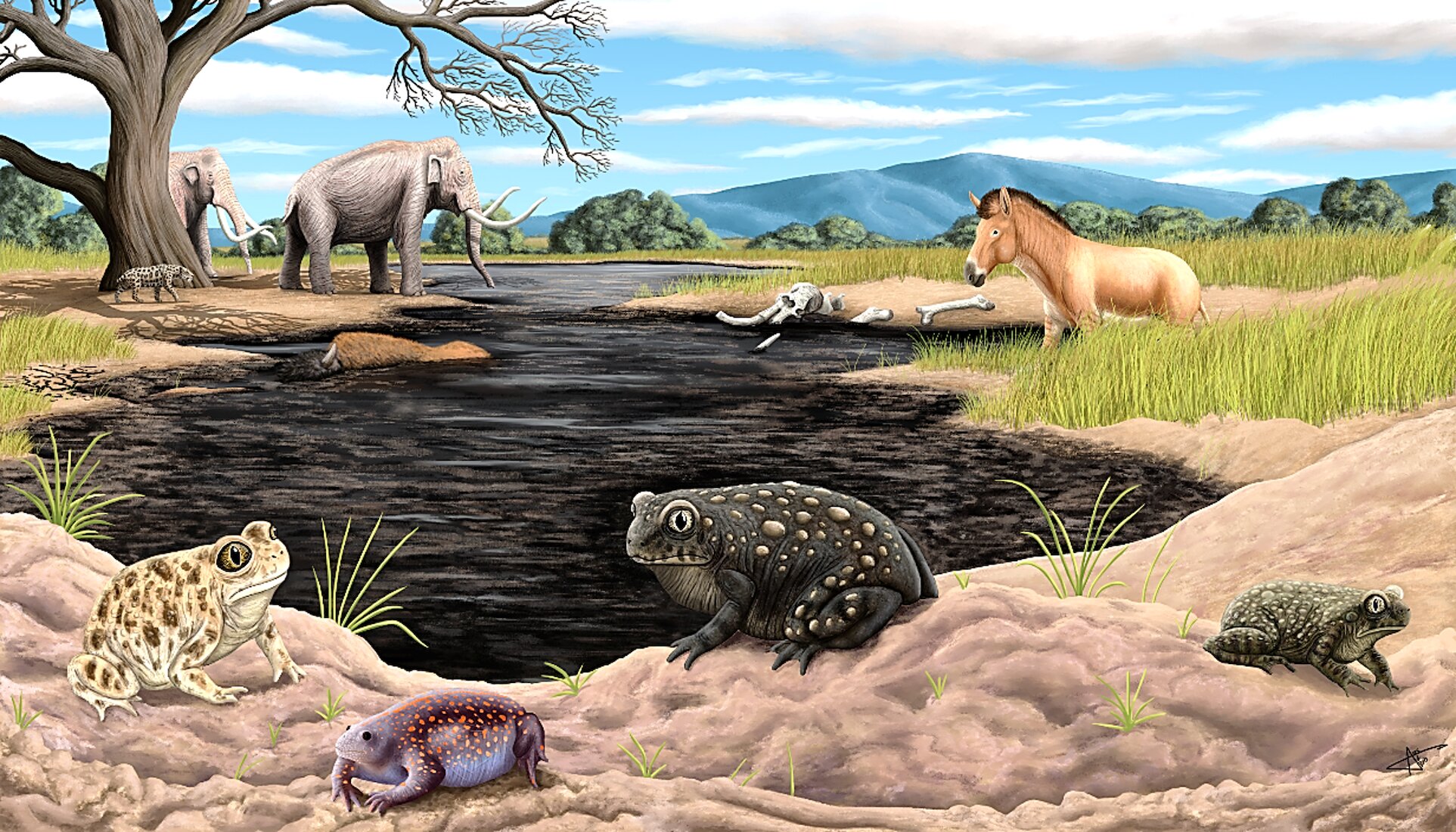
The animals that usually define the La Brea Tar Pits are giants—mammoths, saber-toothed cats, and other Ice Age icons. But one of the site’s newest discoveries is remarkably small. A previously unknown species of spadefoot toad, overlooked for decades in museum collections, is now offering scientists a more detailed window into the environmental changes that transformed ancient Los Angeles as the last ice age drew to a close.
The newly identified amphibian, named Spea labreae, is the first extinct amphibian species ever discovered from the La Brea Tar Pits and only the second extinct amphibian from North America’s Pleistocene to be identified. The research, described in the Journal of Vertebrate Paleontology, emerged from a fresh examination of amphibian and reptile fossils that had received little detailed study for nearly three decades.
Rather than searching for an undiscovered species, lead author Dr. Alberto Cruz was reviewing the Tar Pits’ collection as part of his work on ancient ecosystems.
“I’m really more of a paleoecologist and paleogeographer, not a taxonomist,” Cruz says.
At first, the unusual bones did not convince him he was looking at a different species.
His initial impression was that the specimen might have belonged to an animal that had suffered an illness or injury during its lifetime. Only after repeated comparisons with living spadefoot toads did he reach a different conclusion.
“I reviewed and reviewed a lot of specimens until I was convinced. I thought, ‘Oh my gosh, this is a new species.’ This material is originally from the 1950s, but when you study it again, you can find gold in these specimens. It’s very cool.”
Small amphibians can reveal big environmental changes
Although large Ice Age mammals often attract the most attention, Cruz’s work focuses on much smaller animals because they can provide especially valuable clues about ancient environments.
Amphibians typically remain close to where they live and are highly sensitive to changes in their surroundings. Because they respond directly to shifts in climate and vegetation, scientists can use their presence—or disappearance—as evidence for environmental conditions on a relatively local scale.
“If you change the environment, you change the vegetation, the climate is warmer or colder, it affects these animals directly,” Cruz says.
That makes species such as frogs, salamanders, and toads useful climate proxies when scientists reconstruct past landscapes.
A fossil record that rarely preserves creatures this delicate
Finding fossil amphibians is unusual in itself.
Their skeletons are fragile, making them unlikely to survive long enough to become fossils in most environments. Asphaltic sites such as the La Brea Tar Pits are among the rare places where these delicate remains can be preserved.
According to the researchers, that makes the identification of an entirely new amphibian species from the site an extraordinary discovery.
The same fragility also suggests that many extinct amphibians and reptiles may never have entered the fossil record at all because their remains were simply too delicate to survive.
Old museum collections still hold unexpected discoveries
To determine whether the unusual fossils represented a new species, Cruz carefully examined the shape and size of amphibian bones from the Tar Pits collection.
He compared them with 80 specimens housed in the Herpetology Collections at the Natural History Museum of Los Angeles County and the Museum of Vertebrate Zoology at the University of California, Berkeley.
The work demonstrates that museum collections assembled decades ago can continue to yield important discoveries when examined with fresh questions.
“It’s a great example of how we’re still finding new things at La Brea Tar Pits, even after a century of ongoing excavation and research,” says Dr. Emily Lindsey, curator and excavation site director at the Samuel Oschin Center for Global Ice Age Research at La Brea Tar Pits. “There’s definitely more to come.”
Another toad adds to the picture of a changing landscape
The study also reports the first record of the Mexican burrowing toad, Rhinophrynus, in the southwestern United States.
Today, these living toads no longer occur in the Los Angeles area. Their nearest known populations are almost 2,500 kilometers (1,550 miles) away in southern Mexico.
According to the researchers, that dramatic shift in geographic range, together with the extinction of Spea labreae, helps reveal the complex environmental changes that unfolded as the last ice age ended. The findings also contribute to scientists’ understanding of how amphibians may cope with today’s human-caused climate change.