Deep in the crowded core of the globular cluster NGC 6397, astronomers have uncovered a quiet but extraordinary pair of stellar remnants locked in a tight cosmic embrace. Using the Very Large Telescope (VLT), they identified a compact binary system made of two white dwarfs, nestled within one of the densest stellar environments near Earth.
The discovery, detailed in a paper published February 9 on arXiv, pulls back the curtain on a mysterious object that had puzzled astronomers for years. What they found was not a flickering, explosive system, but something subtler and, in many ways, more intriguing.
NGC 6397, also known as Caldwell 86, lies about 7,800 light years away. It is the second closest globular cluster to Earth, yet it feels like a relic from another universe. With a radius of 36 light years, a mass of roughly 114,000 solar masses, and an estimated age of 13.4 billion years, it formed when the cosmos was still young. Today, it stands as a densely packed sphere of ancient stars, its core collapsed inward under gravity’s relentless pull.
And in that tight stellar crowd, something unusual was hiding.
The Silent Remnants of Dead Stars
To understand the significance of this discovery, it helps to understand white dwarfs. These objects are the leftover cores of stars that have exhausted their nuclear fuel. After shedding their outer layers, what remains is a dense, compact remnant. Because of their extreme gravity, white dwarfs typically display atmospheres composed of either pure hydrogen or pure helium. Only rarely do heavier elements appear in their spectra.
Astronomers are especially interested in systems containing double white dwarfs (DWDs). When two such remnants orbit each other closely, they can eventually merge, potentially forming a more massive white dwarf. The dense cores of globular clusters are ideal hunting grounds for these pairs. As clusters evolve, a process known as mass segregation drives heavier objects, including binaries and massive stellar remnants, toward the center.
NGC 6397 had already hinted at something special. Previous studies suggested that its core contains a diffuse central grouping of white dwarfs with a combined mass of around 1,000 solar masses. Most of these are thought to be carbon–oxygen or oxygen–neon white dwarfs.
Among them was a curious object labeled NF1.
The Mystery of the “Nonflickerer”
NF1 was initially thought to be part of a cataclysmic variable binary, a type of system in which a white dwarf pulls material from a companion star, often producing dramatic brightness variations. But NF1 did not flicker. It showed no photometric variability at all.
Because of this calm, steady behavior, it earned the nickname “nonflickerer”, or NF. Its unseen companion remained a mystery.
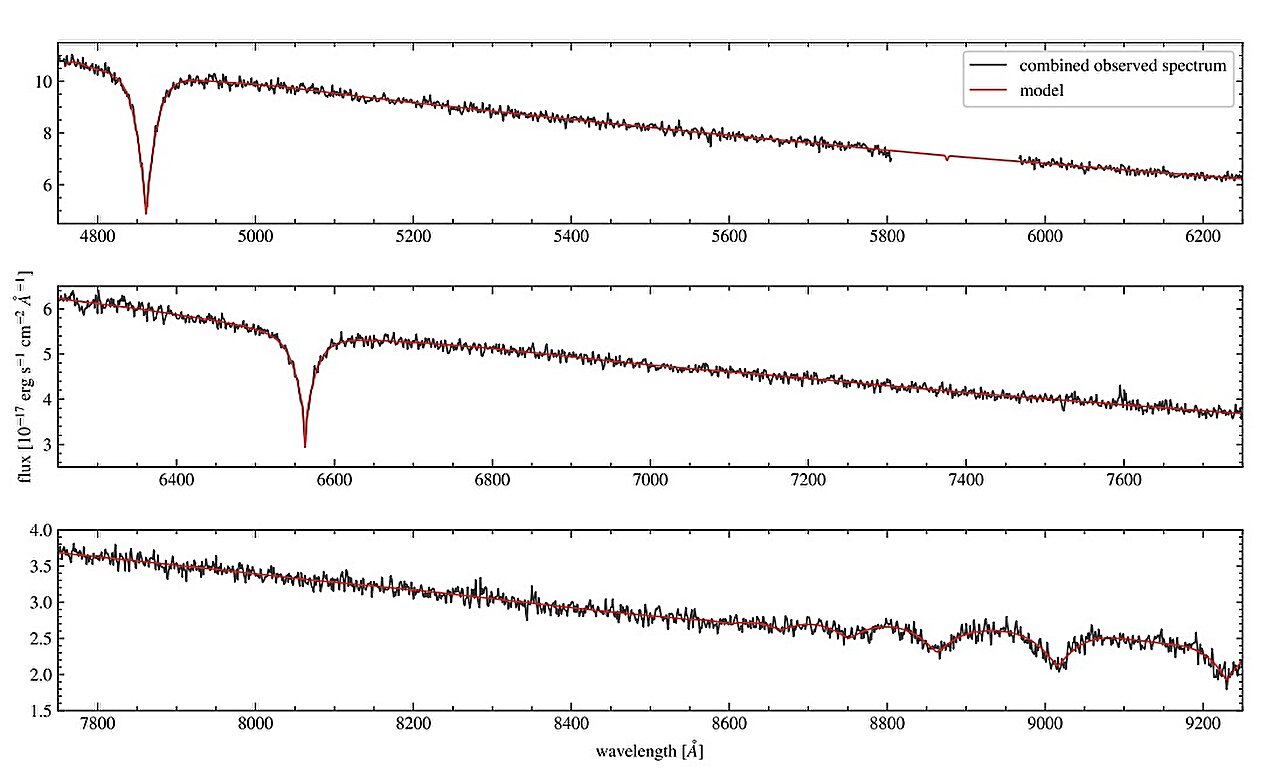
That mystery drew the attention of a research team led by Fabian Göttgens of the University of Göttingen. To probe deeper, they turned to the VLT’s powerful Multi-Unit Spectroscopic Explorer (MUSE) instrument. Their analysis was strengthened by data from the Hubble Space Telescope (HST).
They weren’t looking for fireworks. They were searching for subtle gravitational fingerprints.
Peeling Back the Layers of NF1
The observations revealed that the visible white dwarf in the system, designated NF1 B, is surprisingly lightweight and extended for its type. It has a radius of approximately 0.11 solar radii and a mass of just 0.23 solar masses. Its luminosity measures about 0.74 solar luminosities, and its effective temperature reaches 16,140 K.
From these properties, the researchers concluded that NF1 B is a helium-core white dwarf. This detail alone is significant. It tells a story of stellar evolution shaped by interactions, likely involving mass transfer in the past.
But NF1 B is only half of the tale.
The invisible companion, labeled NF1 A, carries at least 0.78 solar masses. Yet it contributes no detectable light to the system’s spectrum or flux. That absence speaks volumes. The team concluded that NF1 A is almost certainly another compact stellar remnant, most likely another white dwarf. Still, they carefully note a slight possibility that it could instead be a neutron star.
Two stellar corpses, locked together, circling in silence.
A Dance Measured in Hours
The team’s measurements uncovered the rhythm of this binary system. The two objects orbit each other every 0.54 days, just under 13 hours. Their orbit is nearly circular, with an eccentricity smaller than 0.03. The system’s systemic velocity was estimated at 50.1 km/s.
In astronomical terms, this is an intimate dance. Such close orbits are rare treasures for astronomers studying compact binaries. They provide direct insight into how these systems form, evolve, and interact within dense cluster environments.
And just when the story seemed complete, another possibility emerged.
A Whisper of a Third Presence
The data also hinted at something unexpected. There may be a third object in the system, orbiting with a period of either 20 or 80 days. The evidence is not yet definitive. Additional observations will be required to confirm whether this third body truly exists.
If confirmed, it would add another layer of complexity to an already fascinating system. A triple arrangement of compact remnants in such a dense cluster core would offer an even richer laboratory for studying gravitational interactions in extreme environments.
For now, it remains a tantalizing possibility.
Why This Discovery Matters
At first glance, two dead stars orbiting each other may not seem dramatic. There are no explosions here, no blazing outbursts. But this discovery is important precisely because of its quiet precision.
Finding a confirmed double white dwarf system in the core of NGC 6397 strengthens our understanding of how dense star clusters evolve. It supports the idea that heavier remnants migrate inward over time through mass segregation, building up concentrated populations in cluster centers.
The identification of NF1 B as a helium-core white dwarf provides valuable insight into past stellar interactions. Meanwhile, constraining the mass of the unseen NF1 A sharpens our models of compact object populations in globular clusters.
Perhaps most importantly, systems like this are stepping stones in understanding future stellar mergers. Double white dwarfs are believed to merge and form more massive white dwarfs. Observing them before such mergers occur allows astronomers to test theories about their formation pathways and orbital evolution.
NGC 6397 is one of the closest and oldest globular clusters we can study. Each new detail uncovered there is like reading another page from the early history of the universe. At 13.4 billion years old, this cluster has witnessed nearly the entire lifetime of cosmic evolution.
And now, within its tightly packed heart, we know that two stellar remnants are circling each other every half day, bound by gravity, silent but full of meaning.
The universe often reveals its secrets not through explosions, but through careful measurement. In the stillness of NF1, astronomers have found a powerful reminder that even the quietest stars can tell profound stories.
Study Details
Fabian Göttgens et al, Discovery of a double white dwarf in the Galactic globular cluster NGC 6397, arXiv (2026). DOI: 10.48550/arxiv.2602.08898