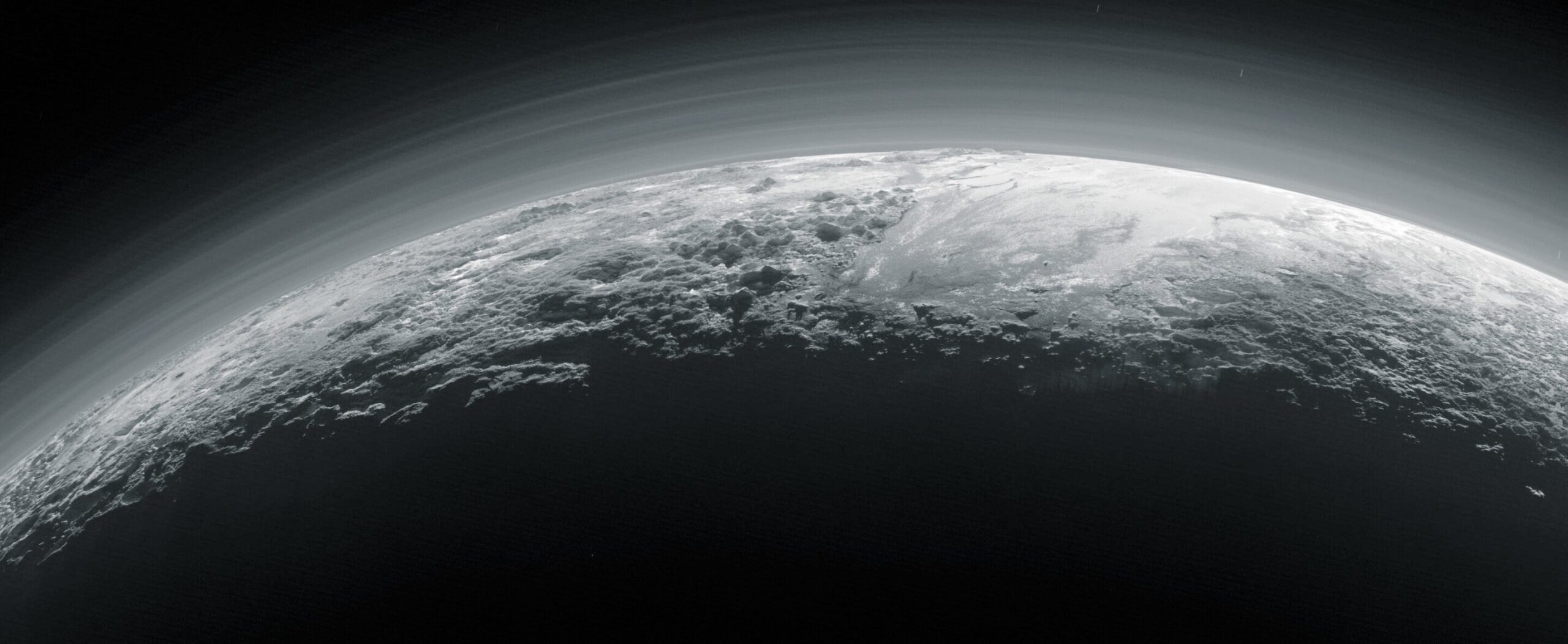
For years after NASA’s New Horizons spacecraft flew past Pluto, the dwarf planet’s thin nitrogen atmosphere appeared to resist the dramatic collapse that many models had anticipated. Then, as Pluto repeatedly drifted in front of distant stars between 2017 and 2023, each fleeting eclipse added another piece to the puzzle. Together, those observations now paint a picture of an atmosphere that remained remarkably stable through roughly 2021 before beginning what may be its first measurable decline—while at the same time revealing subtle changes lower in the atmosphere that could reflect haze slowly settling through the air.
Pluto’s atmosphere is extraordinarily thin, with pressure measured in microbars rather than the dense blanket of air found on Earth. Yet despite its tenuous nature, the atmosphere is tightly connected to the frozen nitrogen ice covering parts of Pluto’s surface. As sunlight reaching the surface changes over Pluto’s long seasons, that ice can exchange material with the atmosphere through vapor pressure equilibrium, linking the behavior of the atmosphere directly to conditions on the ground.
Because Pluto follows an eccentric orbit and has a high axial tilt, the amount and distribution of sunlight across its surface changes dramatically over time. Those seasonal changes have led scientists to develop volatile-transport models that predict how Pluto’s atmosphere should evolve. Some earlier models envisioned an eventual atmospheric collapse as Pluto moved farther from the Sun after passing perihelion in 1989, while more recent models have generally predicted a substantial pressure decline over the coming decades, although many also indicate that Pluto’s large nitrogen reservoir in Sputnik Planitia and the thermal properties of its subsurface could keep the atmosphere from disappearing entirely.
The only way to determine which scenario is unfolding is to continue watching Pluto over many years.
Rather than observing the atmosphere directly, the new investigation relied on one of astronomy’s most powerful natural experiments: stellar occultations. Whenever Pluto passes in front of a distant star, the star’s light does not simply vanish behind the dwarf planet. Instead, the atmosphere bends and dims that light in ways that encode information about atmospheric structure, pressure, and transparency.
Each event lasts only minutes, but careful measurements can reveal how Pluto’s atmosphere is changing over time.
Ten occultations spread across six years
The study reports observations from ten stellar occultations occurring between August 2017 and July 2023.
Four of the events were observed from multiple locations on Earth, allowing several independent paths through Pluto’s atmosphere to be recorded simultaneously. Six additional events were captured from single observing sites. Together they extend atmospheric monitoring beyond the 2015 New Horizons flyby and later observations through 2020.
Observations came from telescopes distributed across the globe, including facilities in Chile, South Africa, Australia, Hawaii, Texas, Mexico, Spain, Germany, and California. Individual events varied widely in observing conditions, telescope size, observing cadence, and data quality.
For every observation, the researchers carefully extracted light curves by measuring how the combined light from Pluto and the background star changed throughout each occultation. Whenever possible, they determined the relative brightness of Pluto and the star using images taken before or after the event, when the two objects had separated in the sky. Those measurements were essential for accurately calibrating the occultation data.
The team then fit atmospheric models to the light curves, examining both clear-atmosphere models focused on Pluto’s upper atmosphere and models that included haze extending through the lower atmosphere.
Years of stability emerge from the combined record
One of the strongest patterns to emerge from the combined dataset is that Pluto’s atmosphere did not appear to begin declining immediately after the New Horizons encounter.
Instead, the observations are consistent with a pressure plateau extending from the spacecraft flyby in 2015 through roughly 2021.
Previous studies had reached differing conclusions. Some analyses had reported that atmospheric pressure continued increasing through 2016. Others interpreted observations from 2018 and 2019 as evidence that the atmosphere had already begun freezing out, including one estimate of roughly a 21% pressure decrease between 2016 and 2019. Another study based on mid-2020 observations concluded that Pluto had entered a plateau phase.
Using a consistently analyzed dataset extending from 1988 through 2023 while adding ten newly presented occultations, the authors conclude that the atmosphere remained broadly stable through approximately 2021 before showing signs of decline afterward.
The newest observations hint at a turning point
The evidence for change comes from comparing atmospheric pressure derived from different periods.
Using clear-atmosphere models, the pressure at a reference altitude of 1,275 kilometers above Pluto’s center decreased by 7% ± 6% when comparing observations from 2015–2021 with those from 2022.
When haze was included in the atmospheric modeling, pressure at 1,215 kilometers decreased by 16% ± 2% over the same comparison.
The authors interpret these results as indicating that Pluto’s atmospheric pressure has started to drop.
At the same time, they emphasize that additional observations are still needed to confirm this recent pressure change. The reported decline is therefore presented as an emerging trend rather than a final, settled conclusion.
The researchers also note that pressure estimates closer to Pluto’s surface depend more strongly on assumptions about atmospheric structure and haze than measurements higher in the atmosphere. For that reason, they focus particular attention on pressures measured near the occultation half-light level and at higher reference altitudes, where extrapolations are more reliable.
The upper atmosphere remained surprisingly consistent
Although pressure may now be beginning to decrease, the overall structure of Pluto’s upper atmosphere remained remarkably stable throughout the study period.
From 2017 through 2023, the upper atmospheric profiles were found to be consistent across the observed occultations.
The investigators modeled the upper atmosphere separately because previous work had already shown that this region generally behaves differently from the lower atmosphere. Above approximately the half-light level of an occultation, Pluto’s atmosphere has often been well described by relatively simple models, while the lower atmosphere requires additional effects—including strong temperature gradients and haze—to explain the observations.
To allow direct comparison among different years, the researchers fixed one atmospheric parameter—the thermal-gradient exponent—to the value derived from high-quality 2015 observations obtained near the New Horizons encounter. That approach enabled consistent fitting even for lower signal-to-noise datasets.
The stability found in the upper atmosphere therefore stands out against evidence that more subtle changes may be occurring lower down.
The lower atmosphere tells a different story
While the upper atmosphere remained consistent, the shapes of the light curves changed in the lower atmosphere.
Specifically, the researchers observed a change in light-curve slope between 2017 and 2023.
Their modeling indicates that this behavior is consistent with haze particles settling over timescales of about a year or even less.
The study does not claim that settling has been definitively observed. Rather, the authors identify it as an explanation consistent with the changing light-curve slopes.
The paper also notes that Pluto’s lower atmosphere has long appeared more complex than its upper atmosphere. Earlier occultation studies suggested haze before New Horizons, while the spacecraft itself later revealed extensive layered haze extending several hundred kilometers above the surface.
The new occultation results fit into that broader picture by indicating that whatever is happening in the lower atmosphere differs from the relative stability seen higher up.
One light curve captured signs of atmospheric waves
Among the many occultation profiles, one contained another intriguing feature.
Small spikes appeared in a light curve that the authors interpret as being indicative of intermittent buoyancy waves.
Such waves have previously been reported in Pluto’s atmosphere, and the new observation is consistent with that earlier phenomenon. The paper does not suggest that these waves were continuously present throughout the entire dataset, only that the observed spikes are indicative of intermittent activity.
Building a consistent record across decades
An important aspect of the investigation was not simply adding new observations but analyzing the long historical record in a consistent way.
The authors combined occultation datasets spanning from Pluto’s first atmospheric detections in the late 1980s through the new observations ending in 2023. They carefully addressed differences among observing sites, telescope systems, calibration methods, background light measurements, and event geometry before fitting atmospheric models.
Multichord occultations, where several observing stations sampled different paths through the atmosphere simultaneously, provided stronger constraints on Pluto’s atmospheric structure than single-site observations. Single-chord events still contributed useful information but required fixed geometries because atmospheric size and viewing geometry cannot both be uniquely determined from only one path.
By processing the newer observations within the same overall framework, the researchers sought to reduce inconsistencies that can arise when different studies use different modeling assumptions.
A picture that is still unfolding
The combined observations now extend nearly a decade beyond the New Horizons flyby, allowing Pluto’s atmosphere to be tracked through a period when scientists expected important seasonal changes.
Instead of an immediate collapse, the atmosphere appears to have maintained a prolonged period of stability before showing evidence that pressure may now be decreasing.
At the same time, the upper atmosphere has remained largely unchanged, while the lower atmosphere exhibits changing light-curve behavior that is consistent with haze particles settling over relatively short timescales. One occultation also contains signatures interpreted as intermittent buoyancy waves.
The authors conclude that the available evidence points toward the beginning of an atmospheric decline after roughly 2021, but they also stress that continued occultation observations will be necessary to determine whether this emerging trend develops into a sustained long-term decrease as Pluto continues its journey through the outer solar system.