A halo exposed to intense ultraviolet radiation keeps collapsing later than expected, allowing it to accumulate an unusually large reservoir of gas. When collapse finally begins, a swarm of rapidly growing stars reaches hundreds of thousands of solar masses before collapsing into black holes, which then undergo a short burst of super-Eddington growth.
The black holes in the simulation do not begin with a small stellar remnant and slowly build their way upward. Instead, some are born from an exceptionally massive stellar system that has already assembled a huge amount of gas.
The setting is an overdense region of the early universe, roughly 10 kiloparsecs from a luminous neighboring galaxy. Radiation from that galaxy contains far-ultraviolet light that suppresses the formation of molecular hydrogen, preventing the target halo from cooling and forming ordinary stars too early. The target therefore remains largely star-free while continuing to grow.
The researchers followed this environment with three-dimensional cosmological radiation-hydrodynamic simulations using the moving-mesh code AREPO. Their starting point came from a larger cosmological simulation containing halos capable of producing Population III stars and heavy black-hole seeds. They selected a halo exposed to sufficiently strong Lyman-Werner radiation while avoiding cases in which a nearby massive galaxy would tidally disrupt it.
Under the usual direct-collapse picture, reaching a virial temperature of about 8,000 kelvin marks the point at which atomic hydrogen cooling can trigger rapid collapse. In the simulated halo, however, reaching that temperature did not immediately produce a protostar.
That delay turned out to be crucial.
The halo continued growing after it crossed the 8,000-kelvin threshold. By the time collapse actually began, its virial temperature had reached roughly 40,000 kelvin and its mass had grown to about 2 × 10^8 solar masses. The authors attribute the delayed collapse to the finite time required for the gas to collapse, combined with dynamical heating associated with mergers and clumps in the rapidly growing environment.
The result was a much larger reservoir of gas than would have been available had collapse begun as soon as the halo first became an atomic-cooling system.
A million-solar-mass seed takes shape
When the gas finally collapsed, it did not produce one simple protostar. Instead, the collapsing cloud fragmented into a dense multiple system.
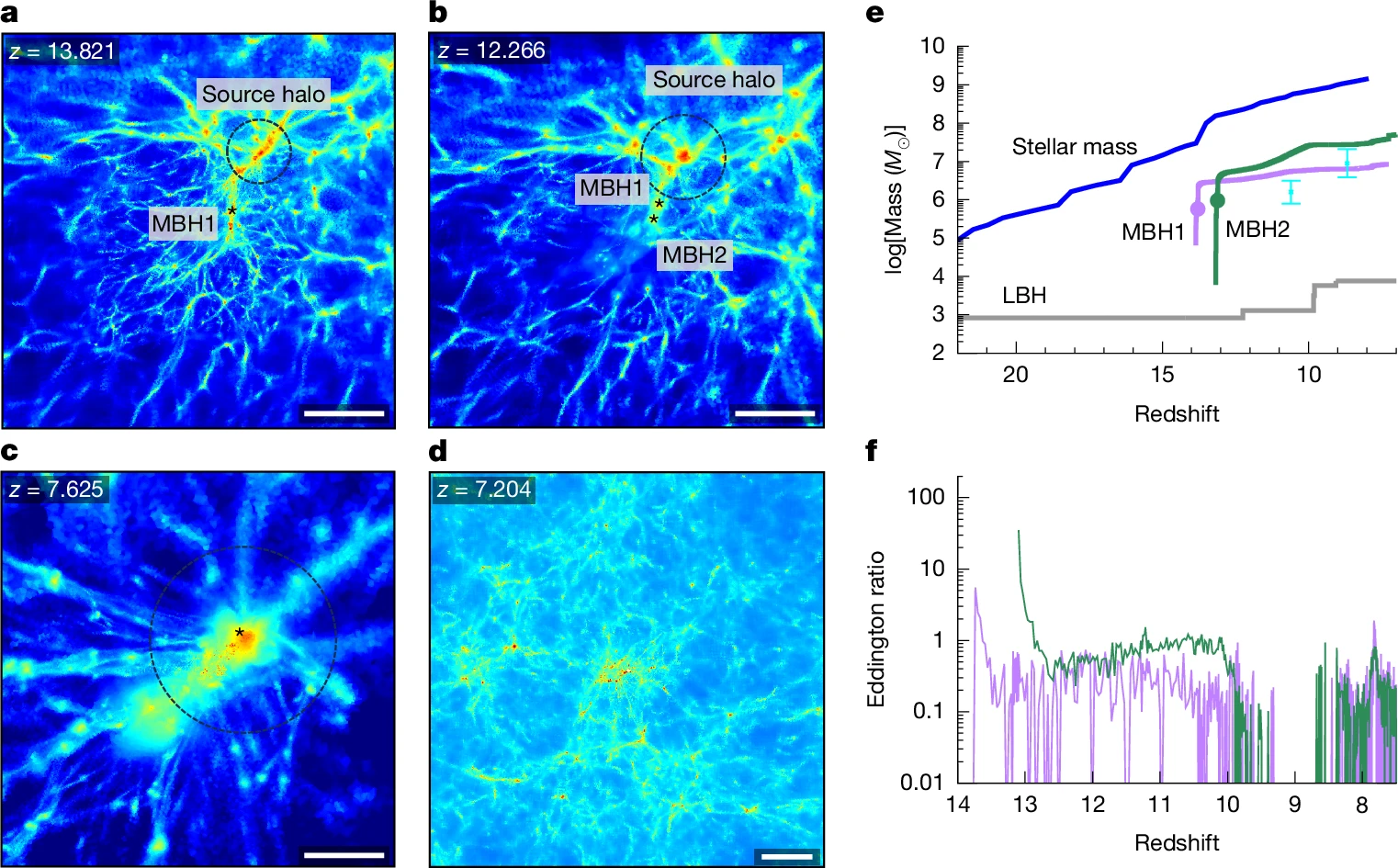
In the main cosmological calculation, the resulting protostars grew to roughly 5 × 10^5 to 9 × 10^5 solar masses before becoming black holes. Two of these objects, designated MBH1 and MBH2, became the massive black-hole seeds followed in the simulation. Their masses were about an order of magnitude above the roughly 10^5-solar-mass seeds commonly expected from standard direct-collapse models.
The unusually deep gravitational potential of the halo helped make this possible. With a virial temperature near 4 × 10^4 kelvin, the halo could retain ionized gas that would have escaped from a much shallower system.
A higher-resolution simulation of MBH1’s progenitor cloud provided a closer look at how the stars grew. It resolved gas densities up to 10^8 particles per cubic centimeter and followed the protostellar system for about 2 million years.
The individual protostars accreted gas at roughly 0.1 to 1 solar mass per year. The most massive object reached about 4 × 10^5 solar masses after two million years. High accretion rates kept the stars in an inflated supergiant state, with radii generally exceeding 100 times that of the Sun and reaching roughly 100 to 1,000 solar radii.
That swollen state mattered because it weakened the stars’ ultraviolet feedback. Rather than becoming compact, hot ultraviolet sources that could rapidly drive gas away, the rapidly accreting stars remained relatively cool at their surfaces. Their radii also varied as episodes of accretion caused repeated contraction and reinflation.
The calculation shows that this combination of rapid accretion and limited radiative feedback can keep gas available to the growing stellar system. The stars ultimately collapse into black holes, providing the massive seeds used in the subsequent cosmological evolution.
The assumed stellar lifetime is 2 million years, although the authors emphasize that the actual lifetime of supermassive stars is uncertain. Stars above several hundred thousand solar masses can become unstable because of general-relativistic effects, potentially collapsing earlier than the assumed lifetime. In that case, the resulting black holes would spend more time embedded in dense gas and could have a longer period of super-Eddington growth.
The newborn black holes feed far above the usual limit
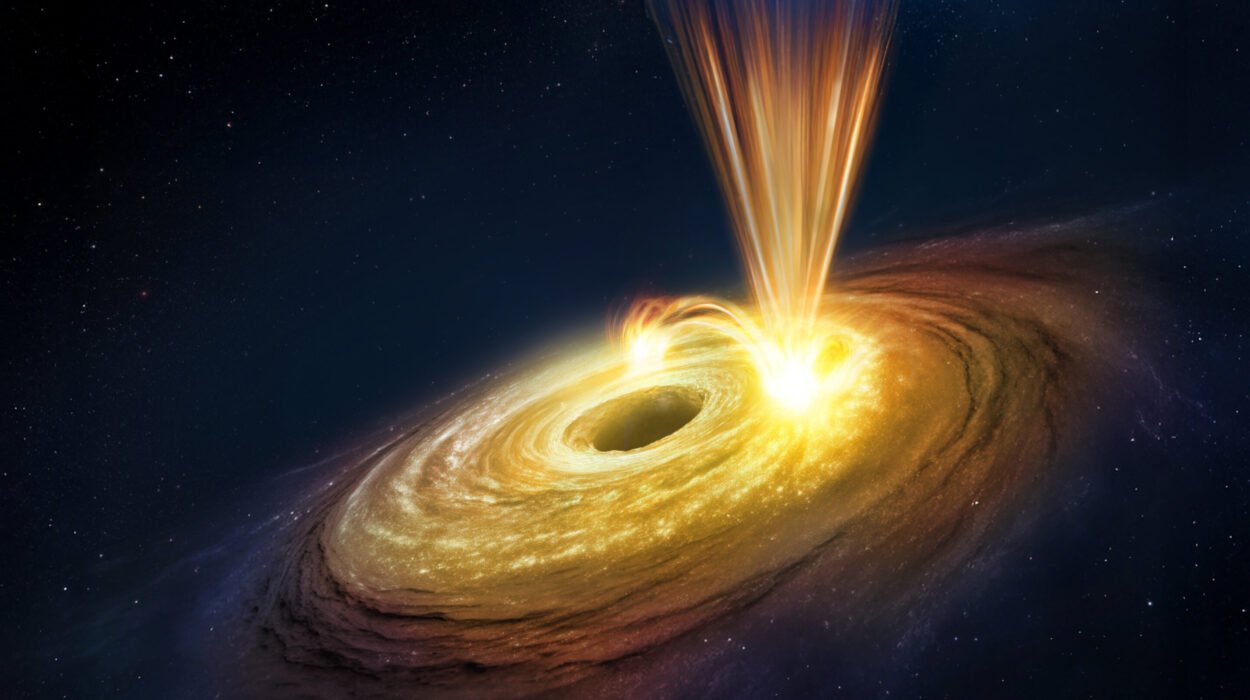
The massive seeds do not simply sit in their gas reservoirs after forming. They enter a brief period of extraordinarily rapid accretion.
Immediately after formation, each black hole is surrounded by a dense, optically thick envelope. In such an environment, radiation can become trapped and carried inward with the gas rather than escaping efficiently. The simulation therefore permits accretion at several times to a few tens of times the Eddington limit for less than a million years.
The gas feeding the black holes comes from a circum-black-hole disk. Gravitational torques remove angular momentum from that gas, allowing it to move inward. As the available reservoir is consumed, the accretion rate falls toward roughly 0.1 to 1 times the Eddington limit, while the black holes grow to several million solar masses.
By around redshift 10, the accretion rate drops sharply to below 1 percent of the Eddington rate. The black holes then pass through the central region of the neighboring massive halo. Their surrounding gas is stripped by the hotter ambient medium, after which dynamical friction draws the black holes toward the galaxy’s center.
By redshift about 8, they have settled into the central kiloparsec of a galaxy with a stellar mass of roughly 10^9 solar masses. At that stage, the black-hole-to-stellar mass ratio is about 1 percent.
The simulated black holes reach masses of more than 10^7 solar masses by about redshift 10 and continue growing more slowly afterward. The authors’ simulated population gives a lower-limit comoving number density of about 10^-4 per cubic megaparsec for galaxies hosting such massive black holes.
The calculation also provides a direct contrast with a much smaller seed.
Earlier in the same environment, a Population III star produces a black hole of roughly 800 solar masses at redshift about 22. That light seed does not undergo the same explosive growth. Radiation from the Population III star photoevaporates gas from its shallow host potential, leaving the black hole with very little fuel. Its mass remains orders of magnitude below that of the heavy seeds.
The difference between the two cases is therefore established before substantial black-hole growth begins: one object starts at only about 800 solar masses, while the other is born from the collapse of a stellar system containing hundreds of thousands of solar masses.
The same dense gas can produce little-red-dot-like signatures
The simulated black holes also develop a phase in which their surrounding gas has physical properties associated with the compact, red objects known as little red dots in James Webb Space Telescope observations.
The circum-black-hole gas reaches densities above 10^8 particles per cubic centimeter. At such densities, hydrogen can develop a large population in its second energy level, producing strong Balmer absorption. The large electron columns also create substantial Thomson scattering, which can broaden Hα emission to more than 1,000 kilometers per second.
To examine this environment more closely, the researchers performed a dedicated zoom-in calculation around MBH2, resolving the region down to about 500 astronomical units.
At 26,000 years after black-hole formation, the black hole is embedded in a dense, geometrically thick disk with hydrogen densities above 10^10 particles per cubic centimeter. The calculated Hα luminosity within 10,000 astronomical units is 1.5 × 10^43 erg per second. The Thomson optical depth across that region reaches 10.2.
That optical depth is larger than observational estimates of roughly 0.1 to 1 for little red dots, but the authors note that most of the simulated Hα emission originates near the outer part of the disk, making the effective optical depth experienced by those photons smaller.
Several hundred thousand years later, the environment has changed. At 523,000 years, dense gas still surrounds the black hole, but the Thomson optical depth has fallen to 0.43 and the Hα luminosity within the same region has dropped to 5.3 × 10^39 erg per second, below typical values inferred for little red dots.
At this later stage, the black hole remains close to the Eddington accretion rate. The inner disk has a luminosity of about 10^44 erg per second. The authors estimate that a fraction of this radiation could emerge in Hα and then be redistributed and broadened by scattering in the surrounding disk, producing Hα luminosities of roughly 10^41 to 10^42 erg per second.
The calculations therefore describe an evolution from a heavily obscured, little-red-dot-like state into a less obscured, more AGN-like state over roughly 0.1 to 1 million years following the burst of rapid accretion.
The second seed still forms despite molecular cooling
One of the more revealing cases is MBH2, which forms in gas that does not remain as uniformly hot as the simplest direct-collapse picture might suggest.
Radiation from MBH1 increases the electron fraction in the surrounding gas. More free electrons promote the formation of molecular hydrogen, which in turn enhances molecular cooling. In the inner region of MBH2’s progenitor, the gas temperature consequently falls below 1,000 kelvin.
Yet the second massive seed still forms.
The authors interpret this as evidence that large-scale gravitational inflow can overwhelm the cooling of the innermost gas. In other words, the existence of molecular cooling in part of the collapsing cloud does not necessarily prevent the formation of a massive seed when the surrounding gas continues to pour inward at a high rate.
This behavior is important to the simulation because it means the heavy-seed pathway does not depend on every part of the gas remaining at the same temperature. The large-scale supply of gas remains the controlling feature during the collapse.
The seeds begin outside the galaxy
The massive seeds also have an unusual early history after their formation. They are initially located about 10 physical kiloparsecs from the source galaxy rather than at its center.
This separation allows the target halos to receive strong far-ultraviolet radiation from the neighboring galaxy without immediately becoming part of that galaxy’s central environment. As the system evolves, the black holes migrate inward.
The light seed and MBH1 enter the neighboring halo at around redshift 12, while MBH2 enters at about redshift 11.2. Their initial orbits are eccentric, and dynamical friction gradually reduces their orbital energy until they settle toward the galaxy’s center.
The separation also helps the simulated seed-forming halos remain metal-poor. The authors note that estimates of galactic winds and superbubbles suggest that enrichment from the nearby galaxy would not necessarily reach the target halo over the relevant period, given the roughly 10-kiloparsec separation.
The heavy-seed phase is hidden from X-rays
The dense environment surrounding the newborn black holes has another consequence. It makes the early accretion phase extremely difficult to see in X-rays.
The researchers examined 64 lines of sight through the environment of MBH2 at two stages, early in its growth and several hundred thousand years later. During the early super-Eddington phase, every line of sight has a hydrogen column density above 10^26 particles per square centimeter.
Such columns imply very strong Compton scattering, so X-rays produced near the accretion flow would have difficulty escaping directly. At the later stage, column densities remain around 10^25 to 10^26 particles per square centimeter.
The authors therefore infer that the simulated system would remain effectively X-ray dark for at least about half a million years, while its optical and infrared emission can resemble the obscured systems identified as little red dots.
The Hα estimates themselves carry a qualification. They use case-B recombination, while resonance scattering at the highest densities could increase the Hα emissivity. The authors also compare the simulated conditions with detailed radiative-transfer calculations, which produce Hα-to-Hβ ratios of roughly 6 to 10, within the range associated with observed little red dots.
The process also appears later in the simulation
The researchers tested whether this sequence is restricted to the earliest seed-forming system they followed.
They selected another candidate halo that met the direct-collapse criteria at redshift about 14, the latest formation redshift among a sample of 62 candidates. A simulation of its surrounding region produced eight seed black holes.
By redshift 7.011, the lowest-redshift direct-collapse object in that calculation had formed. Some of the black holes had already migrated toward the centers of more massive halos, while others were still in the process of forming or evolving in the surrounding region.
Each of the seed black holes eventually grew beyond 10^6 solar masses after a brief period of super-Eddington accretion, and some experienced repeated super-Eddington episodes.
The authors use this second calculation to argue that the heavy-seed and rapid-growth sequence is not confined to an exceptionally early moment in cosmic history. In their simulations, it can occur at redshifts overlapping the period in which little red dots are observed.
The calculation also suggests that several heavy seeds can form in the same overdense environment, rather than requiring one isolated special site.
Tests of the radiation field and numerical resolution
The simulations include uncertainties in how the ultraviolet radiation field and early star formation are modeled. The researchers therefore repeated the calculation with the far-ultraviolet field reduced by factors of 2, 5 and 10.
The timing of the most massive black-hole formation changes only slightly across those tests, with a difference in redshift of less than about 0.1 between the fiducial and weakest-radiation cases. The final black-hole mass varies by less than a factor of three in the tested runs. Even the weakest-radiation case produces a black hole of about 1.9 × 10^7 solar masses by redshift 7.
A higher-resolution simulation also produces the same broad sequence: one Population III light seed forms first, followed by two massive seeds.
These tests support the robustness of the simulated sequence against the particular numerical resolution and ultraviolet intensities examined. They do not eliminate the broader uncertainties in the modeling of early star formation and radiation.
The simulations also do not yet resolve the complete galactic gas inflow needed to establish long-term Eddington-level feeding of the black holes. The authors therefore treat their later growth toward still larger masses as an implication of the available gas supply rather than as a fully simulated continuation.
What the calculations do directly follow is a sequence in which strong ultraviolet radiation delays collapse, the delayed halo accumulates a large gas reservoir, that reservoir fragments into rapidly accreting supermassive stars, and those stars collapse into black holes of roughly 10^6 solar masses. The newborn black holes then undergo a short, deeply obscured period of super-Eddington growth before their accretion rates decline and they migrate into the center of a growing galaxy.
The study was published in Nature.