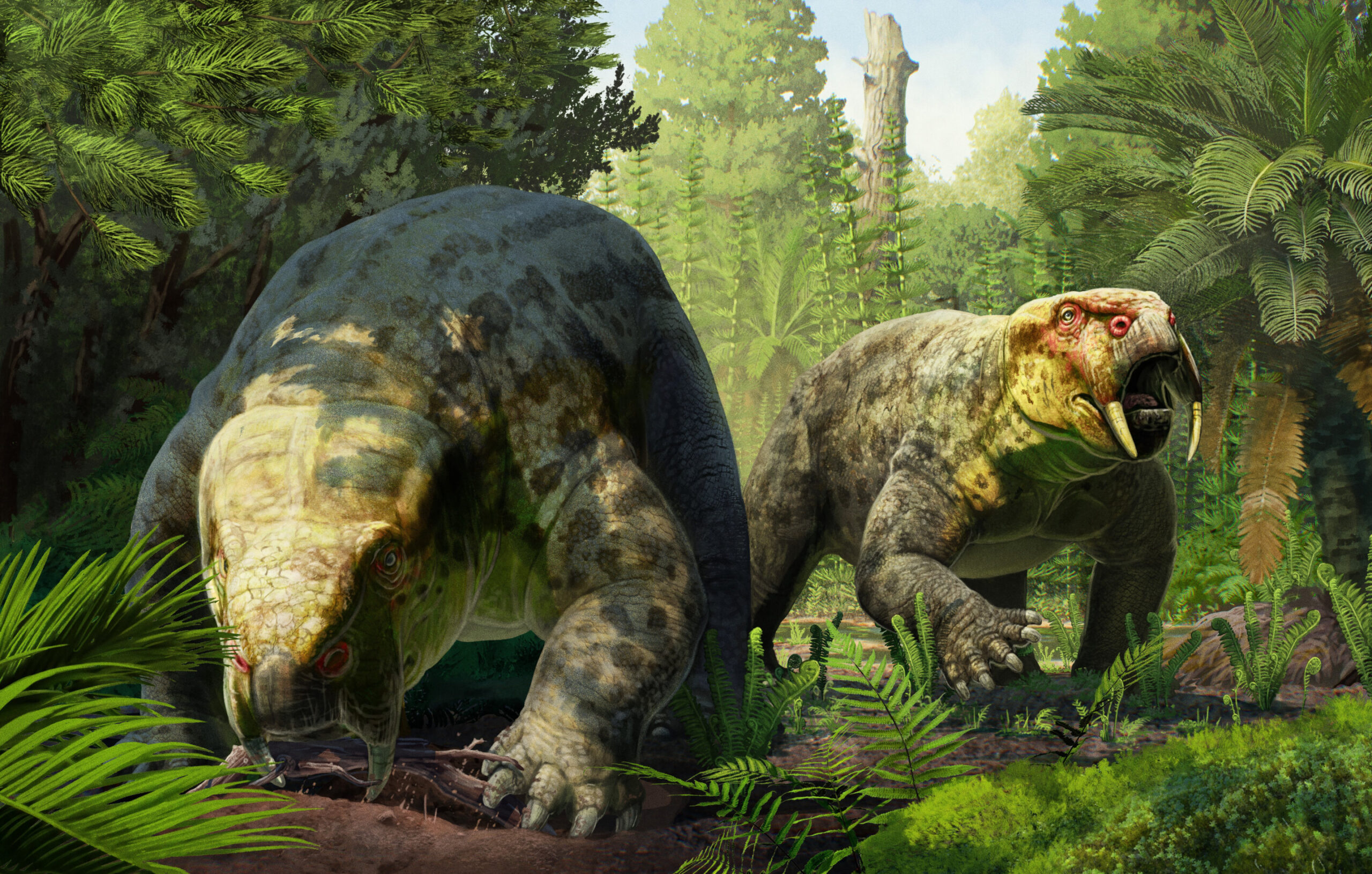
A battered skull and nearly complete jaw collected decades ago in Tanzania have turned out to belong to a previously unknown species of the Triassic herbivore Dinodontosaurus, and its presence alongside other fossils is helping shift the age of the rocks that contain some of the oldest known dinosaur relatives.
The specimen at the center of the discovery spent decades in museum collections. It was collected in 1963 during a British Museum–University of London expedition to what is now Tanzania’s Ruhuhu Basin, from rocks of the mid-to-upper Lifua Member of the Manda Beds. The expedition described it as a partial skull and skeleton of a medium-to-large anomodont, but much of the material eventually became separated from its original associations.
A new examination of the material, including computed tomography of the skull and jaw, has now identified the animal as a new species of dicynodont, a group of beaked therapsids that lived during the Permian and Triassic. The species has been named Dinodontosaurus isiyavamanda.
The researchers also examined another partial skull, NMT RB462, collected in 2012 from a different locality in the same part of the Lifua Member. Its anatomy closely matches the older specimen in several important features, including characteristics of the skull roof and occiput, and it was assigned to the new species.
The main specimen preserves most of the cranium in two major pieces and a nearly complete mandible. The skull is about 30 centimeters long, and the development of its tusks and overall size indicate that the individual was probably at or approaching skeletal maturity.
But identifying the animal was only part of the story. The researchers argue that the new species provides a useful biostratigraphic link between Tanzania and better-dated Triassic fossil assemblages in South America. That link has consequences for the age assigned to the Tanzanian rocks and, in turn, to the early dinosaur record preserved in them.
The skull has a combination not seen before
The animal resembles the South American species of Dinodontosaurus in several important ways. Its snout ends in a squared-off tip, it has large tusks, its nasal bones form a single swollen boss, and its temporal bar is not strongly separated from the rest of the skull roof. The occiput also has a concave upper margin and is widest around the middle of its height.
One especially important feature is found inside the mouth.
The palate contains a ridge on the premaxilla that is unlike the corresponding structure described in the other Dinodontosaurus species. Instead of remaining a relatively narrow ridge along its length, the anterior part expands into a broad, bulbous structure. In the Tanzanian specimen, the posterior part of the ridge is at roughly the same front-to-back level as the tusks, while its bulbous anterior portion extends entirely in front of them.
A second unusual feature occurs on top of the skull. The referred Tanzanian specimen has a groove running along the middle of the temporal bar, from just behind the pineal opening toward the rear of the skull. The researchers could not identify this groove in the South American Dinodontosaurus specimens they examined.
The jaws provide another distinction. The mandibular rami flare farther outward than in the examined material of several other Dinodontosaurus specimens and several other kannemeyeriiform dicynodonts. The new species also lacks the ridge along the front of the mandibular symphysis that is present in some D. brevirostris specimens.
Taken together, these features separate the Tanzanian animals from the previously known dicynodonts of the Manda Beds and from the South American species of Dinodontosaurus. The researchers therefore recognize them as a distinct species rather than as an unusual individual or a sexual form of another known species.
The name isiyavamanda comes from Manda words translated by the authors as “country of the Wamanda,” referring to the Wamanda people, whom the authors say played important roles in discovering the holotype but whose individual names were not documented.
Its unusual palate may have changed how it ate
The skull also gives the researchers a possible clue about how D. isiyavamanda fed.
The species had a relatively short secondary palate compared with several other dicynodonts from the same part of the Lifua Member. Earlier work cited by the authors proposed that longer secondary palates provided more contact area between the upper and lower jaws during food processing. The researchers therefore hypothesize that D. isiyavamanda may have processed food differently from its contemporaries.
The unusual premaxillary ridge is particularly important to that interpretation. In other dicynodonts, a ridge in this region is understood to have helped shear vegetation during chewing. In D. isiyavamanda, however, the front portion of the ridge expands into a lumpy, bulbous surface. The authors suggest that this shape may have allowed the structure to participate not only in shearing but also in crushing and grinding.
From those anatomical differences, they hypothesize that the animal may have relied more heavily on hard, nutritious foods than on the browsing behavior proposed for many other kannemeyeriiforms. The authors present this as a possible example of resource partitioning, allowing several dicynodont species to coexist in the same environment.
There is another potentially relevant piece of anatomy among the material associated with the original specimen: one strongly curved claw-like ungual differs from the curvature seen in other kannemeyeriiforms. But the researchers emphasize that its assignment to D. isiyavamanda is uncertain because the original collection contains material from multiple individuals and may even represent more than one taxon.
The feeding interpretation therefore remains a hypothesis rather than a demonstrated behavior. The authors propose that future finite-element analyses of the skull and palate could test how differences in palate proportions and surface anatomy affected stresses, strains, bite force and mechanical efficiency.
Three evolutionary analyses do not give the same answer
The researchers also tested where the new species belongs in the dicynodont family tree.
They expanded an existing dataset to include 124 operational taxonomic units and 199 characters, including 23 continuous and 176 discrete characters. They then used three approaches: Bayesian analysis, maximum likelihood and parsimony.
All three analyses produced some differences in the relationships among kannemeyeriiforms.
Parsimony recovered 15 most-parsimonious trees. A strict consensus placed D. isiyavamanda as the sister species of D. tener, with that pair as the sister group of D. brevirostris. But the relationship was not retained after jackknife resampling. Bayesian analysis supported a monophyletic Dinodontosaurus containing all three species, with a posterior probability of 0.88, but did not resolve the relationships among the three species.
Maximum likelihood produced a different result. It placed D. isiyavamanda as the sister taxon of Stahleckeriidae, but with only 1% bootstrap support. It recovered D. tener and D. brevirostris as sister taxa with 76% bootstrap support.
The authors consequently emphasize substantial instability in the broader kannemeyeriiform family tree. Some groups appear as a grade in one analysis and as a clade in another, and several relationships have little or no statistical support. They argue that anatomical variation documented in recent studies, including variation in the caniniform process, temporal bar, squamosal and jaw, needs to be represented more fully in future phylogenetic datasets.
That uncertainty does not erase the taxonomic case for the Tanzanian fossil. The anatomical comparisons and some of the phylogenetic results support placing the animal within Dinodontosaurus. But the exact relationships among the species remain unresolved.
The new species connects Tanzania to South America
The most consequential part of the study comes from where Dinodontosaurus occurs.
The genus is otherwise known from South America. Its presence in Tanzania gives the researchers a faunal connection between the mid-to-upper Lifua Member and the Dinodontosaurus Assemblage Zone of Brazil and the Chañares Formation of Argentina.
That matters because the age of the mid-to-upper Lifua Member has been disputed.
Historically, parts of the Manda Beds were correlated with the Cynognathus Assemblage Zone of South Africa. The proposed correlation was based in part on shared fossils, including Cynognathus, Cricodon and Angonisaurus. But the authors point to more recent work that has weakened those links. Angonisaurus has been argued not to occur in the Cynognathus Assemblage Zone, while the identification of Cricodon there has also been questioned.
The fossil evidence instead points toward similarities between the mid-to-upper Lifua Member and several South American and African units. Along with Dinodontosaurus, the comparison involves dicynodonts such as Sangusaurus and Tetragonias, as well as cynodonts, rhynchosaurs, pseudosuchians and silesaurids.
The Chañares Formation provides an especially important reference because its lower part has been dated to the earliest Carnian, at about 236 million years ago, while the Dinodontosaurus Assemblage Zone is considered likely to span the late Ladinian and part of the Carnian. The authors therefore argue that the mid-to-upper Lifua Member was probably deposited during the late Ladinian to Carnian rather than during the Anisian.
The proposed age is not based on Dinodontosaurus alone. The researchers point to the combined similarity of the Tanzanian fauna to the better-dated South American assemblages as the main support for the younger age.
That changes the age of fossils tied to early dinosaur history
The age of the mid-to-upper Lifua Member matters because fossils from these rocks have been used in discussions of dinosaur origins.
One of them is Nyasasaurus parringtoni, which has been hypothesized to be the oldest known dinosaurian. Another is Asilisaurus kongwe, a silesaurid from the mid-to-upper Lifua Member. The authors note that the dinosaurian status of both animals has been disputed, with competing analyses instead placing them just outside Dinosauria as closely related dinosauriforms.
The precise layer that produced Nyasasaurus is also uncertain. The authors note that most fossil material from the Lifua Member comes from the mid-to-upper part, making that horizon a likely source, but they do not treat the stratigraphic assignment as certain.
If the mid-to-upper Lifua Member is instead late Ladinian to Carnian, then those dinosaurs or close dinosaur relatives would no longer represent Anisian-aged animals. Their age would shift to the latest Ladinian through Carnian under the proposed correlation.
That is the central chronological consequence of the new fossil.
The authors describe the younger age as robustly supported by the large amount of faunal similarity between the mid-to-upper Lifua Member and the South American Dinodontosaurus Assemblage Zone and Chañares Formation, which have absolute age constraints. At the same time, they acknowledge limitations and unresolved conflicts in the broader Gondwanan biostratigraphic framework.
Other evidence does not fit neatly into the younger-age picture
The age question is not completely settled.
One complication is Cynognathus, which occurs across numerous Gondwanan fossil assemblages. Because some of those units have been assigned Anisian ages, the occurrence of Cynognathus can be used to argue for an older age for at least some of the Tanzanian rocks. The authors outline several possibilities, including the possibility that the Lifua Member spans a longer interval from the Anisian to the Carnian.
The Puesto Viejo Group in Argentina presents another conflict. A volcanic layer between formations in the group has yielded a uranium-lead zircon age of 235.8 ± 2.0 million years, suggesting an earliest Carnian age for the overlying formation. Yet some of the fossils associated with those rocks have traditionally been used in correlations with older, late-Anisian units. Previously published paleomagnetic data have also suggested an age of about 245 million years for the lower part of the Quebrada de los Fósiles Formation. The authors therefore conclude that the position of the Puesto Viejo Group within their proposed framework remains unclear.
These conflicts are important because the proposed age of the Tanzanian rocks depends on correlations among fossil assemblages whose own ages and taxonomic identifications are not all equally secure.
Even so, the authors conclude that the combined biostratigraphic evidence supports interpreting the mid-to-upper Lifua Member as late Ladinian to Carnian. They recommend that this younger age be taken into account in future studies of the origins of major Mesozoic groups, including Dinosauria.
The new Dinodontosaurus species thus does more than add another animal to the fossil record. Its anatomy establishes a previously unrecognized Tanzanian species, while its occurrence provides another faunal connection between the Manda Beds and Triassic assemblages in South America. That connection is the basis for the authors’ conclusion that the rocks containing some of the fossils long associated with the earliest dinosaur record are younger than they have historically been considered.
The study was published in Journal of Vertebrate Paleontology.