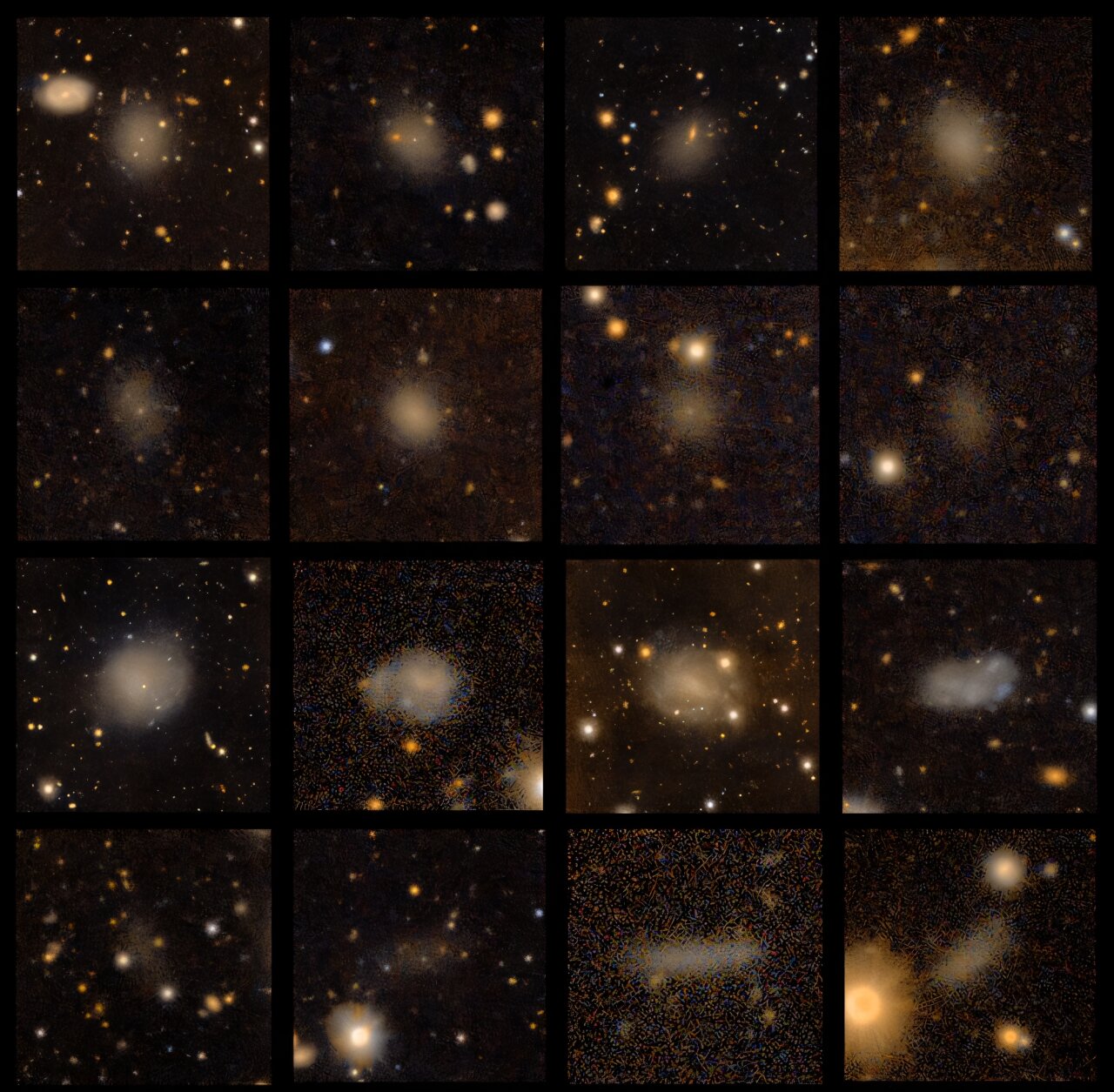
Faint, diffuse galaxies emerge across a 2.6-square-degree patch of sky in unusually deep optical images, with 47 dwarf galaxy candidates identified around NGC 5068, NGC 5084 and NGC 5087. Only four had been reported previously, giving astronomers a much larger population to examine around these nearby systems.
The galaxies are difficult to see because many are both small and faint. To look for them, the VST-SMASH survey used deep, wide-field observations from the European Southern Observatory’s Very Large Telescope Survey Telescope and its OmegaCAM instrument.
The field includes the nearby spiral galaxy NGC 5068, about 5.2 million parsecs away, as well as the more distant NGC 5084 and NGC 5087, at about 20.6 and 24.5 million parsecs, respectively. The latter two lie in the peripheral regions of the Virgo Supercluster.
The observations covered roughly 2.7 square degrees in each of the three optical bands used by the survey, g, r and i. Total exposure times for this particular field were approximately 2.7 hours in g, 3.4 hours in r and 2.2 hours in i. The resulting 1-sigma surface-brightness limits were 30.7, 30.2 and 29.4 magnitudes per square arcsecond in g, r and i.
Rather than beginning with an automated catalogue of possible galaxies, the researchers visually inspected the full mosaic. They deliberately looked for diffuse, low-surface-brightness objects that could be missed by automatic detection methods.
That first inspection produced 71 preliminary candidates. The researchers then examined them again using individual g, r and i images, color information and RGB composites. Three investigators independently classified the objects as high-probability dwarfs, likely dwarfs or objects that were not dwarfs.
After this vetting, 47 candidates remained. Thirty received the high-probability classification and 17 were classified as likely dwarfs.
Most have smooth appearances resembling dwarf elliptical or dwarf spheroidal galaxies. About 10 show internal features such as arms, blobs or central concentrations. The researchers caution, however, that the roughly 1-arcsecond image resolution can smooth out real substructure.
Most of the candidates were new
A search through the SIMBAD and NED databases, supplemented with information from the HECATE catalogue, found that only four of the 47 candidates had previously been reported.
Three of those four were already associated with catalogued objects. ESO 576-23 appears small and irregular or spiral-like in the new images, while ESO 576-25 has an irregular appearance. Another previously known object, CCF97G4, also has an irregular morphology with several bright clumps.
The fourth, designated dw1318-2153 in the new catalogue, had previously been reported as a dwarf candidate. Its smooth appearance is typical of the dwarf elliptical or dwarf spheroidal systems in the sample.
The comparison with that previously studied galaxy also provided a check on the new measurements. For dw1318-2153, the researchers found good agreement with earlier measurements over much of the galaxy’s surface-brightness profile. Their profile was smoother, which they attribute to the greater depth of the new observations and more detailed treatment of the galaxy’s geometry.
The new data were about one magnitude deeper than the earlier observations used for comparison. The researchers suggest that this difference in depth helps explain why many of their newly identified candidates were absent from the earlier catalogue.
The galaxies have the properties expected of dwarfs
The researchers measured the light from the candidates after masking foreground stars, background galaxies and other contaminants. They extracted radial surface-brightness profiles and fitted them with single-component Sérsic models.
The Sérsic model describes how a galaxy’s brightness changes with distance from its center. From the fits, the researchers obtained quantities including effective radius, surface brightness and Sérsic index, which describes the shape of the light profile.
The candidates generally have shallow light profiles. For the r-band sample used for the main structural analysis, the median Sérsic index was 0.8, with the central 68% of the distribution spanning roughly 0.6 to 1.1. The candidates therefore generally had Sérsic indices below 2.
Their median effective radius was 5.4 arcseconds, with the 16th and 84th percentiles at 2.3 and 8.0 arcseconds. Because the actual distances to most of the candidates are unknown, the researchers kept the observed sizes in angular units rather than converting all of them directly into physical sizes.
The apparent r-band Sérsic magnitudes had a median of 19.6 magnitudes, spanning a distribution centered between 17.8 and 20.7 magnitudes at the 16th and 84th percentiles.
The surface-brightness measurements also place the candidates in the low-surface-brightness regime. The median central surface brightness was 24.1 magnitudes per square arcsecond, while the median effective surface brightness was 25.3 magnitudes per square arcsecond.
Their colors match the dwarf population
Color provides another way to test whether the faint objects have properties consistent with dwarf galaxies.
Measured within one effective radius, the median g−r color was 0.57 magnitude and the median r−i color was 0.24 magnitude. The 16th–84th percentile ranges were 0.37–0.64 magnitude for g−r and 0.10–0.36 magnitude for r−i.
The researchers compared these distributions with dwarf galaxy candidates previously studied in the Fornax cluster. The color distributions were broadly consistent.
They also tested the distributions statistically rather than relying only on their appearance in plots. Kolmogorov-Smirnov and Mann-Whitney tests indicated good agreement for absolute magnitude, g−r and g−i under the reference distance assumption, with the KS tests giving p values above 0.05. The r−i distributions produced p values below 0.05, indicating a statistical difference, although the researchers noted that the difference was not visually obvious.
An Earth Mover’s Distance analysis, combined with 1,000 within-sample bootstrap iterations, did not find the differences large enough to exceed the adopted significance threshold. The researchers therefore note that the small discrepancy in r−i could reflect the large scatter and limited size of the VST-SMASH sample, or simply be too small to have physical significance.
The unknown distances are the main complication
The candidates’ apparent properties can be measured directly, but their absolute magnitudes and stellar masses depend on distance. Distances are unavailable for the vast majority of the sample.
To explore their likely physical properties, the researchers examined galaxies with known distances in the HECATE catalogue that fall within the field. Restricting that comparison to galaxies no farther than 100 Mpc produced a median distance of about 26 Mpc, which the researchers adopted as a reference distance.
At 26 Mpc, the candidates have a median absolute r-band magnitude of −12.5 and a median stellar mass of log₁₀(M⋆/M☉) = 7.3. The 16th–84th percentile range for stellar mass is 6.7–7.9.
But those numbers are assumptions rather than direct distance measurements for the dwarf candidates.
Changing the assumed distance has a substantial effect. If all of the candidates were placed at the 5.2 Mpc distance of NGC 5068, their mean absolute magnitude would shift by 3.49 magnitudes toward fainter values, while the corresponding stellar masses would shift by −1.40 dex. At 40 Mpc, the mean absolute magnitude would shift by −0.94 magnitude and stellar masses by +0.37 dex.
This uncertainty becomes especially important when asking which large galaxy, if any, the dwarfs orbit.
Several groups of dwarfs line up near possible hosts
The researchers mapped the positions of the dwarf candidates against the roughly 30 catalogued galaxies in the field with measured distances.
The sky distribution contains clear concentrations near NGC 5084 in the southeast and NGC 5087 in the northeast. Several other galaxies are also located near NGC 5087 and could plausibly contribute to the population of dwarfs in that region.
Two additional concentrations appear toward the central-east and southwest portions of the field.
NGC 5068 presents a different case. If the candidates were assumed to be at its 5.2 Mpc distance, their average size-luminosity relation would not match the comparison dwarf population well. At that distance, the galaxies would generally appear too faint relative to their inferred physical sizes unless they were intrinsically fainter than the comparison dwarfs.
Yet their positions on the sky place many of them at physically plausible projected separations from NGC 5068.
The researchers therefore developed an empirical probability scheme to estimate possible host associations. The calculation combines projected separation, the candidate’s size, its absolute magnitude under the assumed host distance and any available distance measurement.
The approach is explicitly described as somewhat arbitrary. The separation term is based on a satellite number-density profile that declines strongly with distance, while the size term is constructed from dwarf galaxies in the Local Volume Database and Extended Virgo Cluster Catalog. The magnitude term checks whether a candidate falls within an adopted range of dwarf-galaxy absolute magnitudes. For candidates with known distances, a separate term requires their distance to be within 5 Mpc of a potential host.
The researchers emphasize that this is an empirical procedure rather than a physically complete model. They also do not account for the possibility that some candidates are isolated galaxies. They plan to use cosmological simulations in future work to develop a more physically motivated probability scheme.
Even with those qualifications, the analysis points to NGC 5068, NGC 5084 and NGC 5087 as plausible hosts for many of the candidates.
NGC 5084 has a possible concentration of at least 10 dwarfs
The spatial pattern around NGC 5084 is particularly interesting.
The researchers identify at least 10 dwarf candidates with a potential association with the large edge-on lenticular galaxy. Some of these candidates appear in a region roughly perpendicular to NGC 5084’s disk.
That arrangement could resemble the type of flattened satellite structure observed around the Milky Way, but the authors do not treat the apparent alignment as established.
The crucial missing information is motion. Confirming whether these galaxies actually belong to NGC 5084 and form a coherent structure would require radial-velocity measurements and a kinematic study of their relationship to the host.
About five dwarf candidates have a high-probability association with NGC 5087 in the empirical analysis. Because NGC 5068 is much closer than the two Virgo Supercluster galaxies, the researchers find it a plausible host for many of the remaining candidates despite the tension between the assumed 5.2 Mpc distance and the observed size-luminosity relation.
The centers of many dwarfs are slightly redder
The study also examined how galaxy colors change from the centers toward the outskirts.
For 44 candidates with sufficiently reliable measurements, the researchers calculated g−r and g−i color gradients from their central color profiles. They used both the observed profiles and profiles based on deconvolved Sérsic fits to reduce the effects of seeing, which are particularly important for the smallest objects.
The gradients show substantial scatter. At stellar masses below log₁₀(M⋆/M☉) = 7.5, the deconvolved profiles have a median g−r gradient of −0.12 magnitude per dex, with a 1-sigma scatter of 0.16 magnitude per dex. The corresponding weighted mean is −0.09 ± 0.03 magnitude per dex.
For g−i, the median gradient in the same mass range is −0.13 magnitude per dex, with a 1-sigma scatter of 0.20 magnitude per dex, and the weighted mean is −0.15 ± 0.04 magnitude per dex.
For the most massive dwarfs in the sample, with stellar masses around or above 10⁸ solar masses, the gradients are instead mostly near zero or positive.
The authors interpret the predominantly negative central gradients as being mainly associated with negative metallicity gradients, while noting that stellar age and dust can also contribute. They discuss supernova feedback and early galaxy formation as possible processes that could produce such metallicity patterns. Those explanations remain interpretations rather than measurements of the individual galaxies’ metallicities or star-formation histories.
At larger radii, the color gradients behave less uniformly. Extending the g−r profiles to five effective radii gives a median deconvolved gradient of 0.1 magnitude per dex, but with a large scatter of 0.7 magnitude per dex. When measurement uncertainties are taken into account, the weighted mean is −0.1 ± 0.2 magnitude per dex.
The sample points to a larger population, but its membership is not yet settled
The observations substantially expand the census of faint galaxy candidates in this part of the sky. The candidates have colors and structural properties consistent with dwarf populations studied elsewhere, and their size, luminosity and Sérsic-index relations are broadly consistent with the comparison samples when the reference distance of 26 Mpc is adopted.
The researchers also find that those structural relations remain consistent when distances as large as 40 Mpc are considered. At 5.2 Mpc, however, the candidates become much less compatible with the comparison relations. This makes it difficult to determine how many of them belong to NGC 5068 from photometry alone.
The study therefore stops short of assigning definitive membership to the candidates. The apparent concentrations around NGC 5084, NGC 5087 and NGC 5068 are based on projected positions and empirical probability estimates, not confirmed three-dimensional associations.
Spectroscopic observations that provide distances and velocities are needed to determine which galaxies actually belong to which host. Deeper, higher-resolution imaging would also help establish their detailed morphologies and stellar populations. Until those measurements are available, the 47 objects remain dwarf galaxy candidates rather than a fully confirmed satellite population.
The study was published in Astronomy & Astrophysics.