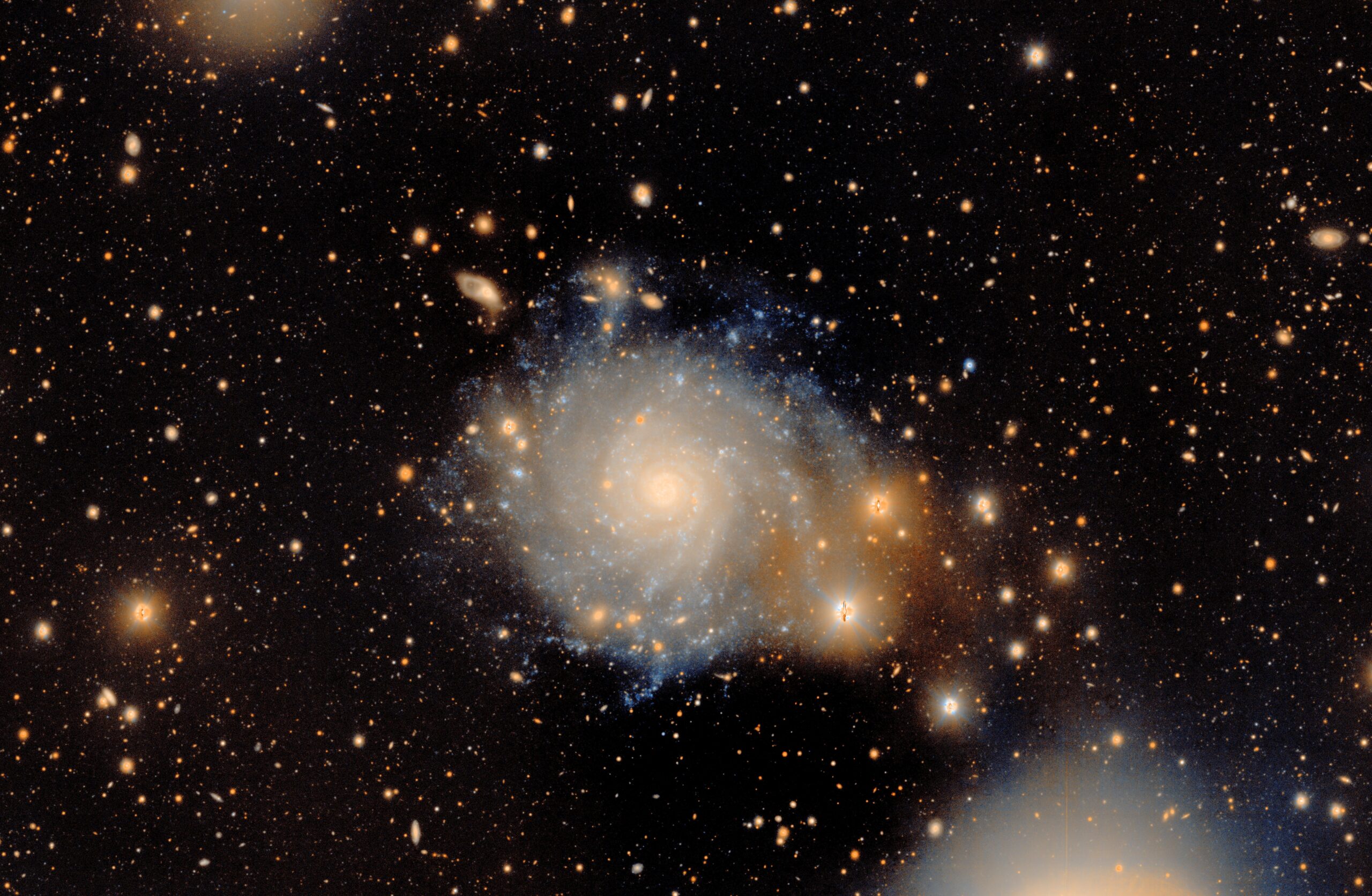
Two faint stellar streams emerge from the outskirts of IC 5332, a nearby spiral galaxy whose outer regions become increasingly difficult to see as its light fades into the background sky. One extends about 7 kiloparsecs and the other about 15 kiloparsecs, and both are redder than nearby parts of the galaxy. Their shapes, colors and locations point toward material that may have been added to the galaxy through past or ongoing accretion, although the observations do not identify the streams’ original galaxies with certainty.
IC 5332 lies about 7.8 million parsecs from Earth in the constellation Sculptor. It is an almost face-on, low-surface-brightness spiral galaxy and belongs to the NGC 7713 group. Its stellar mass is estimated at about 1.4 billion solar masses, while its total mass within its Holmberg radius is about 1.7 × 10¹⁰ solar masses. The galaxy contains about 1.5 × 10⁹ solar masses of neutral hydrogen and forms stars at roughly 0.3–0.4 solar masses per year, based on Hα and ultraviolet measurements reported in the study.
The new observations were made as part of VST-SMASH, a survey designed to examine the extremely faint outer regions of nearby spiral galaxies. The survey covers 27 galaxies within 11 Mpc and uses deep optical imaging in three filters, called g, r and i. Its purpose is to trace structures that can be missed in ordinary images, including diffuse stellar components, satellite galaxies and tidal streams.
For IC 5332, the observations were obtained with the 2.6-meter VLT Survey Telescope at ESO’s Paranal Observatory between May and December 2023. The telescope’s OmegaCAM camera provides a one-square-degree field of view. Because IC 5332 is relatively extended on the sky, the observations used an ON-OFF strategy, with a separate nearby field used to estimate the background sky. The g and r observations each accumulated 2.5 hours of exposure, while the i band received 2 hours.
The resulting images reached formal 1σ surface-brightness limits of about 30.7 magnitudes per square arcsecond in g, 30.5 in r and 29.5 in i, measured over 100-square-arcsecond regions. The median image quality, measured by the point-spread-function width, was about 0.9 arcsecond in g, 1.1 arcseconds in r and 0.8 arcseconds in i.
Those depths allowed the researchers to follow IC 5332’s light much farther out than its bright central disk. The radial surface-brightness profiles extend to about 19 kpc in g, 28 kpc in r and 23 kpc in i, reaching faintest measured levels of 29.1, 29.9 and 28.9 magnitudes per square arcsecond, respectively.
The outer light is not simply a smooth continuation of the inner galaxy.
Inside roughly 1.5 kpc, the colors are relatively flat. Farther out, to about 6.5 kpc, the galaxy becomes progressively bluer, which the authors interpret as evidence for a radial change in its stellar population, potentially involving younger and/or lower-metallicity stars farther from the center. Beyond about 170 arcseconds, or roughly 6.4 kpc, that pattern reverses. The g−r and g−i colors become redder, while r−i trends in the opposite direction and becomes bluer, although the latter measurement has larger uncertainties.
That reversal occurs at approximately the same radius where the newly identified stellar streams begin.
A sudden change in the galaxy’s outer structure
The researchers examined the shape of IC 5332 as a function of radius by measuring the position angle and ellipticity of its light distribution in all three filters.
Through most of the main disk, the ellipticity remains below about 0.2, consistent with the galaxy’s nearly face-on appearance. The position angle fluctuates between roughly 12 and 170 arcseconds, which the authors associate with the winding and asymmetric spiral arms.
Beyond about 170 arcseconds, however, both measurements change markedly. The position angle settles toward roughly 170–180 degrees, while the ellipticity rises dramatically, reaching at least about 0.7 in all three bands. Instead of the relatively regular disk dominating the isophotes, the outer light becomes elongated and asymmetric. The researchers interpret this transition as evidence that low-surface-brightness structures such as the stellar streams are beginning to dominate the measured shape of the galaxy.
The change is also reflected in the galaxy’s surface-brightness profile. A single Sérsic model, commonly used to describe a galaxy’s radial light distribution, can approximate the inner regions but fails systematically in the outskirts. A two-component model, consisting of an inner Sérsic component and a more extended outer component, provides a better description in all three bands.
The improvement is substantial in the fitting statistics. The one-component fits have reduced χ² values of 62.420, 69.27 and 90.81 in g, r and i, respectively. The corresponding two-component values are 14.67, 23.70 and 27.11. The sums of absolute residuals also fall from 17.31, 10.41 and 10.07 magnitudes for the one-component fits to 1.068, 1.012 and 1.954 magnitudes for the two-component fits. The authors caution, however, that reduced χ² in these deep surface-brightness analyses can be larger than one because neighboring radial measurements have correlated uncertainties and because residual background systematics are not fully represented by the formal errors. They therefore use it as a relative measure of fit quality rather than an absolute statistical test.
The two fitted components also change with wavelength. The inner component becomes progressively more compact and brighter toward the redder bands. Its effective radius falls from 12.87 ± 0.6 arcseconds in g to 10.65 ± 0.5 arcseconds in r and 10.35 ± 0.4 arcseconds in i. Its Sérsic index changes from 1.17 ± 0.06 to 1.06 ± 0.03 and 0.99 ± 0.05. The authors associate this inner component with a more compact central structure or inner disk and interpret its wavelength dependence as consistent with older stellar populations contributing more strongly at longer wavelengths.
The outer component is much more extended. Its effective radius is about 115 arcseconds in g, 127 arcseconds in r and 110 arcseconds in i. Its Sérsic index rises from 1.06 ± 0.06 in g to 1.47 ± 0.1 in r and 1.37 ± 0.1 in i. The researchers say the outer component likely traces an extended disk, but they discuss several possible ways such a component could arise, including radial migration, accreted material or minor interactions.
The two streams emerge at different distances
The most distinctive structures appear on the western side of IC 5332.
The first, called Stream 1, begins at about 170 arcseconds from the galaxy’s center, corresponding to roughly 6.4 kpc, or about 1.4 times the r-band effective radius. It has a projected length of approximately 7 kpc and an average width of about 2.3 kpc. Its orientation resembles the galaxy’s spiral arms, but its pitch angle is substantially different. The researchers say this geometry could suggest some interaction.
Stream 1 is also clearly separated from a bright star near its southern end. That matters because scattered light from bright stars is a major concern when trying to detect extremely faint structures. Its separation from the star argues against the feature being simply scattered starlight.
The second feature, Stream 2, begins farther out, at about 220 arcseconds, or 7.6 kpc from the center. That is also where the bump in the r-band surface-brightness profile appears. Unlike Stream 1, Stream 2 is completely disconnected from the main disk, crosses Stream 1 and does not follow the pattern of the galaxy’s spiral arms. It has an arc-like shape oriented toward the center and extends for about 15 kpc, with an average width of about 3.2 kpc.
A smaller feature, Stream 3, is also visible in the deep images, although its very low surface brightness makes it difficult to detect. The different shapes of these structures led the authors to suggest that they may have a tidal origin, potentially representing debris from a disrupted satellite galaxy.
The streams are redder than the surrounding disk
The researchers did more than identify the structures by eye. They measured their extinction-corrected integrated g−r colors and compared them with regions at similar distances from the galaxy’s center.
Stream 2 has a g−r color of about 0.5–0.6 magnitude, while its comparison region has a value of about 0.2–0.3 magnitude. Stream 1 has a g−r color of about 0.3–0.4 magnitude, compared with about 0.1–0.2 magnitude for its counterpart. In both cases, the streams are therefore measurably redder than the nearby comparison regions.
The color difference supports the interpretation that the streams are not simply ordinary parts of the star-forming spiral disk. The authors say the redder colors are consistent with accreted material containing older and/or more metal-rich stellar populations. Stream 2’s color is also broadly consistent with values reported for dwarf and low-surface-brightness galaxies.
That comparison leads to a specific possibility: Stream 2 could be the remains of a dwarf or low-surface-brightness satellite that has been completely or partially disrupted. But the researchers explicitly do not regard that as established from the colors alone. Other interpretations cannot be excluded, and the original object could still be present but hidden behind one of the bright foreground stars in that part of the image.
The color pattern across the whole galaxy adds another complication. The redward turn in g−r and g−i begins around the same 170-arcsecond radius where the streams appear, potentially marking the emergence of a distinct outer stellar population. At the same time, r−i becomes bluer.
The authors caution that this latter behavior may not be straightforward evidence about the stars themselves. A pronounced bump in the r-band light around 220 arcseconds could indicate additional emission in that filter. They suggest that diffuse Hα+[N II] emission from ionized gas may contribute to the r-band signal, although the nearly face-on orientation of IC 5332 makes such emission difficult to distinguish. Spectroscopic observations would be needed to test this possibility.
The faint structures survive several artifact checks
Detecting structures this faint requires ruling out effects caused by the telescope, bright foreground stars and imperfect background subtraction.
The researchers first divided the galaxy into three angular sectors and compared their surface-brightness and color profiles. One sector contained the region potentially affected by bright stars and also overlapped the streams. It did not show a significant systematic difference from the other sectors. This indicates that scattered light from those stars does not significantly affect the measured outer colors.
They also modeled the extended wings of the OmegaCAM point-spread function. Even after including an exponential outer component in addition to the central Moffat profile, the predicted scattered light remained several magnitudes fainter than the observed galaxy emission beyond roughly 150 arcseconds. The authors therefore conclude that the extended PSF wings do not significantly affect the surface-brightness profiles or the stream detection.
An independent check came from the DESI Legacy Surveys DR10 imaging. Those data have their own artifacts, particularly in the outer regions, so the researchers did not use them as a replacement dataset for the full analysis. But both Stream 1 and Stream 2 are nevertheless visible in the independent images. Stream 2 is especially useful for this test because part of it overlaps the region affected by bright stars in the VST images. Its appearance in both datasets supports the conclusion that the streams are genuine structures associated with IC 5332 rather than artifacts from stellar halos or background subtraction.
The outer light also changes the estimated stellar mass
The deep observations affect not only the visible structure of IC 5332 but also how its stellar mass is distributed with radius.
The researchers estimated the stellar mass surface density from the observed colors and r-band light using five empirical mass-to-light relations. Because these relations make different assumptions about stellar populations and their evolution, the resulting mass-to-light ratios differ. The extreme models have an average offset of about 0.18 dex in log mass-to-light ratio, corresponding to a scatter of about 0.09 dex.
The resulting total stellar mass is estimated at log₁₀(M*/M☉) ≈ 9.42–9.54. The mass-to-light ratio stays nearly constant out to about 150 arcseconds, or 5.6 kpc, before increasing and reaching a peak around 200 arcseconds, or about 7.5 kpc. The mass-density profile consequently rises beyond about 6 kpc, reaches a maximum and then declines.
The cumulative mass profile shows a corresponding flattening around 6 kpc. It reaches log₁₀(M*/M☉) of about 8.90–9.10 there, then rises again around the mass-to-light-ratio bump before approaching saturation beyond roughly 12 kpc at about log₁₀(M*/M☉) = 9.3–9.4. This complex behavior occurs in the same region where the stream-like structure is detected.
The study emphasizes that these mass estimates depend on the adopted color-to-mass-to-light relations. They are somewhat larger than the earlier estimate listed in the paper’s literature table, which used a scaled Salpeter initial mass function, but smaller than an earlier estimate of 7.6 × 10⁹ solar masses derived from 3.6-micron emission under the assumption of a constant mass-to-light ratio.
A central gradient and a disturbed outer disk
The deep photometry also reveals a strong color gradient inside the galaxy. Between 0.1 and 1 times the r-band effective radius, the g−i color gradient is −0.32 dex. The authors compare this with a median value of about −0.15 dex for late-type galaxies with similar stellar masses reported in earlier work.
Internal dust extinction changes the measured gradient. Using an extinction that declines from AV = 0.40 magnitude at the center to 0.25 magnitude at one effective radius, and assuming a linear change between those points, the researchers obtain a dust-corrected gradient of −0.24 dex. They say this is consistent with a gradient driven by changing stellar metallicity, with metallicity declining outward. The result also agrees with the steep gas-phase metallicity gradient previously reported for IC 5332.
The authors interpret the inner gradient within a dissipative, or monolithic, collapse scenario in which the central regions retain gas more effectively and undergo stronger star formation and chemical enrichment, with stellar and supernova-driven outflows potentially reinforcing the gradient. This is an interpretation of the observed color and metallicity behavior rather than a direct measurement of the galaxy’s formation history.
The outer regions present a different picture. There, the distorted spiral structure, abrupt changes in the isophotes, color reversal and distinct stellar streams are all consistent with an external component added to the galaxy. The authors interpret the combined evidence as supporting past or ongoing accretion that contributed to the buildup of IC 5332’s outer disk.
At the same time, the study does not establish exactly when the accretion occurred, what object produced the streams or whether all of the unusual outer color behavior comes from stars. The possible contribution of Hα+[N II] emission to the r band remains unresolved, and the authors note that spectroscopic follow-up is needed to investigate it.
The study examines only one galaxy, so its authors do not use IC 5332 alone to establish how frequently such structures occur. Instead, this first VST-SMASH analysis demonstrates the depth of the survey and its ability to detect faint outer structures. The full survey contains 27 nearby galaxies, and future work is intended to examine their stellar streams, diffuse structures, dwarf galaxies and globular clusters and to quantify how often such features occur.
For IC 5332 itself, the deepest images leave a galaxy whose bright inner disk gives way to a much less orderly outer region, where two confirmed low-surface-brightness streams cross the faint outskirts. Their morphology and colors are consistent with accreted material, with Stream 2 in particular compatible with the possible debris of a disrupted dwarf or low-surface-brightness satellite. But the source of that material remains unresolved from the optical photometry alone.
The study was published in Astronomy & Astrophysics.