Tiny fragments of silica preserved in the sediments of Cloggs Cave are helping reconstruct how the Old Ancestors of GunaiKurnai Country brought plants deep underground, where whole grasses appear to have been deliberately burned. The microscopic remains also reveal why separating human activity from the feeding habits of possums is not always straightforward.
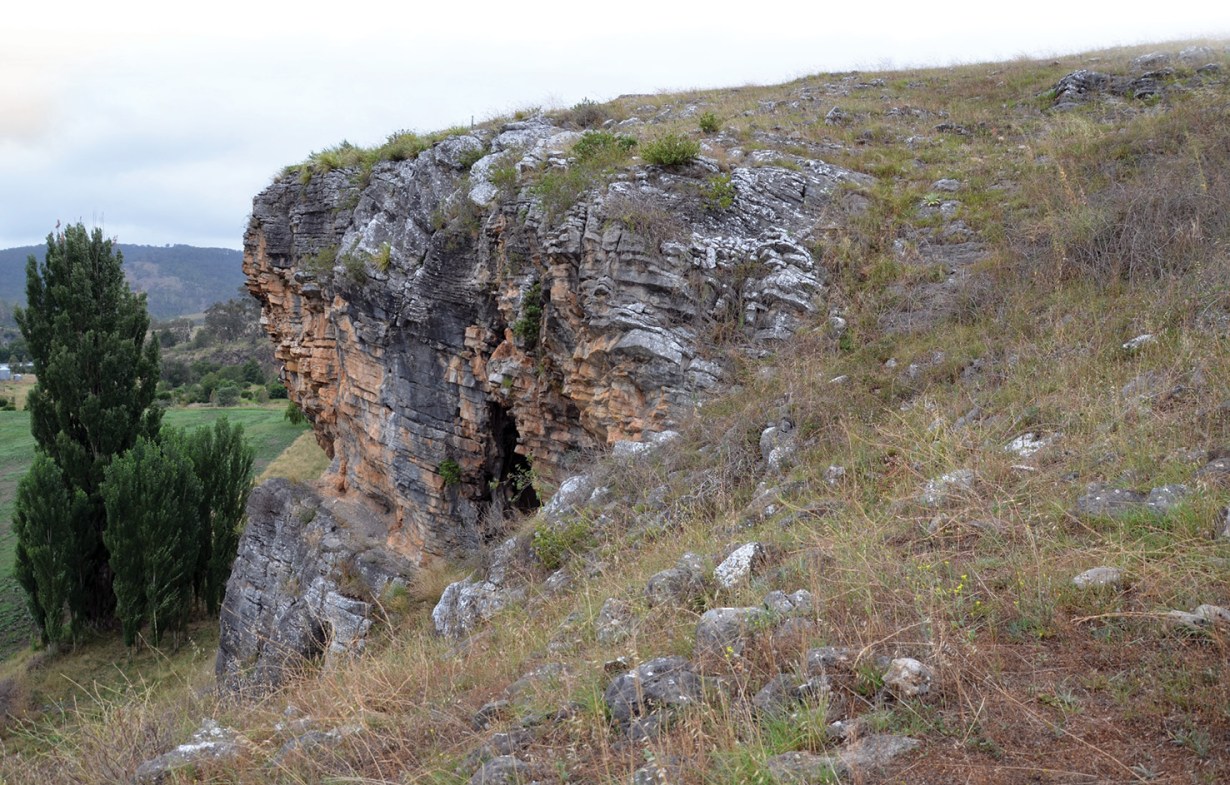
Cloggs Cave lies in GunaiKurnai Country in southeastern Australia, in the Buchan karst at the foothills of the Australian Alps. The cave is only about 12 meters deep and its main chamber is roughly 5 meters long, 3.5 meters wide and 5 meters high. Its narrow, curving entrance passage leads down into the chamber, where archaeological excavations have revealed a stratified record of human activity extending back roughly 25,000 years.
The deposits preserve an unusually rich record of plants. Earlier archaeological work had identified ashes, charcoal, whole leaves and pollen, along with evidence of fires and distinctive installations. Among the most striking discoveries were two miniature fireplaces dating to about 11,000 and 12,000 years ago, each containing a deliberately trimmed Casuarina stick smeared with animal or human fat. Higher in the sequence, dozens of thin ash layers record repeated burning of soft plant material between roughly 4,400 and 1,460 years ago. Around 2,000 years ago, a 28.1-centimeter-high standing stone was erected in the cave, with vegetation repeatedly accumulated and burned around it for about 400 years.
Pollen recovered from the cave has also provided evidence of flowering plants known through GunaiKurnai knowledge and nineteenth-century ethnographic records to have cultural and medicinal uses. Some pollen occurred in intact clumps that had apparently arrived while still attached to the plants rather than being dispersed individually through the air. Together with the archaeological features, those findings supported the interpretation that the cave was a secluded place associated with special practices.
The new study approached that history through phytoliths, microscopic silica bodies formed inside plants.
The microscopic remains left by plants
Plants take up dissolved silica from soil and can deposit it within their tissues. When the organic parts of a plant decay, the resulting silica structures, known as phytoliths, can remain preserved in soils and archaeological sediments. Different parts of plants can produce different shapes, allowing some phytoliths to provide clues about both the type of plant and the part of the plant from which they came. Heating can also alter phytoliths, producing changes such as darkening, warping and melting.
That made phytoliths particularly useful at Cloggs Cave. Pollen is valuable for reconstructing vegetation, but it is difficult to use for identifying grasses below the family level, and pollen does not survive exposure to temperatures above about 350°C. Phytoliths can survive burning and therefore offer a way to investigate plant material in the cave’s numerous ash-rich layers.
The researchers analyzed nine sediment samples from excavation square P35 and 24 from R31. They also examined whole Common Brushtail Possum scats recovered from the deposits. The possum samples were important because the animals repeatedly entered the cave and ate vegetation, potentially introducing phytoliths through their feces.
The sediment samples contained widely varying quantities of phytoliths. P35 generally had between 0.1 million and 0.6 million phytoliths per gram of sediment. R31 showed a much stronger pattern with depth, rising from 0.2 million per gram near the top to 11.4 million between XU2 and XU20, reaching 13.1 million per gram in XU21 before declining toward the deeper part of the sampled sequence.
The possum scats could contain even more. Most R31 scats contained between 3.0 million and 8.5 million phytoliths per gram of fecal material, with two samples reaching 19.2 million and 20.6 million per gram. The researchers caution that sediment and scat concentrations cannot be directly compared because the two materials have different compositions.
That difference became central to interpreting what the microscopic remains actually meant.
Grass dominates the microscopic record
The sediment phytolith assemblage was overwhelmingly characterized by grasses. Grass silica short-cell phytoliths, or GSSCP, made up between 22.6% and 54.2% of the morphotypes in individual sediment samples. These forms are diagnostic of the grass family because they are produced in the epidermis, especially in leaves and inflorescences.
Other common forms were also most frequently associated with grasses. ACUTE BULBOSUS phytoliths accounted for 4.6% to 23.7% of morphotypes in individual samples, while BLOCKY forms made up 0.6% to 12.3% and ELONGATE ENTIRE forms 9.4% to 26.0%. Some of these shapes can occur in other plant groups, so they cannot by themselves establish that the source was grass. But their prevalence, together with the diagnostic grass forms, produced a strong grass signal.
The researchers also found delicate, articulated structures in which multiple phytoliths remained connected in patterns corresponding to their original plant tissues. Some of these structures preserved rows of cells characteristic of grass leaves and culms. Chains of BILOBATE phytoliths associated with ELONGATE cells were particularly common and indicated leaves of Panicoid grasses. Other articulated structures contained forms associated with grass inflorescences, the flowering or seed-bearing parts of the plant.
That anatomical information matters because it points beyond the possibility that people merely brought grass seeds into the cave.
The phytoliths came from leaves, stems and inflorescences. Taken together, the authors interpret this as evidence that whole grass plants were collected and transported into the cave, including plant parts that would not have been useful if the sole purpose had been harvesting edible grains.
The strongest evidence comes from fire
The most decisive clue was not simply the abundance of grass. It was the evidence that some of the phytoliths had been burned.
Blackened phytoliths appeared throughout the sediment samples, and some were partially melted. In R31 XU11B, 18.3% of all phytoliths were burnt, the highest proportion recorded in any sample. Other upper R31 samples also contained substantial burnt fractions, including 12.8% in XU4 and 3.9% in XU7. In P35, burnt phytoliths made up 3.5% of the assemblage at 25 centimeters and 10.9% at 35 centimeters.
The burnt remains were not restricted to one part of the grass. The researchers observed charred phytoliths from leaves and stems as well as articulated forms associated with grass inflorescences. Some multicellular structures were partially melted as well as charred.
The distinction between burned and unburned phytoliths allowed the researchers to address the possum problem.
Possums clearly contributed plant material to the cave. Their scats contained abundant phytoliths and many of the same common morphotypes found in the sediments. The scat assemblages were also rich in grass phytoliths. But none of the examined possum scats contained burnt or melted phytoliths.
The researchers therefore treat the presence of burnt phytoliths as an unequivocal indicator of human activity involving plants and fire. Those remains could not be explained by the phytoliths passing through possums.
The unburned phytoliths are less straightforward. Because possums introduced large quantities of plant material, some of the unburned remains in the cave sediments probably came from disintegrated scats. Other unburned phytoliths may have been introduced by people. The study could not unequivocally separate those pathways.
The cave preserves evidence of repeated burning
The physical setting of the cave makes some other explanations for the phytolith accumulation unlikely.
Plants do not currently grow in the main chamber because insufficient sunlight reaches it. Wind transport is also considered unlikely to account for the large quantities found deep inside the cave. The entrance is narrow and curves for about 5 meters, while the cave entrance lies on the lee side of the predominant winds. Although water percolates through the cave, there is no evidence of flowing water in the chamber, and the phytoliths do not show the physical abrasion expected from substantial long-distance transport.
The phytoliths were also frequently preserved in articulated groups rather than only as isolated particles. Up to 35.1% of the phytoliths in an individual sediment sample were part of articulated structures. Because those structures preserve plant cells in their original connections, the authors interpret their abundance as evidence that plant material decayed in place rather than being extensively reworked after deposition.
The archaeological layers themselves reinforce that interpretation. In P35, the sampled sequence includes a roughly 40-centimeter-thick series of 73 mostly fine, ash-rich anthropogenic layers dating from about 4,400 to 1,600 years ago, with particularly intensive accumulation during the final 400 years of that interval. R31 contains another sequence of thin layers, including seven ash lenses between about 5,000 and 2,000 years ago.
Burnt phytoliths occur both in those younger ash-rich deposits and farther down the R31 sequence. In P35, samples at 25 to 35 centimeters contain 3.5% to 10.9% burnt phytoliths, while R31 XU4 through XU11 contain 3.9% to 18.3%. Those R31 deposits span modeled ages of roughly 12,950 to 2,950 years ago. Burnt phytoliths also persist farther down the sequence, although generally at lower frequencies.
The authors therefore conclude that people brought and used plants inside the cave throughout the archaeological span represented by the sampled deposits, extending across roughly 25,000 years.
The grasses were not simply burned by accident
The anatomical evidence gives the burning evidence more detail.
Phytoliths from grass leaves and culms were present alongside phytoliths from inflorescences. The combination indicates that entire plants, rather than only selected edible portions, were brought into the cave. The study therefore interprets the grasses as having been intentionally selected and transported for purposes that included cultural burning rather than exclusively for food preparation.
The physical character of the archaeological deposits fits that interpretation. The cave contains expansive, thin layers of plant ash, while charcoal is scarce. The authors note that the relatively small proportion of phytoliths showing clear burning, at no more than 18.3% in any sample, is consistent with fires that were generally not hot enough to alter every phytolith. Experimental work cited by the study indicates that blackening tends to occur above about 450°C and melting at roughly 600–800°C.
The researchers interpret the plant remains as evidence that grasses were intentionally selected over woody plants for cultural burning activities that produced shallow ash layers or lenses. The low charcoal content, rare charcoal fragments observed through micromorphology and scarcity of woody ash pseudomorphs all support that interpretation.
At the same time, the study does not treat the absence of woody phytoliths as proof that woody plants were never burned.
Trees and shrubs can produce few or no phytoliths, making them difficult to detect through this method. The researchers therefore also looked for ash pseudomorphs, microscopic calcium carbonate structures that can form when woody plant tissues burn. Most samples contained none. Four samples contained them, but only in very low concentrations of about 11,000 to 20,000 per gram of sediment, and each of those samples had independent evidence of burning.
Even that evidence has a limitation. Ash pseudomorphs can dissolve or be altered after burial, and micromorphological analysis indicates that some of the cave’s ashes experienced decalcification, localized dissolution and other forms of alteration. The scarcity of ash pseudomorphs therefore cannot establish that woody plants were absent from the fires.
Grass types offer clues, but not a precise vegetation history
The phytoliths also contained forms associated with different grass subfamilies. Pooideae, generally associated with cool, temperate C3 grasses, and Panicoideae, C4 grasses associated with warmer and wetter environments, occurred in broadly similar proportions. Pooideae dominated much of P35 as well as the upper and lower portions of R31, while Panicoideae increased somewhat in the middle of the R31 sequence. Chloridoideae, a group of drought-resistant C4 grasses associated with warmer, drier environments, made up a smaller component.
Those patterns might appear to offer a record of environmental change around the cave. But the authors deliberately stop short of making a detailed reconstruction.
Grass phytolith shapes overlap between subfamilies. For example, RONDEL forms can occur outside Pooideae, while BILOBATE forms are not restricted to Panicoideae. Detailed classification schemes have also not yet been developed for the local vegetation of Gippsland. Because of those limitations, the study does not further refine the environmental interpretation of the C3 and C4 grass patterns.
This is one reason the study combines phytolith evidence with other botanical evidence rather than treating the microscopic silica record as a complete picture of the ancient landscape.
Pollen from Cloggs Cave provides much stronger representation of woody plants and herbaceous vegetation, while the phytolith assemblage is overwhelmingly dominated by grasses. The two records therefore complement one another. The phytoliths provide anatomical information about grasses that pollen cannot supply, while pollen captures plant groups that produce few or poorly diagnostic phytoliths.
A microscopic record of plant selection
The combined evidence points to a repeated pattern.
Grass remains are abundant in the cave. Some preserve their original cellular arrangements, including structures from leaves, culms and inflorescences. Some have unmistakable signs of burning. Burnt phytoliths occur through much of the archaeological sequence, while the possum scats contain no burnt phytoliths. And the cave contains numerous archaeological ash layers independently associated with human activity.
For the researchers, those lines of evidence establish a human contribution to the phytolith record that cannot be explained by possums alone. The burned phytoliths provide the secure link to human activity, while the presence of phytoliths from different anatomical parts of grasses indicates that whole plants were being brought inside.
The exact meaning of every unburned phytolith remains less certain. Possums and people both introduced vegetation into the cave, and the similarities between their phytolith assemblages prevent the researchers from assigning all unburned remains to one source. The authors consequently use the burned fraction, rather than the entire phytolith assemblage, as the clearest evidence for human plant use.
The highest total phytolith concentrations occur in R31 between XU18 and XU30, corresponding roughly to 15,000 to 12,000 years ago. The researchers suggest that this could indicate relatively intense human visitation or plant-related activity during that period. But they explicitly describe that interpretation as tentative because it is not known whether cultural and natural sedimentation accumulated at comparable rates across all excavation units. Unburned phytoliths also have the unresolved contribution from possums.
The study therefore leaves a distinction between what the microscopic evidence establishes most securely and what remains interpretive.
It establishes that burned plant remains accumulated inside the cave through human activity and that grasses were a major component of those materials. It provides evidence from leaves, culms and inflorescences that whole grass plants were transported into the cave. But it cannot determine the source of every unburned phytolith or reconstruct a precise history of the surrounding vegetation from the phytolith assemblage alone.
That combination of certainty and uncertainty is important to the archaeological record at Cloggs Cave. The microscopic remains do not replace the cave’s pollen, charcoal, ash, artifacts or other evidence. Instead, they add another line of evidence showing that plants were repeatedly carried into the darkness of the cave and that grasses, including their normally inedible parts, were deliberately involved in burning activities.
The study was published in Frontiers in Environmental Archaeology.