For more than a decade, a quiet mystery has been unfolding in a distant corner of the universe. The culprit is a blazar named TXS 0518+211, a compact, fiercely energetic object powered by a supermassive black hole. Indian astronomers, using NASA’s Swift and Fermi space telescopes, have spent nearly sixteen years watching its behavior—patiently waiting for it to blink, flare, dim, or do something that might betray the secrets hidden in its powerful jet.
Their new analysis, published Nov. 26 on the arXiv pre-print server, reveals that this blazar is far more complicated than previously imagined. What began as a study of flickering light across different wavelengths has grown into a deeper question about how a cosmic jet can behave with such contradiction.
A Galaxy’s Heart That Stares Back
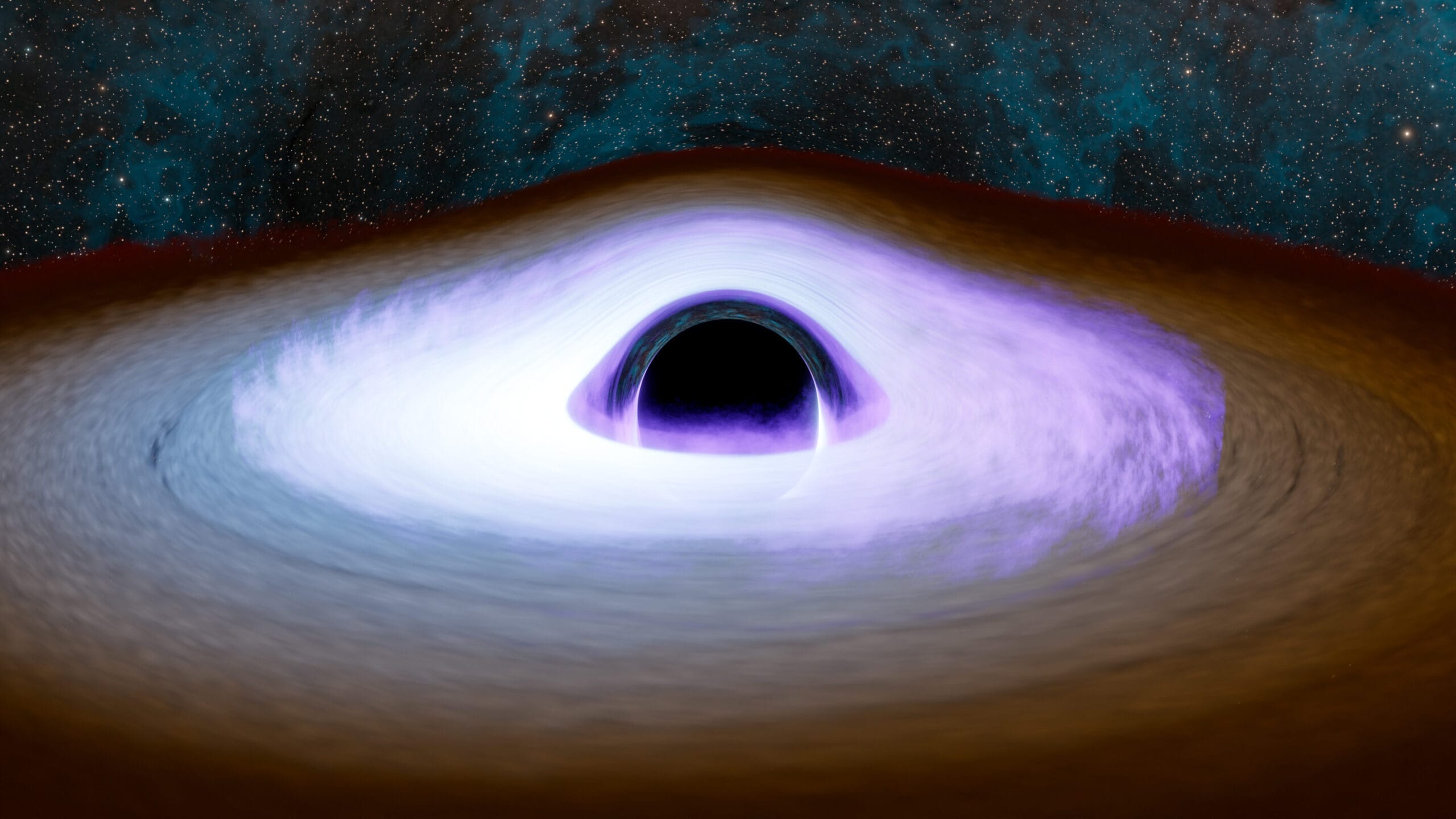
Blazars are among the most dramatic objects the universe has to offer. They reside in giant elliptical galaxies, anchored by supermassive black holes that feed on surrounding material. When those black holes launch narrow jets of matter at nearly the speed of light directly toward Earth, astronomers call the result a blazar. It is an alignment so perfect that the jet beams straight into our view, turning the object into one of the most luminous and extreme forms of an active galactic nucleus.
TXS 0518+211 belongs to a subclass known as BL Lacertae objects, or BL Lacs, which lack the prominent optical emission lines seen in flat-spectrum radio quasars. More than a decade ago, it was flagged as a very high energy gamma-ray source, and even now its distance remains uncertain. Some studies suggest a redshift of 0.18. Others propose an upper limit of 0.34. Either way, it sits relatively nearby on the cosmic scale, making it an ideal laboratory for long-term study.
But what truly drew astronomers to it were its flares—bursts of energy that erupted in both very high energy gamma rays and X-rays, sometimes at the same moment. Those flashes held clues, and a team led by Avik Kumar Das wanted to know exactly what they meant.
Sixteen Years of Watching a Blazar Breathe
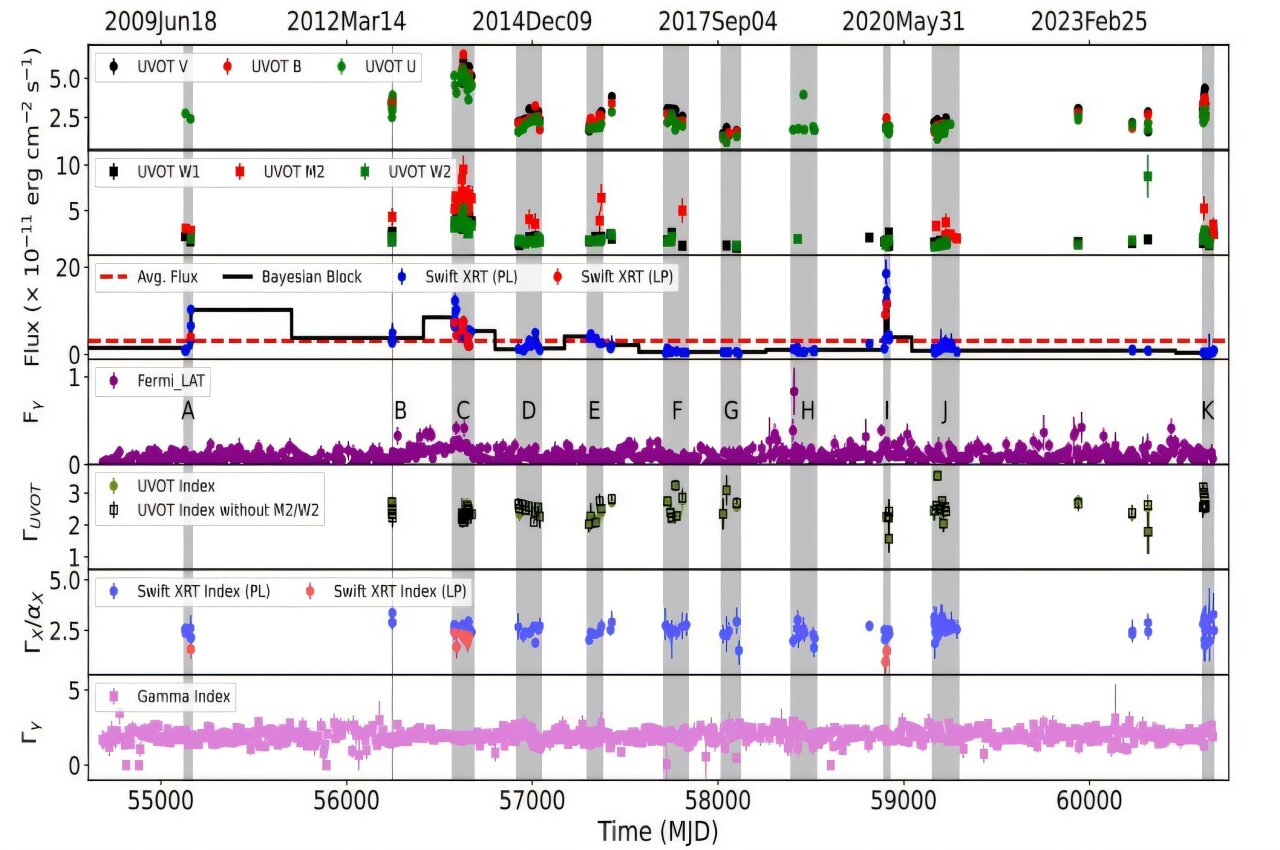
The researchers embarked on a sweeping investigation, gathering nearly sixteen years of multiwavelength observations. “We present a long-term broad-band temporal and spectral study of a TeV BL Lac source TXS 0518+211 by analyzing nearly 16 years (MJD 54682—60670) of simultaneous optical, UV and X-ray light curves from Swift-XRT/UVOT and gamma-ray light curves from Fermi-LAT,” they wrote.
Sixteen years of data is not just a dataset. It is a timeline, a diary of a distant galaxy’s heart, a record of everything the blazar chose to show—and everything it chose not to.
When the team analyzed the blazar’s fractional variability across its entire observing window, an intriguing pattern emerged. The X-ray band was by far the most restless, with variability measured at around 1.10. In contrast, the optical, ultraviolet, and gamma-ray bands fluctuated far more gently, ranging only from 0.35 to 0.45. It was as if the X-ray-emitting region inside the jet pulsed with a volatility that the other wavelengths simply did not share.
Yet when the astronomers zoomed in, studying variability on short timescales, the story shifted. None of the differential light curves showed strong signs of rapid changes. Intra-night optical behavior was subdued, consistent with what is commonly seen in BL Lacs of the IBL and HBL types. TXS 0518+211 was moody over years, but calm over hours.
A Blazar That Refuses to Behave
The most striking discoveries came when the researchers examined individual observational epochs, each capturing a different moment in the blazar’s long, flickering life.
In one epoch, TXS 0518+211 behaved almost poetically—its optical, ultraviolet, and X-ray bands rising and falling together in perfect synchrony, as if driven by a single heartbeat deep within the jet.
But in another epoch, the harmony shattered. The X-ray band surged dramatically, yet the optical and ultraviolet wavelengths barely stirred. The jet had changed the tune of its own internal orchestra, letting one section flare while the others stayed silent.
In the most recent epoch, the story twisted again. This time the X-ray emission fell sharply, dimming more than expected, while the optical, ultraviolet, and gamma-ray bands held steady. The blazar collapsed inward in one wavelength but preserved its brightness in the others.
These mismatched rises and falls were more than strange behavior. They were strong clues that the jet was far from uniform. Different zones must be lighting up or fading independently—regions that sometimes cooperate, sometimes clash, and sometimes act as if separated by invisible boundaries.
The Puzzle Hidden Within the Jet
The astronomers concluded that TXS 0518+211 is not a simple source of radiation but a layered, dynamic structure. According to the authors, the diverse and inconsistent behavior across the multiwavelength light curves suggests “a complex emission region structure in the jet of TXS 0518+211.”
In other words, this blazar isn’t powered by a single glowing region. It is a shifting landscape of particle populations and magnetic fields, each capable of erupting or fading on its own schedule. One part may produce X-rays while another produces optical and ultraviolet light. Sometimes they work together; sometimes they do not.
This realization transforms TXS 0518+211 from a distant point of light into a sprawling, multi-layered system whose internal physics may vary more dramatically than expected.
Why This Research Matters
Blazars are some of the most powerful particle accelerators in the universe, capable of producing energies far beyond anything humans can create on Earth. Understanding how their jets evolve and where different wavelengths originate is essential to decoding how matter behaves under extreme conditions.
TXS 0518+211, with its contradictory flares and mismatched dimming events, offers a rare window into that complexity. Long-term monitoring like this helps astronomers map the structure of blazar jets, understand how their emission zones interact, and refine the physical models that describe how supermassive black holes feed and launch high-energy particles.
By revealing that different parts of the jet can brighten or fade independently, this study deepens our understanding of how blazars work—and reminds us that even the most distant cosmic beacons have intricate inner lives.
The universe, it seems, still has many stories to tell.
More information: Avik Kumar Das et al, Broad-band temporal and spectral study of TeV blazar TXS 0518+211, arXiv (2025). DOI: 10.48550/arxiv.2511.21182