“The children of” appeared inside a scroll that had been reduced to brittle charcoal and could no longer be safely unrolled. Researchers had written the text on a laboratory-made papyrus scroll, carbonized it, then used X-ray tomography and virtual unrolling to expose part of the writing without physically opening the scroll.
The experiment began with a problem that has made the Herculaneum papyri unusually difficult to read.
Hundreds of papyrus manuscripts were discovered in 1752 at the Villa of the Papyri in the buried Roman town of Herculaneum. The scrolls had been carbonized during the eruption of Mount Vesuvius in 79 CE, leaving them in a brittle, charcoal-like state. Many were eventually opened, but others remained rolled because attempts to physically unroll them could destroy the material.
The writing itself presents a particular imaging problem. The ancient scrolls were written with carbon-based black ink, while the papyrus was also carbonized. From the perspective of X-ray absorption, the ink and the surrounding papyrus can therefore look nearly identical. The resulting low signal-to-noise ratio makes the writing difficult to distinguish from its surroundings.
Previous analyses had detected lead in the letters of two Herculaneum fragments using synchrotron X-ray fluorescence. Lead has a much greater ability to absorb X-rays than the carbon-based materials surrounding it, so its presence can increase the contrast between writing and papyrus. Lead has also been detected in letters written with black and red inks in ancient Egyptian papyri from the Roman period, although the origin of the lead in those inks remains uncertain. It may have come from the ink itself or from an additive used to help dry the writing.
The researchers wanted to test whether that difference could be exploited in a controlled experiment. Rather than risk precious ancient scrolls, they built their own.
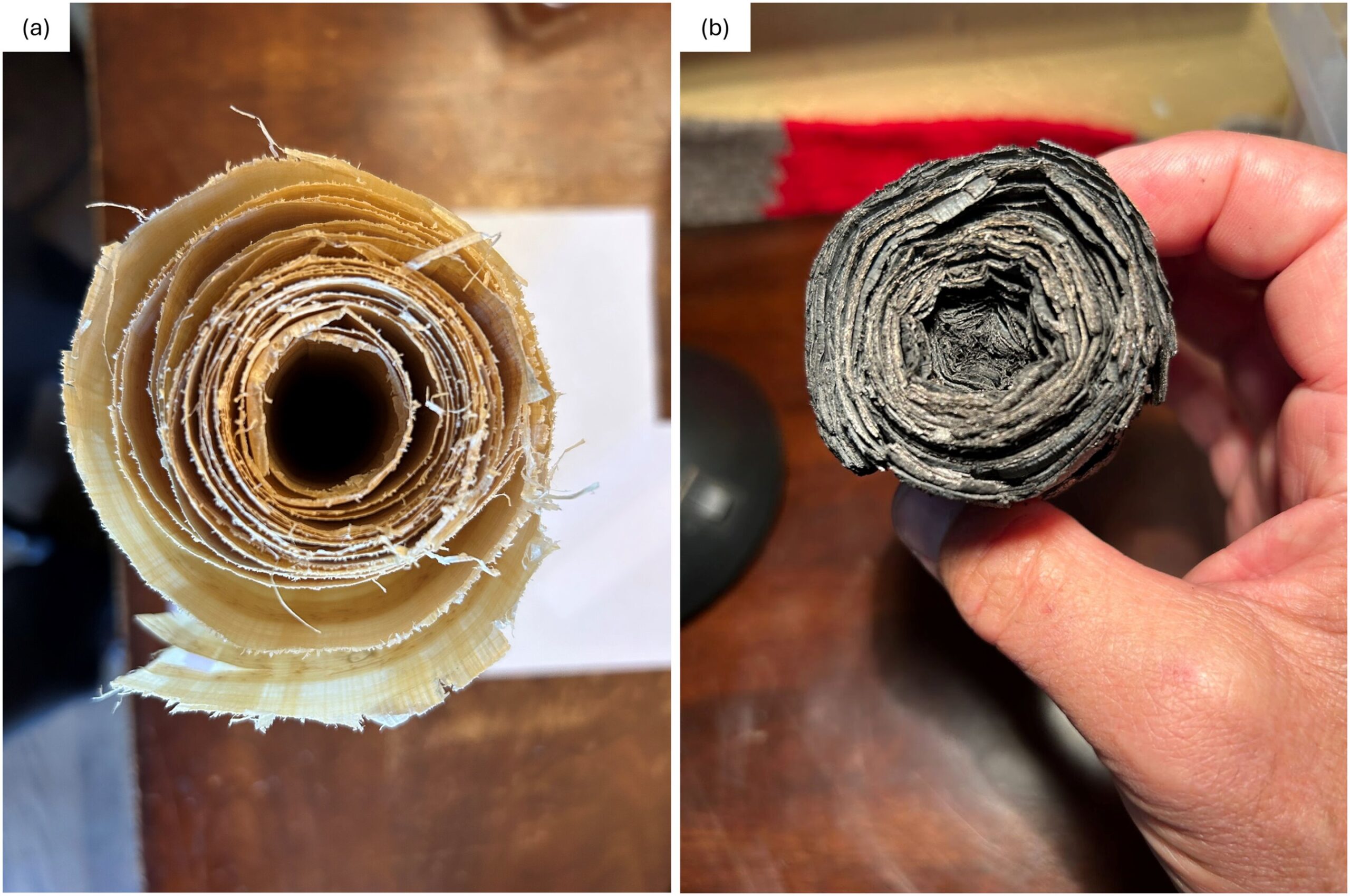
They used modern Egyptian papyrus, a reed stylus and a commercial carbon-based black ink. The papyrus was rolled and heated in a nearly oxygen-free environment inside a steel container. The resulting material was extremely brittle, and attempts to unroll it caused fragmentation, resembling the physical behavior of some Herculaneum scrolls.
Adding lead to make the writing visible
Before making the scroll, the researchers established that their modern ink contained no detectable lead down to the detection limit of their inductively coupled plasma optical emission spectroscopy analysis. They then added lead nitrate to the ink to create lead-spiked formulations at controlled concentrations.
Adding the lead salt changed the ink. The mixture became less homogeneous and more viscous, which the researchers attributed to salt-induced aggregation of the colloidal particles in the ink. After dilution, however, the lead-containing inks could still produce well-defined lines and letters on the papyrus.
The team then calibrated how much ink was deposited when writing. Covering a 15-by-15-centimeter square of papyrus with closely packed lines required about 0.4 to 0.5 grams of ink. Using an approximate ink density of 1 gram per cubic centimeter, they estimated that about 2 microliters of ink were needed to cover 1 square centimeter with lines.
Using reported lead concentrations from an earlier analysis of a Herculaneum fragment as a benchmark, they formulated one lead-spiked ink at about 100 micrograms of elemental lead per 2 microliters of ink, equivalent to 50 grams per liter. The resulting writing was intended to have a lead surface density comparable to that measured in the ancient material.
The researchers also prepared papyrus samples carrying letters with several different lead concentrations: 200, 100, 50 and 20 micrograms per square centimeter, along with a lead-free control.
Even small amounts of lead stood out in X-rays
The first tests asked a simple question: could an ordinary commercial handheld X-ray fluorescence instrument detect the lead after it had been incorporated into writing?
It could.
The lead-free control produced no detectable signal with the Bruker Tracer handheld XRF unit. Every sample containing lead produced a detectable signal, and the signal declined as the lead concentration decreased.
The researchers then tested carbonized papyrus fragments with lines containing different amounts of lead. In a set of lines ranging from lead-free to 25 micrograms per square centimeter, the two lines without lead could not be distinguished in the two-dimensional X-ray transmission image. The lines containing lead were visible, and even the lowest concentration tested, 25 micrograms per square centimeter, could still be detected.
That experiment separated two different capabilities. Lead made the writing visible through material contrast in the X-ray image. But the researchers also recognized that three-dimensional tomography might reveal lead-free writing through the physical structure of the papyrus, rather than through a difference in chemical composition alone. The paper does not establish that this model system can recover lead-free writing, however.
The model scroll was virtually unrolled
The more ambitious test used the complete carbonized model scroll.
The researchers scanned the scroll with the Neutron and X-ray Tomography system at the National Institute of Standards and Technology. The scroll was rotated through 360 degrees while 1,001 X-ray images were collected. The X-ray tube operated at 30 kilovolts and 1.3 milliamps, and each image required five seconds to acquire.
The resulting data were reconstructed into a three-dimensional volume with custom Python code using the ASTRA tomography toolbox. A separate unrolling program traced the spiral structure of the scroll with splines and interpolated along normals to those curves, effectively mapping the curved layers onto a flat surface.
The raw X-ray projections already showed indications of the lead-containing writing. After reconstruction, the letters became apparent in the three-dimensional data, although they were initially not readable. The virtual unrolling process allowed the researchers to select locations where the text could be viewed more clearly.
At one point in the unrolled model, text could be seen without additional enhancement or text-extraction processing. A zoomed-in region clearly contained the words “the children of.”
The result was therefore not a complete transcription of the model scroll. The experiment demonstrated that the writing could be exposed in a virtually unrolled X-ray representation and that at least part of the text could be visually read without physically opening the carbonized scroll.
The same scroll also gave a positive XRF signal
After the tomography experiment, the researchers examined the model scroll with a handheld Olympus Innov-X Systems DS-4000CC XRF instrument at NIST.
Measurements were taken at several positions along the length of the scroll, with the handheld instrument held close to the surface without touching it. Lead was detected at multiple locations. The researchers noted that additional work would be needed to develop a more efficient or automated method for scanning scrolls in this way.
That result is important to the proposed workflow because the XRF measurement and the tomography serve different purposes. XRF can be used to look for lead without opening the scroll, while X-ray tomography can generate three-dimensional images of the rolled structure for virtual unrolling.
The researchers propose using those capabilities as a two-step process. First, intact Herculaneum scrolls could be screened in place with XRF to identify those producing elevated lead signals. Selected scrolls could then be sent for synchrotron-based X-ray tomography when suitable beamtime is available.
Model scrolls can also provide known answers
The experiment has another purpose beyond making lead-containing writing easier to see.
When researchers work with an ancient scroll whose text is unknown, an algorithm attempting to recover that text has no straightforward way to determine exactly how much of the hidden writing it has recovered. A model scroll changes that because its original text is known before the material is carbonized.
The researchers propose producing additional model scrolls with different ink compositions and thicknesses, writing styles and languages, then carbonizing and scanning them with X-ray tomography. Because the original text is known, the recovered text can be compared directly with the ground truth. The researchers suggest that the process could be conducted blindly, with people developing reading algorithms not given the original text during the recovery process.
In this study, the model scroll therefore serves as both an imaging target and a controlled test object. Its known writing provides information that is unavailable when algorithms are tested only against ancient scrolls whose hidden text has not yet been recovered.
The experiment stops short of testing an ancient scroll
The strongest qualification in the work is also explicit in its design: the experiment was performed on a laboratory-made model, not on an intact Herculaneum scroll.
The researchers say direct testing on the original material with synchrotron radiation is difficult because the ancient scrolls are extremely fragile and synchrotron access is expensive. Their work was therefore designed as a proof of concept using model material. They describe the resulting evidence as preliminary support for testing the proposed workflow on actual Herculaneum material.
The paper also does not establish that every Herculaneum scroll contains lead, or that lead-free scrolls cannot be read. Instead, the authors’ proposal is to use lead as a screening characteristic because some ancient samples have contained it and because lead produced detectable X-ray contrast in their model.
The amount of lead needed for reliable detection in an actual ancient scroll also remains an open practical question. In the model fragment experiment, 25 micrograms per square centimeter was the lowest concentration tested and was detectable, so the experiment establishes detectability down to that tested level rather than a lower detection limit.
The authors likewise note that an efficient system for scanning large numbers of intact scrolls with a handheld XRF device still needs to be developed.
The work ultimately establishes a controlled demonstration: modern papyrus carrying carbon-based ink spiked with lead can be carbonized into a brittle scroll, the lead can remain detectable afterward, X-ray tomography can expose the writing within the rolled structure, and virtual unrolling can make at least part of that text readable. The researchers propose using the same kind of model material to develop and test text-recovery algorithms while using lead detection as a possible way to select ancient scrolls for further imaging.
The study was published in PLOS One.