Honeybees navigating crowded environments do not simply pick the biggest opening they see. Experiments from researchers at the University of New South Wales Canberra show the insects compare gaps based on their relative size, following a principle known as Weber’s law. The findings suggest bees dynamically adjust how carefully they judge openings depending on collision risk, balancing safety with energy efficiency during flight.
A honeybee weaving through dense vegetation may look effortless, but every split-second turn involves a surprisingly complex decision. Faced with multiple openings, the insect must rapidly judge which path is safest without wasting energy or crashing into obstacles.
Researchers at University of New South Wales Canberra wanted to understand exactly how bees make those decisions. Their study, published in Biology Letters, found that honeybees rely heavily on comparing openings relative to one another instead of evaluating each gap in isolation.
The results offer a closer look at how insects with tiny brains navigate challenging environments so effectively.
Testing How Bees Judge Openings
The study was inspired by a simple question: when bees encounter several possible routes through cluttered spaces, how do they decide which one to take?
According to senior author Sridhar Ravi, honeybees regularly fly through dense shrubs, branches, and narrow spaces while foraging. Yet scientists still know relatively little about how the insects visually assess these pathways.
The researchers specifically wanted to know whether bees choose gaps based on their actual size or by comparing them with nearby alternatives. This idea relates to Weber’s law, a principle suggesting animals often perceive differences in relative rather than absolute terms.
Previous research had hinted that bees respond strongly to relative comparisons in other contexts. The team wanted to see whether the same rule applies during fast-paced flight navigation.
Inside the Tunnel Experiment
To test the idea, the researchers built a tunnel where honeybees could freely fly toward a sugar solution reward.
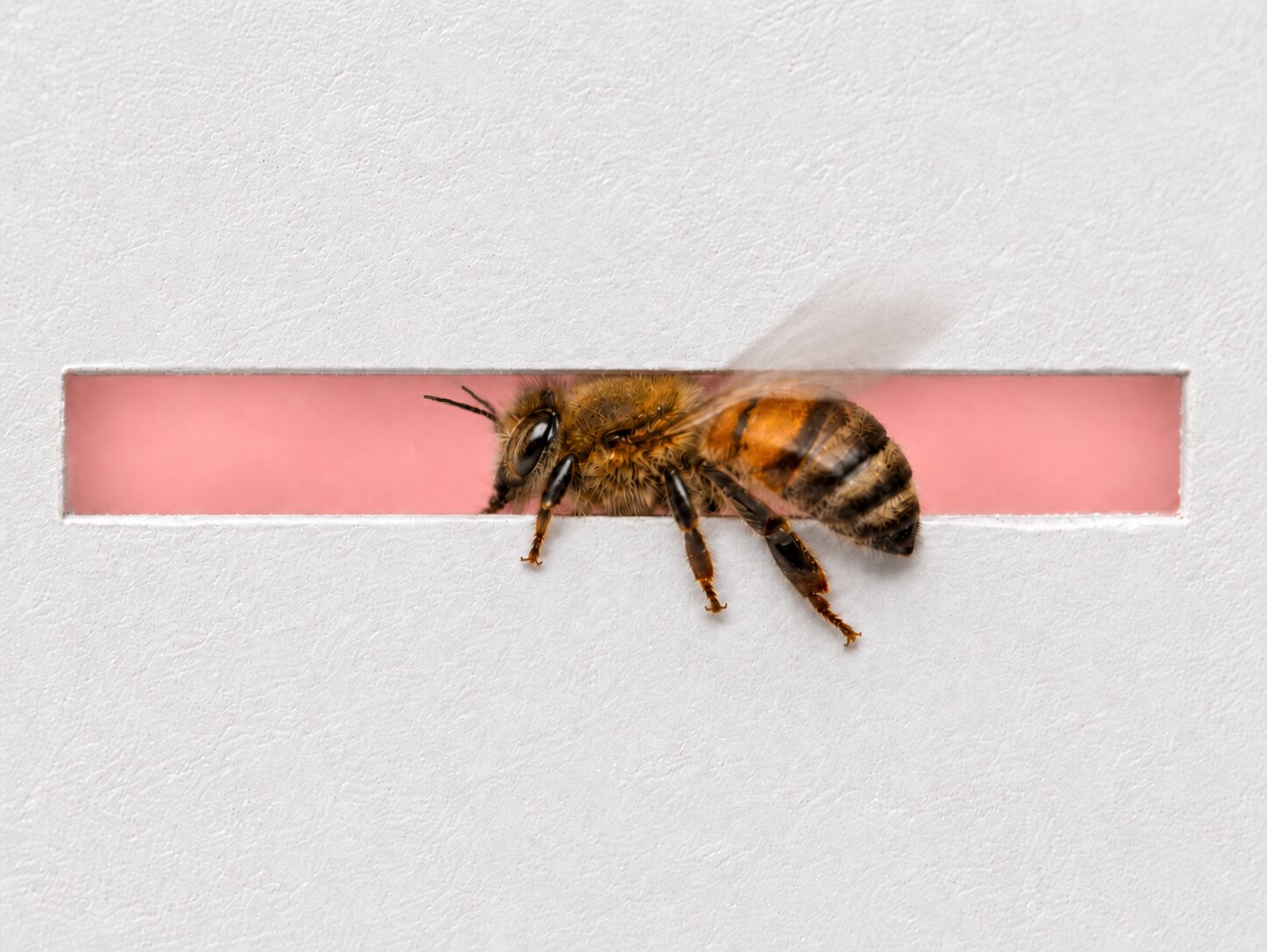
Once the insects became familiar with the setup, the team introduced a barrier inside the tunnel containing two rectangular openings. Both gaps had the same width, but their heights differed.
By carefully changing both the absolute size of the openings and the relative differences between them, the researchers could observe how the bees responded under different conditions.
The setup allowed the team to examine not only which opening the bees preferred, but also how sensitive they were to small differences between available routes.
Bees Became More Careful When Risk Increased
The experiments revealed that bees do indeed compare openings based largely on relative size differences. But their behavior also depended on the overall level of risk.
When both apertures were small and the danger of collision was higher, the insects appeared to evaluate the options much more carefully. As the difference between the openings became larger, the bees’ preferences also became clearer and more predictable.
However, the behavior shifted once both gaps were already large enough to safely pass through.
In those lower-risk situations, the bees no longer showed a strong preference. Their choices became far closer to random, suggesting they reduced the effort spent analyzing the options because careful comparison was no longer necessary.
The researchers said this behavior points to a flexible strategy designed to conserve energy while still maintaining safe navigation.
Tiny Brains, Efficient Decisions
One of the most striking aspects of the findings is that this adaptive behavior emerges from an animal with a very small nervous system.
Rather than performing detailed visual comparisons every time they fly, the bees appear to use an efficient shortcut. They invest more perceptual effort only when the environment becomes more dangerous.
That ability to dynamically scale decision-making based on risk impressed the researchers.
While the strategy may seem intuitive from a human perspective, observing it in insects with small eyes and tiny brains provides valuable insight into how sophisticated behavior can arise from compact biological systems.
The study also contributes to broader theories about insect perception, learning, and movement through complex environments.
What Researchers Want to Study Next
The team now plans to investigate how experience influences bee flight behavior over time.
One area of interest is whether bees improve their navigation abilities after repeated exposure to difficult environments. The researchers also want to identify the exact visual cues guiding the insects as they move through narrow spaces.
Another recently completed experiment explored whether bees can be fooled by visual illusions that make openings appear larger or smaller than they really are.
According to Ravi, those results are especially intriguing, though the findings have not yet been published.
Why This Matters
Understanding how honeybees navigate could extend far beyond insect biology.
The study suggests that efficient decision-making does not always require massive computational power. Bees appear capable of balancing risk, perception, and energy use using streamlined visual strategies that work remarkably well in real-world environments.
Insights like these could eventually help researchers design smarter robotic systems or more efficient artificial intelligence models capable of moving through crowded or unpredictable spaces.
At the same time, the findings deepen scientists’ understanding of one of nature’s most skilled flyers. Even after decades of bee research, honeybees continue to reveal unexpectedly sophisticated ways of interacting with the world around them.
Study Details
Timothy R. Jakobi et al, Threading the needle: spatial constraints sharpen visual sensitivity in honeybees, Biology Letters (2026). DOI: 10.1098/rsbl.2025.0849.