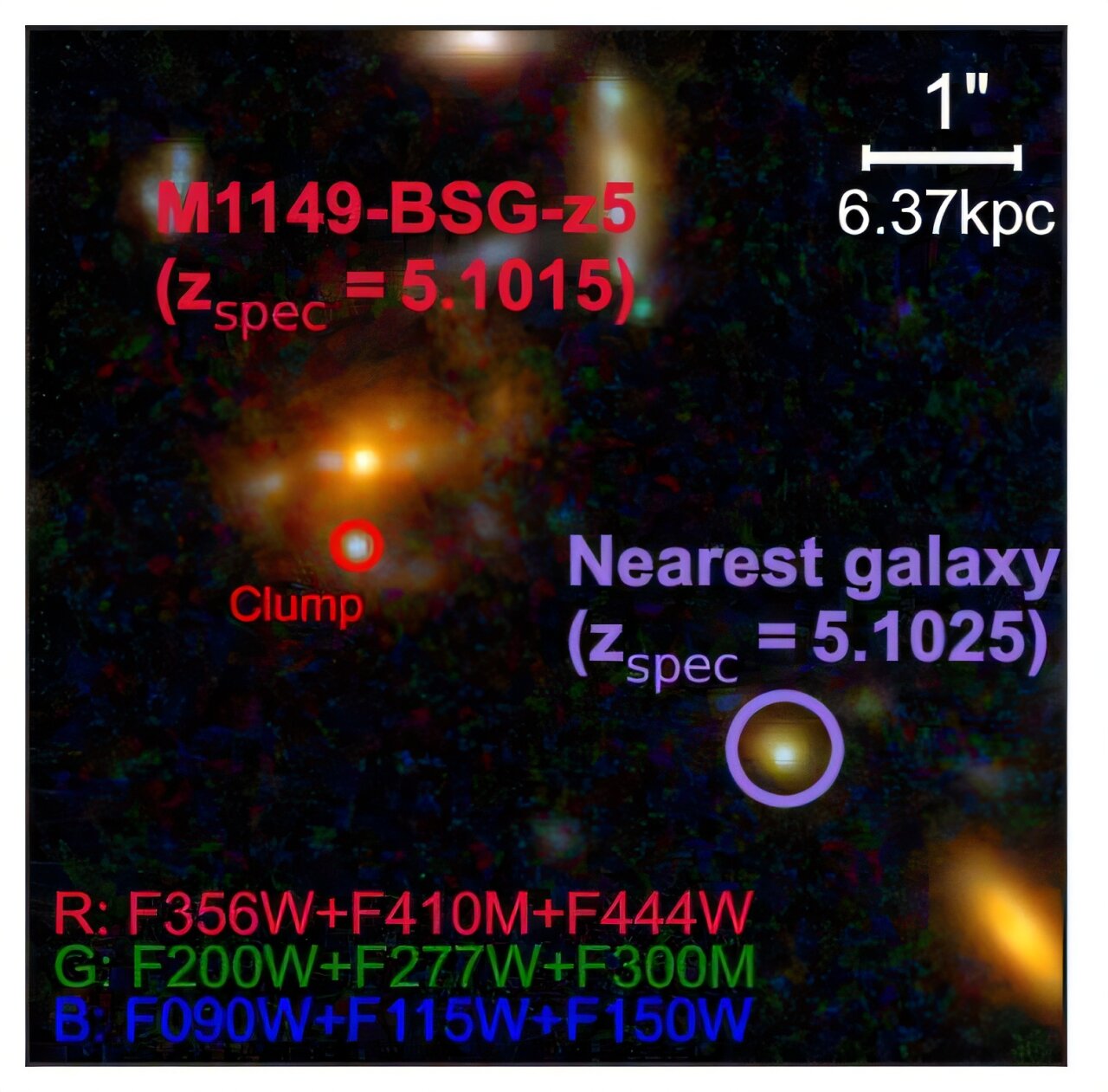
Observations from the James Webb Space Telescope have uncovered a candidate barred spiral galaxy dating to less than 1.2 billion years after the Big Bang, potentially making it the most distant example of its kind ever identified. The galaxy’s surprisingly mature structure—including a stellar bar, spiral arms, chemically enriched gas, and signs of a growing supermassive black hole—suggests that some galaxies settled into organized forms much earlier than expected.
Galaxies in the young universe are generally expected to be chaotic places. Rich in gas and frequently disrupted by mergers and intense bursts of star formation, they were thought to remain turbulent for billions of years before developing the stable structures commonly seen in nearby galaxies today.
Yet observations from the James Webb Space Telescope (JWST) continue to challenge that picture. Astronomers have now identified what may be the most distant barred spiral galaxy ever discovered, offering evidence that at least some galaxies became remarkably organized during the universe’s first billion years.
The newly reported galaxy, known as M1149-BSG-z5, lies at a redshift of 5.102, corresponding to a time less than 1.2 billion years after the Big Bang. The study describing the object was posted to the arXiv preprint server on June 23.
A galaxy with an unexpectedly mature design
One of the most striking features of M1149-BSG-z5 is the apparent presence of a stellar bar—an elongated structure of stars stretching across the galaxy’s center.
Rather than being a simple visual feature, stellar bars play an important role in galactic evolution. As they rotate, they funnel gas toward the central regions of a galaxy. That inflow can trigger new star formation, feed the central black hole, and help build a dense central bulge. The Milky Way itself is a barred galaxy.
Until recently, astronomers believed such structures should not appear so early in cosmic history. Bars generally develop in galaxies with dynamically “cold” disks, where stars move in relatively smooth, orderly orbits. Early galaxies, by contrast, were expected to have “hot,” turbulent disks shaped by constant interactions and vigorous star formation.
The growing number of barred galaxies identified by JWST has begun to challenge that long-standing expectation, suggesting some galaxies reached stable, rotating configurations far sooner than models predicted.
Evidence for both a bar and spiral arms
To investigate the galaxy’s structure, researchers led by Xiaohan Wang of Tsinghua University combined observations from JWST and the Hubble Space Telescope.
They applied isophotal analysis, a technique that examines how the shape and orientation of a galaxy’s brightness contours change with distance from its center. The analysis revealed a structure consistent with a stellar bar. Independent modeling of the galaxy’s overall shape also supported that conclusion.
The researchers found additional evidence that the galaxy possesses spiral arms, making the system resemble barred spiral galaxies commonly observed in the nearby universe.
“The discovery of M1149-BSG-z5 and its structural and global properties suggests that bars emerge as early as z > 5,” the team writes in the paper.
Large, rapidly growing, and chemically evolved
The galaxy’s overall properties also point to an unexpectedly advanced stage of development.
The researchers estimate that M1149-BSG-z5 contains a stellar mass of about 28 billion solar masses while producing new stars at a rate of roughly 145 solar masses per year. Its effective radius measures approximately 8,500 light-years, making it larger than most galaxies known at similar redshifts.
According to the researchers, its size exceeds that of typical galaxies around redshift 5 but is comparable to barred galaxies observed at somewhat later cosmic times.
The team also analyzed the galaxy’s spectrum to examine its chemical composition. By studying the ratios of different emission lines, they concluded that the gas is already chemically enriched rather than extremely metal-poor.
As the researchers explain, “… the emission-line ratios are difficult to reconcile with a very metal-poor interpretation, and instead suggest that the gas is already chemically enriched in M1149-BSG-z5.”
That finding indicates the galaxy had already undergone substantial chemical evolution despite its young age.
A growing black hole with an unusual balance
The observations also revealed evidence for an actively feeding supermassive black hole at the galaxy’s center.
Interestingly, the black hole appears relatively small compared with the galaxy’s stellar mass. Instead of matching the larger black hole-to-stellar-mass ratios often observed in other early-universe galaxies, M1149-BSG-z5 more closely resembles the balance seen in galaxies today.
Taken together, the galaxy displays several hallmarks typically associated with much more mature systems: a well-developed stellar bar, spiral arms, a central bulge, chemically enriched gas, and an actively growing central black hole.
How did such an orderly galaxy form so early?
The researchers also found evidence that M1149-BSG-z5 resides in a crowded neighborhood. A nearby companion galaxy lies about 70,000 light-years away, raising the possibility that past gravitational interactions influenced its evolution.
That leaves astronomers with two possible explanations for the galaxy’s bar. It may have formed naturally within a disk that settled into an orderly state surprisingly early, or it may have been triggered by an external event such as a merger or close encounter with the neighboring galaxy.
At present, the available observations cannot distinguish between these possibilities.
The team says future observations will be needed to determine how the galaxy’s stars and gas move. Measuring those internal motions would help verify the presence of the bar and clarify how it formed.
“Further follow-up observations, particularly kinematic measurements of M1149-BSG-z5, would be the key to confirm its baryon dominance and help to determine the bar formation mechanisms in the early universe,” the researchers conclude.
For now, M1149-BSG-z5 stands as a compelling candidate for the most distant barred spiral galaxy yet identified. If confirmed, it would provide further evidence that at least some galaxies reached surprisingly organized, chemically evolved states within the universe’s first 1.2 billion years, reshaping ideas about how quickly galactic structure can emerge.