Evidence from Üçağızlı II Cave in southern Türkiye suggests that Homo sapiens and Neanderthals may have shared not only landscapes but also cultural traditions, including symbolic preferences, during a period of coexistence between 50,000 and 60,000 years ago. The discovery points to a level of interaction that could reshape how scientists understand relationships between these closely related human groups.
For decades, evidence that many people today carry a small amount of Neanderthal DNA has shown that Homo sapiens and Homo neanderthalensis interacted in the distant past. A new archaeological discovery now suggests that those interactions may have gone far beyond occasional encounters, revealing signs that the two groups could have shared aspects of their culture over a period spanning more than 20,000 years.
The findings come from excavations at Üçağızlı II Cave in southern Türkiye, a location situated in the Levant, one of the most important migration corridors linking Africa and Eurasia. The research has been published in Proceedings of the National Academy of Sciences.
A crucial site for understanding early human migrations
The Levant occupies a central place in the story of human expansion. During the Out of Africa migration, modern humans dispersed from Africa into other parts of the world, yet fossils dating to this pivotal period have remained relatively rare in the region.
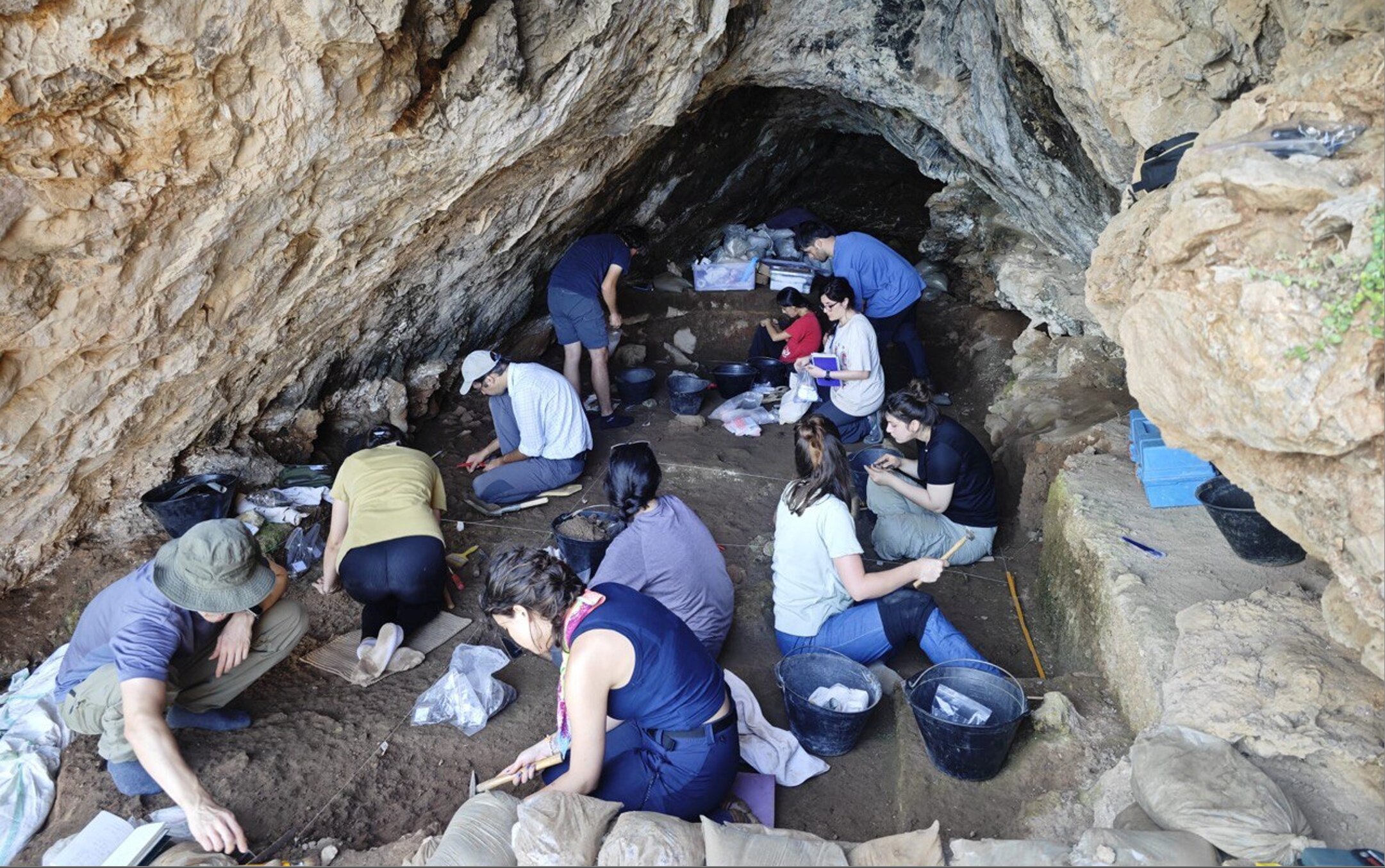
To better understand the movements and interactions of early humans, an international research team that included scientists from Türkiye, France, Japan, and Kyoto University carried out excavations at Üçağızlı II Cave. Their work extended over five years and involved meticulous excavation conducted millimeter by millimeter, allowing the researchers to document evidence with exceptional precision.
The discoveries revealed remains associated with both modern humans and Neanderthals, offering an unusually detailed glimpse into a time when the two species occupied the same region.
Shared technology and similar ways of life
The archaeological evidence indicates that both groups used the same stone-tool technologies and adopted similar survival strategies while living in the area.
Finding identical technological approaches suggests that the two human groups were not simply responding independently to the same environmental challenges. Instead, the discoveries raise the possibility that knowledge and behaviors moved between populations as they coexisted.
The researchers argue that the similarities extended beyond practical activities, pointing toward interactions that included elements of culture rather than just shared methods of obtaining food or making tools.
Marine shells hint at symbolic traditions
Among the most striking discoveries was evidence that both modern humans and Neanderthals deliberately collected a particular type of marine seashell.
According to the researchers, these shells offered virtually no value as food. Instead, they appear to have been selected for reasons unrelated to survival. Before this study, such nonutilitarian shell collection had been associated exclusively with modern humans.
Because both species showed the same preference for these shells, the researchers interpret the finding as evidence that cultural practices may have crossed biological boundaries. Rather than representing isolated traditions, these shared choices suggest the possibility that symbolic behavior itself was exchanged between the two groups.
Evidence for deep cultural interaction
The researchers believe the discoveries point to a level of interaction that exceeds simple coexistence.
“Our findings indicate a deep level of cultural interaction,” said corresponding author Naoki Morimoto of Kyoto University. “These two distinct but closely related human groups were not just adapting to the same environment: they were probably sharing symbolic preferences.”
That conclusion rests not only on the shared stone-tool technology but also on the common selection of objects that appear to have served no practical purpose, making them especially significant for understanding cultural behavior.
Fossils from a pivotal moment in human history
The modern human fossils recovered from Üçağızlı II Cave date to approximately 50,000 to 60,000 years ago, placing them within the timeframe identified genetically as the Out of Africa expansion.
Because of their age and location, these individuals may represent a population closely related to the founding lineage from which all living non-African populations ultimately descended.
The researchers also present another possibility. Rather than belonging to that founding lineage, these individuals could represent previously unknown survivors from an earlier wave of modern humans that had already migrated into the Levant.
Although the available evidence does not distinguish between these scenarios, the fossils occupy an especially important position in the archaeological record because they capture a period that has remained poorly documented.
Filling a long-standing gap in the archaeological record
The discoveries from Üçağızlı II Cave provide a rare window into a period when modern humans and Neanderthals lived alongside one another in a region critical to human history.
By combining fossil evidence with archaeological remains, the site helps bridge a longstanding gap in understanding how these populations interacted during one of the most significant phases of human migration.
Rather than portraying modern humans and Neanderthals as neighboring groups with little contact, the findings suggest they may have shared technologies, survival practices, and even symbolic traditions. If supported by future research, this picture would represent a substantial shift in how scientists view the relationship between the two closely related human species.
The researchers conclude that the discoveries from Üçağızlı II Cave offer important new evidence that early human groups did more than simply inhabit the same landscapes. They may also have communicated, exchanged ideas, and developed shared cultural practices that endured across species boundaries over thousands of years.